
 E-Paper



Problematics | Card multiplication
Here’s a card trick that is actually simpler than it looks. What makes it work?

 Prefer HTon Google


Anyone who has ever played cards knows the difference between a cut and a shuffle, but there is something new I have just learnt. The shuffle we most commonly use in India, with one hand holding the deck while the other repeatedly draws off small packets from the bottom to the top of the main deck, is called a “Hindu shuffle” or “Indian shuffle”. There are many other kinds of shuffles, of which at least one is widely used both in India and abroad: the riffle shuffle, in which the deck is divided into two halves and their cards are interleaved.

A cut, as we know, is less about randomisation and more about changing the starting point of the original cyclic order. If the original order is A, 2, 3, 4, 5, 6, 7, 8, 9, 10 and a single cut is made with the bottom four cards being brought on top, the new order is 7, 8, 9, 10, A, 2, 3, 4, 5, 6.
This puzzle is about a simple trick where the performer cuts the packet of cards in his hand. No shuffles are involved.
#Puzzle 216.1
The performer of a card trick holds six black cards — A, 2, 4, 5, 8, 7, in a certain predetermined order. A participant is handed five red cards — 2, 3, 4, 5, 6, in any order. The performer cuts his packet of six cards once. This is actually a sham; the cut is preplanned so that the order is now exactly what the trick needs. The participant doesn’t know this, of course.
The performer lays out his six cards on the table, face up. “Treat the A as 1, and the cards as a six-digit number,” he tells the participant, who nods. “Now choose any of your five red cards and place it below the red row,” the performer tells her.
Once this is placed, the performer tells the participant to multiply the six-digit number by the single digit represented by the red card. The performer does so and writes down the result on a slip of paper.
While she was doing the calculations, the performer had picked up the six black cards, held them face down, and performed a single cut. This retains the original cyclic order but changes the first card of the cycle. For example, if the order was A, 5, 7, 2, 4, 8 and the magician brought the bottom three cards on top, the new order would be 2, 4, 8, A, 5, 7.
Note: this illustrative order is not the actual order. In fact, the order laid out on the table represents a very interesting six-digit number whose properties we discussed in Problematics a long time ago.
But to come back to the trick, once the cut is performed, the new order represents a six-digit number which is the product obtained by the above multiplication. The moment the participant writes down her answer and places her slip of paper on the table, the performer turns the six cards face up on the table. And bingo, the number formed by the six digits is the same as the number written on the slip.
When the cards were first laid on the table, the six digits were arranged so that rotating their order produces the products obtained by multiplying the six-digit number by each of the digits 2, 3, 4, 5 and 6.
What was the order in which the six cards were laid out before the multiplication? And how does the performer know where to cut after the participant places her multiplier on the table?
#Puzzle 216.2
The following are anagrams of the names of six personalities, all of them leading figures in their respective fields. Every name consists of two words, with the letters in each word given in brackets below:
TORCH BROKE (6, 4)
ESTATE IN BERLIN (6, 8)
RENDERERS OF TRUTH (6, 10)
PURE BLACK (5, 4)
THERE’S A METRO (6, 6)
MORONS LOITER (6, 6)
Once you have rearranged the letters and deciphered the names, you should also be able to identify the common link connecting the six.
MAILBOX: LAST WEEK’S SOLVERS
#Puzzle 215.1
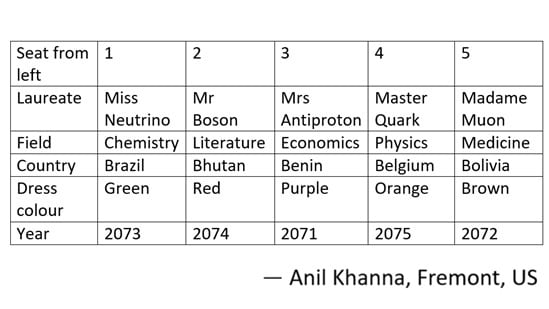
Dear Kabir,
My solution to the Nobel Prize puzzle is as shown in the table.
— Anil Khanna, Fremont, US
#Puzzle 215.2
Hi Kabir,
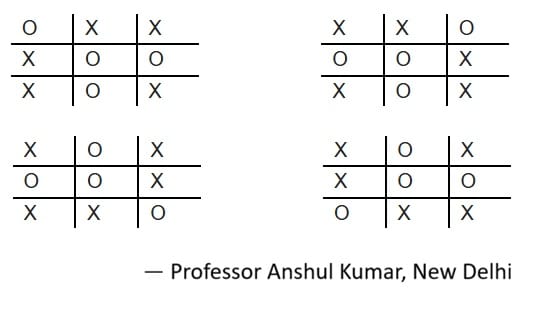
There is one X in the central column and one X in the central row. If these two Xs were the same, it would mean that this X was in the central cell (common to the central column and the central row). That would force us to place the remaining 4 Xs in the four corners, which is not possible because the game ended in a draw.
Therefore, there is an X in the middle cell of either the left column or the right column. Also, there is an X in the middle cell of either the top row or the bottom row. Thus, there are four possible configurations for these two middle cells — left + top, right + top, right + bottom, or left + bottom. The remaining three Xs are in three of the four corner cells. The four solutions are shown in the illustration. Basically, these four are the same since these can be obtained from one another by rotation.
— Professor Anshul Kumar, New Delhi
Solved both puzzles: Anil Khanna (Fremont), Professor Anshul Kumar (Delhi), Yadvendra Somra (Sonipat), Dr Sunita Gupta (Delhi), Sabornee Jana (Mumbai)
Solved #Puzzle 215.2: Dr Vivek Jain (Baroda), YK Munjal (Delhi)
Problematics will be back next week. Please send in your replies by Friday noon to problematics@hindustantimes.com


