
 E-Paper



The interlinked AI business empire and its economics | Number Theory
The economics of the AI business is as important for the present as its technological impact
Updated on: Oct 19, 2026, 06:38:49 IST

 Prefer HTon Google

Share via


Copy link

AI as a technology is the future, perhaps even a dystopian one. AI the global business empire that is now dominating the world economy, especially its capital markets, is a small club of uber-rich companies. The economics of the AI business is as important for the present as its technological impact. A recently published Bank of International Settlements (BIS) bulletin gives an insight into the processes that have driven the rise and rise of small club of AI companies and what it possibly means.

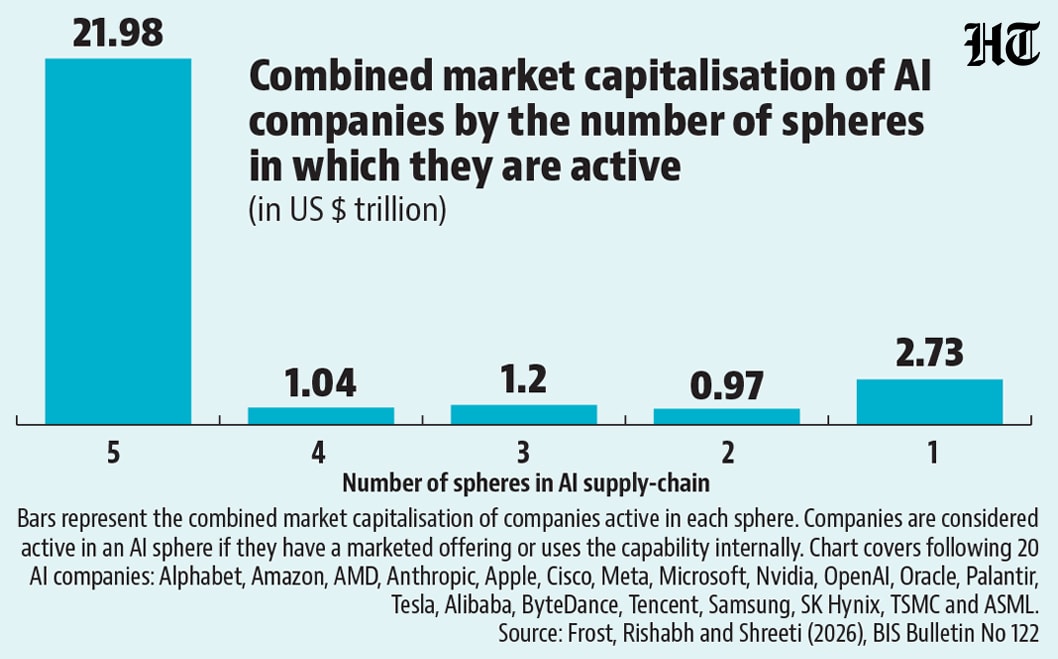
 Jack of all AI trades is the way to growIn the world of AI, it takes five, not two, things to tango: applications, compute, data tools, infrastructure and models. Compute power requires access to chips. Infrastructure refers to the availability of data centers where the chips are used. Data training is feeding data, which in turn generate models, while applications provide the consumer- or business-facing interface. Some of the biggest AI companies are active in all five spheres of the AI world.
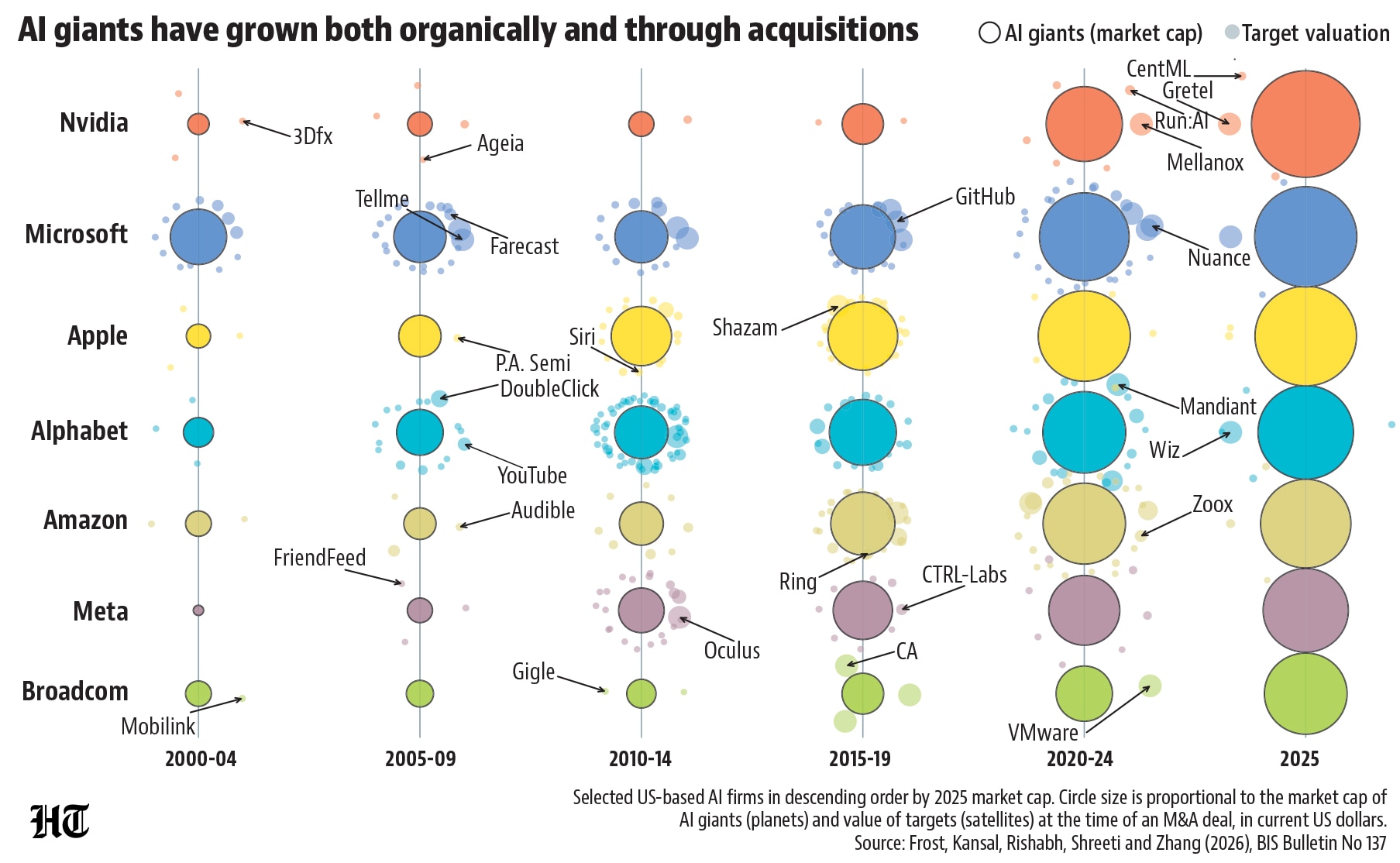
- Big fish eat the small fish to become biggerToday’s AI giants have grown dramatically in size and value over the last couple of decades, especially in the last decade. A significant part of this growth has come from investment deals in the form of mergers and acquisitions of firms, equity financing or joint ventures. One example is GitHub which Microsoft targeted and subsequently acquired in 2018. From 2005 to 2024, many acquisition deals took place across different AI companies, though activity became somewhat muted in 2025 as company size increased significantly.
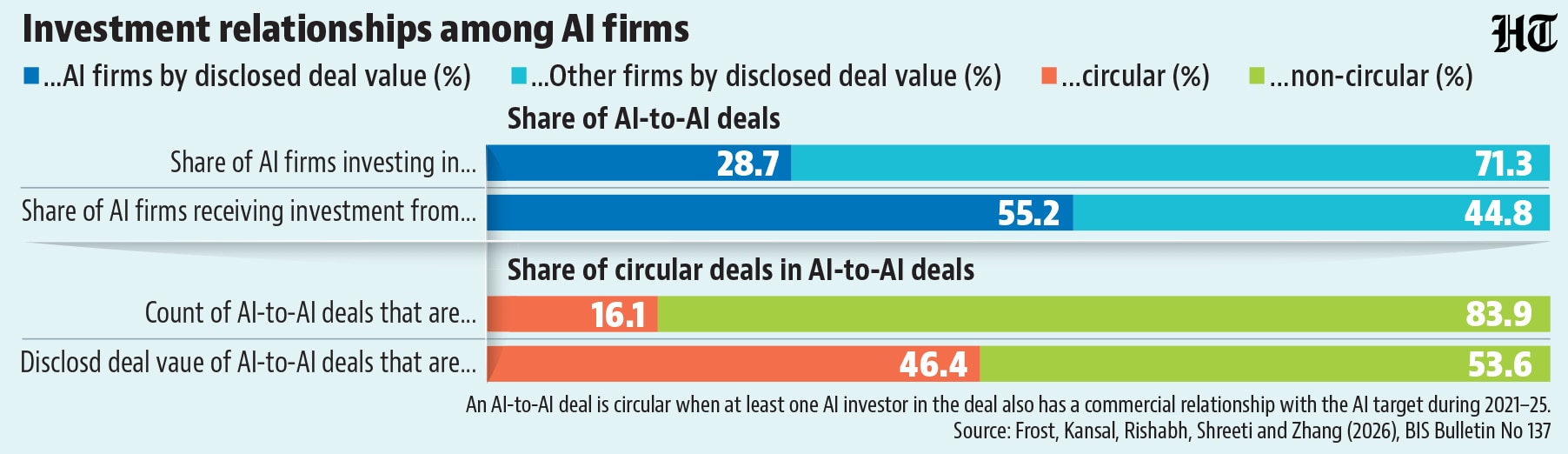
- You scratch my balance sheet I scratch yoursWhat if AI firms start investing in other AI companies? Well, they did and may as well do it in the future. Many of the target firms which were part of the M&A activity creating today’s AI giants were AI firms themselves. In fact, the BIS bulletin talks in detail about what it terms as circular relationship in the AI world. The authors define such a relationship as one between two AI firms that shared a supplier-customer relationship at any point during 2021–2025. Their research identifies 972 intra-AI relationships between 2021 and 2025. Around 28.7% of AI firms’ investment deals, by value, involved other AI firms as targets. To put it differently, 55.2% of AI firms’ incoming investment value came from other AI companies. Approximately 16% of deals occurred between AI firms that also share a commercial supply chain relationship and this accounts for approximately 46.4% of the deal value.
- Are circular relationships in the AI world tantamount to a Ponzi scheme?Not necessarily, conventional economic wisdom would suggest. Economists have acknowledged the benefits of, or reasons for, such relationships. Suppliers know their customers better and understand how quickly inputs are used to make the final product. So, the credibility of customers in terms of paying back money is known to suppliers but only available at a cost for outside lenders and investors which makes it difficult for customers to borrow money. In such cases, it helps when the supplier itself provides the finance. The roles can be reversed as well, with financial market frictions contributing to a customer’s decision to finance its supplier of critical inputs. Such a setup solves contracting problems at the firm level. The convenience is not without its risks though. These relationships are highly intertwined and capital-intensive, and private firms are often opaque about signed deals, making monitoring and supervision difficult. A fissure in the health of either commercial or financial segment of the firm may lead to economic spiral of the AI sector as a whole, which will only add to the existing risks of over-investment and debt financing in the ongoing AI boom. Before we face AI’s consequences for the future of humankind, we might have to reckon with the potential headwinds of its commercially intertwined world for the stability of the financial system.


Unlock a world of Benefits with HT! From insightful newsletters to real-time news alerts and a personalized news feed – it's all here, just a click away! -Login Now!


