
 E-Paper



CBSE Sample paper 2019 for Physics: Attempt these questions to practise for board exams
Physics: CBSE boards and other state board exams are round the corner. With just few days left for the board exams to start, it is time to revise and attempt mock tests. HT will bring to you sample papers of major subjects for your practice, daily for the next few days. These questions are prepared by experts.


General Instructions:
1.All questions are compulsory. There are 26 questions in all.
2.This question paper has five sections: Section A, Section B, Section C, Section D, Section E.
3.Section A contains five questions of 1 mark each, Section B contains five questions of 2 marks each, Section C contains twelve questions of 3 marks each, Section D contains one question of 4 marks and Section E contains three questions of 5 marks each.
4.There is no overall choice. However, an internal choice has been provided in one
question of two marks, one question of three marks and all the three questions of
five marks weightage. You have to attempt only one of the choices in such questions.
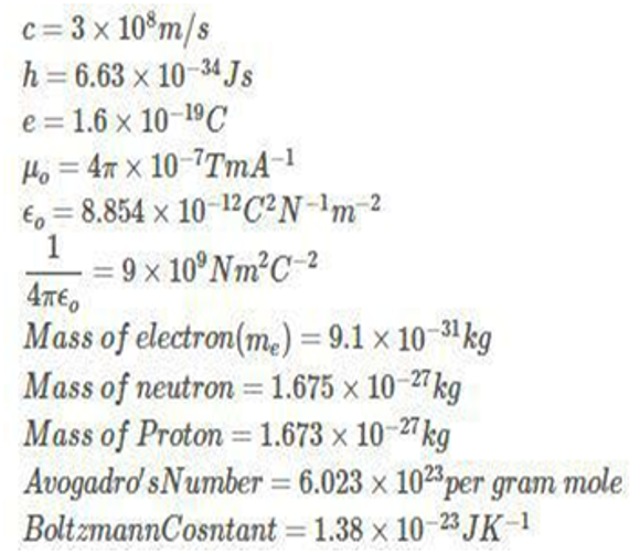
5.You may use the following values of physical constants wherever necessary:.
Section A
1.An electron does not suffer any deflections while passing through a region. This makes sure that there is no magnetic field in that region. Is the given statement true or false?
2.State two ways of providing energy to metal to emit electrons from its surface.
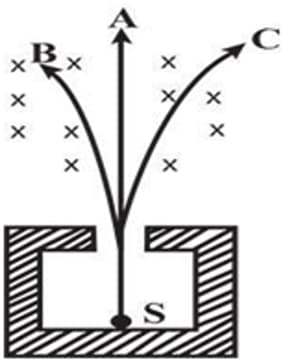
3.The diagram shows a radioactive source S placed in a thick lead walled container. The radiations given out are allowed to pass through a magnetic field. The magnetic field (shown as x) acts perpendicular to the plane of paper inwards. Arrows show the paths of the radiations A, B and C. Name the radiations labeled A, B, and C.
4.To which part of the electromagnetic spectrum does a wave of frequency 3×10¹³ Hz belong?
5.A message signal of peak voltage 20V is used to modulate a carrier wave of peak voltage 30V. Determine the modulation index.
Section B
6.An electric iron consumes energy at a rate of 880 W when heating is at the maximum rate and 330 W when the heating is at the minimum. The voltage is 220 V. What is the current and the resistance in each case.
7.A copper wire has a diameter of 0.5 mm and a resistivity of 1.6× 10(−6) ohm-cm. How much of this wire would be necessary to make the resistance of 10 ohms?
(OR)
When we run a 40-watt bulb for 5 hours, if 1 unit (= 1kWh) costs 2 rupees, find the bill we have to pay for this?
8.(i) Name the high energetic invisible electromagnetic waves which help in the study of the structure of crystals.
(ii) State an additional use of the waves mentioned in part (i).
9.The photoelectric cut-off voltage in a certain experiment is 1.5 V. What is the maximum kinetic energy of photoelectrons emitted?
10.(a) Explain any two factors which justify the need of modulating a low-frequency signal.
(b)Write two advantages of frequency modulation over amplitude modulation.
Section C
11.The electrostatic force on a small sphere of charge 0.4μC due to another small sphere of charge −0.8μC in the air is 0.2 N.
(a)What is the distance between the two spheres?
(b)What is the force on the second sphere due to the first?
OR
(a)Two insulated charged copper spheres A and B have their centres separated by a distance of 50 cm. What is the mutual force of electrostatic repulsion if the charge on each is 6.5× 10(−7) C? The radii of A and B are negligible compared to the distance of separation.
(b)What is the force of repulsion if each sphere is charged double the above amount, and the distance between them is halved?
12.(a) Three resistors 2Ω, 4Ω, and 5Ω are combined in parallel. What is the total resistance of the combination?
(b)If the combination is connected to a battery of emf 20 V and negligible internal resistance, determine the current through each resistor, and the total current drawn from the battery.
13.A rectangular wire loop of sides 8 cm and 2 cm with a small cut is moving out of a region of the uniform magnetic field of magnitude 0.3 T directed normal to the loop. What is the
emf developed across the cut if the velocity of the loop is 1 cm/s in a direction normal to the
(a)longer side,
(b)the shorter side of the loop?
For how long does the induced voltage last in each case?
14.A circular coil of 16 turns and radius 10 cm carrying a current of 0.75A rests with its plane normal to an external field of magnitude 5.0× 10⁻² T. The coil is free to turn about an axis in its plane perpendicular to the field direction. When the coil is turned slightly and released, it oscillates about its stable equilibrium with a frequency of 2.0/sec. What is the moment of inertia of the coil about its axis of rotation?
Stay tuned to HT Education Section for more questions of Physics.
(The questions given here are provided by Toppr.com. Answers will be provided shortly. Hindustan Times does not take any responsibility for the questions or the answers.)


