
 E-Paper



College libraries are evolving, with phone zones, events, hubs for networking
From silent zones with limited lending, they now offer unrestricted access to digital archives, and student-friendly spaces that welcome conversation, collaboration.

 Prefer HTon Google


As libraries on Indian campuses adapt in an effort to stay relevant, they’re becoming unlikely spaces for students to network and socialise too. These new hybrid offerings call themselves workstations — you go there to browse or draw on reference books, but also to network, make friends, attend events, or just hang out and chat. For one thing, the no-talking rule has been lifted in institutes such as TISS, IIT and SIES.
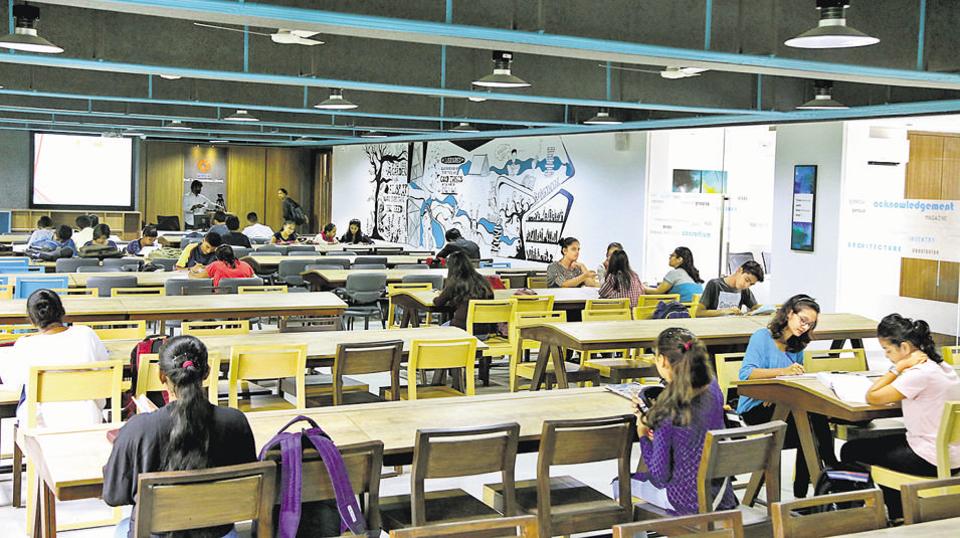
“We spend a lot of our free time here. It’s no longer a space of prohibition on phones and working alone and in silence,” says Jit Hazarika, 28, a second-year PhD student at the Tata Institute of Social Sciences (TISS).
TISS has the four-storey, air-conditioned Sir Dorabji Tata Memorial library that combines physical books with digital volumes. A conference room within often hosts speakers and events. Students say it’s so comfortable, they often feel they have nowhere to go when it shuts in the evenings.
“The cyber cell within the library helps us research a range of topics at a touch,” says Muhammed Afsal, a second-year MPhil in social work. He further adds, “We recently had a public lecture by the president of the International Association of Schools of Social Work in the library conference hall. We have academic talks held in the library and also events where international universities come to promote themselves and reach out to students.”
A library should be a collaborative learning space where all the academic needs of the students are met, says TISS librarian Satish Kanamadi.
“We have designated the space in zones—there’s a discussion zone, a silent study zone, a mobile-friendly zone, etc, to help students use the library based on their needs. And we’re happy to see that this creative approach to the space and to our services has turn it into a preferred place for students to socialise and network.”

Community hubs
The two-storey Central library and lounge at the Indian Institute of Technology, Bombay (IIT-B) is a meeting place too. It’s designed to be that way, with comfy couches rather than old-school table-chair formats.
“I found a really good campus friend at the library,” says Aditya Maitri, 20, a chemical engineering student. “He approached me asking if I could explain a concept to him. We’ve been friends ever since and we keep helping each other out.”
Students also bond over the events and workshops held in the Indian Institute of Technology- Bombay’s (IIT-B) library.
“There are creative writing workshops, storytelling sessions, book exhibitions, essay and quiz competitions and other activities, all organised in the library,” says chief library officer, Manju Naika.
“We want the library to be a neutral point where like-minded students can meet, network and collaborate, since education and research are collaborative in nature.”

No holds barred
The South Indian Education Society (SIES) College of Arts, Commerce and Science has revamped its entire library, added digital volumes and new ‘cyber cells’.
“When we revamped, we made it more colourful and inviting. We no longer restrict the use of cyber cells to research students only. Students can now issue as many reference books as they want. It made no sense to have a limit of three per student, when we really want them to read,” says vice-principal Rashmi Bhure.
The changes, students say, have made them feel more welcome.
“A library is indeed one place where I am sure to find my tribe. In the last year we usually witness an influx of students from colleges across Mumbai.
“I remember how I instantly struck a chord over an author’s ideas with a girl whom I might never have otherwise talked to,” says Ankita Suresh, 19, a final-year psychology student.


