
 E-Paper





For over a decade, the Hindustan Times Digital Streams – Education Desk has been a trusted source for accurate, in-depth, and timely news on education and careers. We bring the latest updates on board exams, competitive exams, results, employment news, study abroad, scholarships, and school and college admissions, helping students, job seekers, and educators make informed decisions. Our Coverage Areas 1. Board Exams & Results: Comprehensive reporting on CBSE, CISCE, and state board exams (UP, Bihar, Maharashtra, West Bengal, Rajasthan, Andhra Pradesh, Telangana, Karnataka, Tamil Nadu, and others), including schedules, admit cards, answer keys, results, and career opportunities. 2. Competitive Exams: Insights into major exams like UPSC, JEE, NEET, GATE, CAT, SAT, and state and central government services. Exam Results: Timely updates on UPSC, SSC, SBI, IBPS, NTA, IIMs, and other competitive exam results. 3. Employment News: Notifications on government and private sector jobs, vacancies, eligibility, application processes, and results. 4. Study Abroad: Information on top universities, courses, tuition fees, scholarships, visa regulations, and career prospects for international students. Features & Analysis: Opinion pieces, expert explainers, deep-dive reports, and interviews with key figures in education. 5. Breaking Education News: Real-time updates on major policy changes, institutional reforms, and trends shaping the education sector. 6. With a commitment to factual, unbiased journalism, HT Digital’s Education Desk has seen continuous growth in readership, offering credible and engaging content tailored for students, parents, and professionals. Meet the Team 1. Nilesh Mathur – News Editor A journalist with 24 years of experience, including 18+ years at Hindustan Times, Nilesh leads editorial planning, ensures factual accuracy, and enhances audience engagement through strategic content. 2. Papri Chanda – Deputy Chief Content Producer With over a decade of experience in education journalism, Papri specializes in exam-related content, study abroad insights, and education trends. She also explores new opportunities in education that benefit students. 3. Bishal – Senior Content Producer Active in the education and jobs sector since 2019, Bishal focuses on tracking developments, analyzing trends, and crafting informative content for students and job aspirants. 4. Gaurav Sarma – Deputy Chief Content Producer A multimedia journalist with 9+ years of experience, Gaurav is skilled in research-based storytelling, feature writing, and reporting on competitive exams, online courses, and education trends. At Hindustan Times Digital Streams – Education Desk, we strive to be the go-to platform for students and professionals navigating the dynamic world of education and careers.
New Education Policy: Breakfast for school children besides mid-day meals
The mid-day meals provided to students in government or aided schools should be supplemented by breakfast, the new National Education Policy (NEP) has proposed


The mid-day meals provided to students in government or aided schools should be supplemented by breakfast, the new National Education Policy (NEP) has proposed. The policy which was approved by the Union Cabinet earlier this week has noted that morning hours after a nutritious breakfast can be particularly productive for the study of cognitively more demanding subjects and hence recommended expansion of the mid-day meal scheme to include provisions for breakfast in schools.
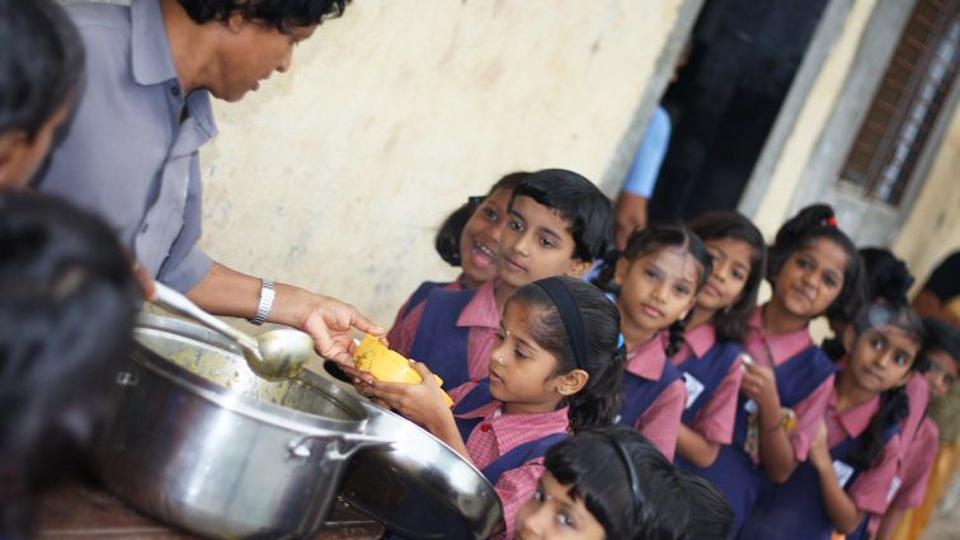
“Children are unable to learn optimally when they are undernourished or unwell. Hence, the nutrition and health (including mental health) of children will be addressed, through healthy meals and the introduction of well-trained social workers, counsellors, and community involvement into the schooling system,” the policy said.
“Furthermore, research shows that the morning hours after a nutritious breakfast can be particularly productive for the study of cognitively more demanding subjects and hence these hours may be leveraged by providing a simple but energizing breakfast in addition to mid-day meals,” it added.
In locations where hot meals are not possible, a simple but nutritious meal-- groundnuts or chana mixed with jaggery and local fruits may be provided. “All school children shall undergo regular health check-ups especially for 100 pc immunization in schools and health cards will be issued to monitor the same,” the policy said.
The revised policy has proposed that prior to the age of 5 every child will move to a “preparatory class” or “balavatika”.
Read More| NEP 2020 Highlights: Major changes in school and higher education to be seen
“The learning in the preparatory class shall be based primarily on play-based learning with a focus on developing cognitive, affective, and psychomotor abilities and early literacy and numeracy. The mid-day meal programme shall also be extended to the preparatory Classes in primary schools. “Health check-ups and growth monitoring that are available in the anganwadi system shall also be made available to preparatory Class students of anganwadi as well as of primary schools,” the policy document said.
The National Programme of Mid-Day Meal in Schools, popularly known as the Mid-Day Meal Scheme (MDMS), is an on-going centrally-sponsored scheme which covers all school children studying in Classes 1 to 8 of government, government-aided schools, special training centres including ‘Madarsas’ supported under ‘Samagra Shiksha’.
“As per the provisions of National Food Security Act, 2013, children studying in classes 1 to 8 or within the age group of 6-14 years are entitled to one mid day meal free of charge, every day except on school holidays, in all schools run by local bodies, government and government aided schools so as to meet nutritional standards specified in the Act,” a senior HRD Ministry official said.
“However, some States and Union Territories provide additional items such as milk, egg and fruits to students from their own resources,” the official added.
At least 11.59 crore elementary school students are beneficiaries under the mid-day meal scheme of the Human Resource Development (HRD) Ministry, while nearly 26 lakh cook-cum helpers are employed for the same.
The Ministry also advised states during lockdown to provide mid-day meals or food security allowance to students till schools are closed due to the novel coronavirus outbreak.
The NEP replaces the 34-year-old National Policy on Education framed in 1986 and is aimed at paving the way for transformational reforms in school and higher education systems to make India a global knowledge superpower.


