E-Paper



In Gujarat, BJP promises 20 lakh jobs, Uniform Civil Code implementation
In the manifesto, BJP also promised 1 litre of edible oil four times a year and 1 kg subsidised chana per month at subsidised rates through the PDS system to the people of Gujarat

 Prefer HTon Google


Gujarat chief minister Bhupendra Patel, Bharatiya Janata Party (BJP) national president JP Nadda and state party president CR Patil on Saturday released the party’s manifesto for Gujarat Assembly polls.
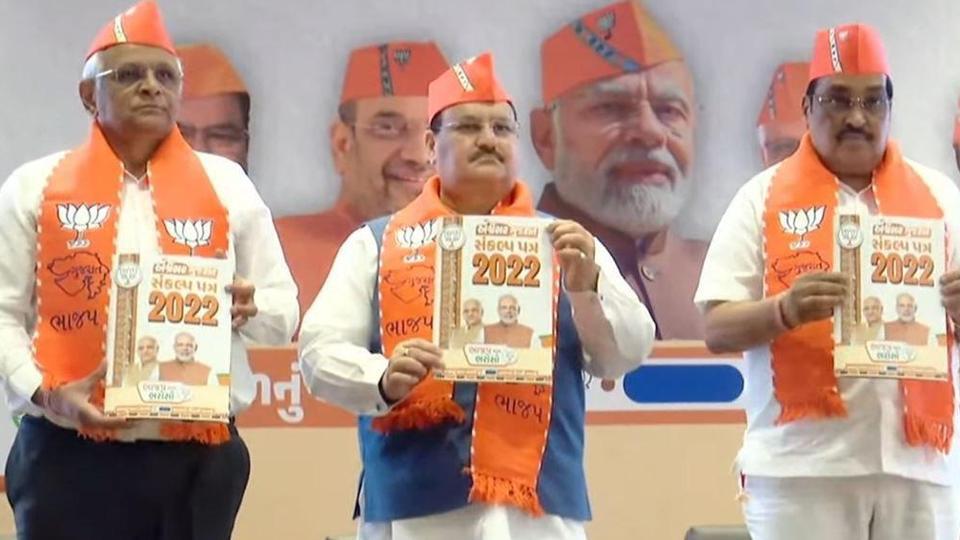
In its manifesto, the BJP has announced a slew of promises, including jobs for 2 million unemployed youth, under ‘Sankalp Patra’ scheme in the next five years. Making Gujarat a $1 trillion economy, schools of excellence (SoE) project, doubling the annual cap under the Pradhan Mantri Jan Arogya Yojana (Ayushman Bharat) from ₹5 lakh to ₹10 lakh per family, implementation of Uniform Civil Code, blue economy industries corridor, etc.
Also Read: Gujarat elections: Spotlight on AAP’s CM face in high-stakes battle
BJP in its manifesto also promised to implement the Gujarat Recovery of Damages of Public and Private Properties Act. The Act aims to recover damages done to public and private properties by anti-social elements during riots, violent protests, unrest, etc.
“We always do what we say and it is our speciality that we also do what we have not said (in the manifesto),” Nadda said at the launch.
The party said it will also launch Gujarat Olympics Mission and create world-class sports infrastructure with an aim to host the Olympic Games in 2036, as per the manifesto.
The manifesto also mentioned converting 20,000 government schools into schools of excellence with a budget of ₹10,000 crore in the next 5 years.
“We will provide free-of-cost, quality education to all female students from KG to PG,” said Nadda.
“For the progress of Gujarat, we will make Gujarat a $1 trillion economy by maintaining its pole position in manufacturing, focusing on services and investing in human and institutional capacity-building for new-age industries. We will attract ₹5 lakh crore foreign investment and make Gujarat the defence and aviation manufacturing hub of India,” Nadda said while releasing the manifesto.
According to the manifesto, for agriculture and farmers, BJP will invest ₹10,000 crore under Gujarat Krishi Infrastructure Kosh to develop a holistic system of Khedut Mandis, modern APMCs, sorting and grading units, cold chains, warehouses, primary processing centres, etc. BJP will also invest another ₹25,000 crore to expand the existing irrigation network through projects such as Sujalam Sufalam, SAUNI, lift irrigation projects, micro irrigation, drip irrigation and other systems across Gujarat.
Also Read: BJP has established ‘permanent’ peace in state during its rule, says Shah
In the manifesto, BJP also promised 1 litre of edible oil four times a year and 1 kg subsidised chana per month at subsidised rates through the PDS system to the people of Gujarat.
Furthermore, BJP will ensure holistic care for livestock by strengthening Gaushalas (additional budget of ₹500 crore), setting up 1,000 additional mobile veterinary units and ensuring complete vaccination and insurance, as per the manifesto.
For the all-round socio-economic development of tribals in Gujarat, BJP said it will spend ₹1 lakh crore under the Vanbandhu Kalyan Yojana 2.0.
BJP will also set up two Sea Food Parks (one each in South Gujarat and Saurashtra), build India’s first Blue Economy Industrial Corridor and strengthen fishing-related infrastructure (jetties, cold supply chain and mechanisation of boats) if voted back to power, said the BJP chief.
The party aims to double the annual cap under the Pradhan Mantri Jan Arogya Yojana (Ayushman Bharat) from ₹5 lakh to ₹10 lakh per family and ensure free-of-cost medical treatment, as per the manifesto.
In the temple town of Dwarka in the Saurashtra region, the party said it will build a “Devbhumi Dwarka Corridor to establish it as western India’s biggest spiritual centre, comprising of the world’s tallest Shree Krishna statue, a 3D immersive Bhagwat Gita experience zone and a viewing gallery for the lost city of Dwarka.”
The party had on November 5 launched the ‘Agresar Gujarat’ (progressive Gujarat) campaign aimed at reaching out to the people of the state and seeking their opinion on how the party should go about making its manifesto for the upcoming elections in Gujarat.
BJP has been ruling Gujarat for six successive terms and aims to retain power against the opposition Congress and Aam Aadmi Party (AAP) in the upcoming elections scheduled in the first week of December.
In the last elections in 2017, BJP won 99 seats and the Congress came close with 77 seats.
The elections for the 182-member State Assembly will be held in two phases on December 1 and 5. The counting of votes will take place on December 8.