
 E-Paper



Akhilesh Yadav likely to field Swami Prasad Maurya from Karhal for bypoll
This possibility arises as Akhilesh Yadav, who won his first assembly election from Karhal by over 67,000 votes, is likely to vacate the seat and remain the Azamgarh MP

 Prefer HTon Google


Samajwadi Party (SP) national president Akhilesh Yadav is likely to field former BJP minister Swami Prasad Maurya from the Karhal assembly constituency when a by-election is held there, people familiar with the matter said on Sunday.
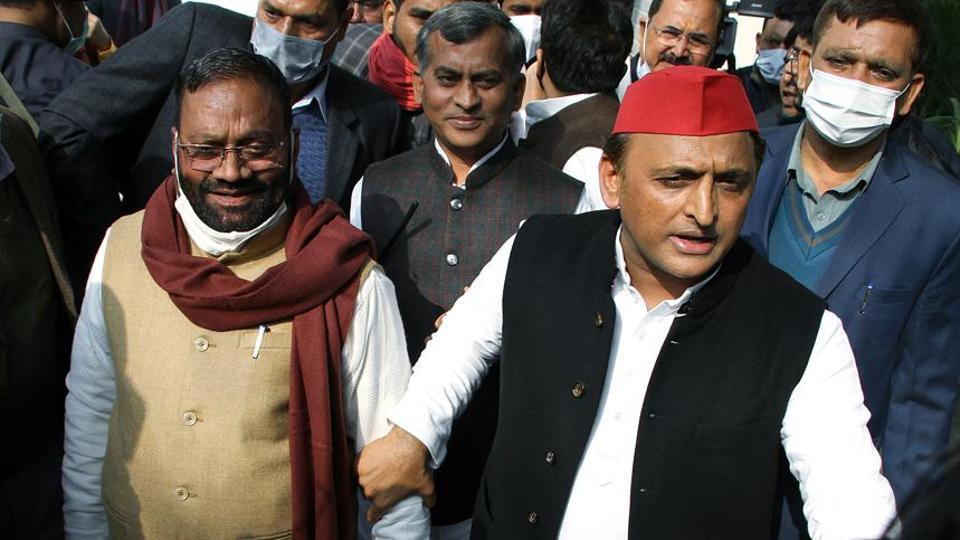
Akhilesh Yadav and Swami Prasad Maurya met on Sunday and discussed the idea, those aware of the issue said.
Akhilesh Yadav, who won his first assembly election from Karhal by over 67,000 votes, is likely to vacate the seat and remain the Azamgarh MP, they said.
Maurya had switched sides from the Bharatiya Janata Party (BJP) to the SP before the polls but lost the contest for the Fazilnagar assembly seat in Kushinagar district of eastern UP.
Akhilesh Yadav defeated Union minister SP Singh Baghel in Karhal. It was the only assembly seat for which two Lok Sabha members were in the fray. Akhilesh is the Azamgarh MP and Baghel represents Agra in Parliament. Akhilesh bagged 1.48 lakh votes while Baghel gathered 80,000 votes.
Earlier also, a senior party leader had said that Akhilesh Yadav would quit Karhal. At that time, there was speculation that the party would field Sobaran Singh Yadav, who won the Karhal seat in 2002, 2007, 2012, and 2017. He made way for Akhilesh in 2022.
Swami Prasad Maurya is a prominent non-Yadav other backward classes (OBC) leader from Uttar Pradesh. He had quit the Yogi Adityanath cabinet shortly before the 2022 UP assembly elections and joined the SP.
He had been the MLA from Padrauna, his traditional constituency in Kushinagar district, from 2007 to 2022. He had won the seat for the Bahujan Samaj Party (BSP) in the 2007 and 2012, and for the BJP in 2017. He was a key member of the Mayawati government before the BSP lost power in 2012. He had joined the BJP in 2016, months before the assembly polls.
This time, he contested from Fazilnagar and lost to the BJP’s Surendra Kushwaha, son of the previous BJP MLA Ganga Singh Kushwaha.
Despite his own defeat in Fazilnagar, Maurya said on Saturday that he was happy that the SP’s support base had expanded. He said he will work towards increasing it further.
He also said: “The issues because of which I had left the BJP are still relevant today. I wasn’t able to take those issues to the people. I am happy that the support base of the Samajwadi Party has expanded. The SP has emerged as a big force in the state. Our campaign will continue to make the SP a bigger force.”
The BJP won 255 seats in the 403-member UP assembly. It became the first party since 1985 to retain power in the state after completing a full five-year term. The BJP’s alliance partners won 18 seats — the Apna Dal (Sonelal) bagged 12 seats and the Nishad Party got six seats.
The Samajwadi Party won 111 seats. Its allies won 14 seats — Rashtriya Lok Dal bagged eight and the Suheldev Bharatiya Samaj Party (SBSP) got six.
The Congress and the Jansatta Dal Loktantrik got two seats each. The Mayawati-led Bahujan Samaj Party (BSP) got one seat.
Akhilesh had tied up with Rashtriya Lok Dal for west UP and OBC-based parties like Suheldev Bharatiya Samaj Party (SBSP) and the Apna Dal (K) for east UP. He inducted several prominent OBC leaders into the SP. They included Lalji Verma and Ramachal Rajbhar from the BSP. Swami Prasad Maurya and Dara Singh Chauhan came in from the BJP.
The RLD won eight seats and the SBSP got six seats, including Zahoorbad where Om Prakash Rajbhar was victorious.
Dharm Singh Saini won his Ghosi seat, but Maurya lost in Fazilnagar.
The Uttar Pradesh assembly election was held in seven phases between February 10 and March 7.


