
 E-Paper



From a home exam to a national AI challenge at IIT Bombay: How the Techfest pathway works
The GLF AI Olympiad 2026 gives students in Grades 3-10 a chance to compete for a place in SparkX, a national AI challenge hosted at Techfest, IIT Bombay.

 Prefer HTon Google


For most Indian families, IIT Bombay is a destination with a long road of preparation behind it. This journey typically begins in Class 10 or 11 and depends on an entrance exam. Very few people talk about the years before.
What not many know is that there is a nearer door. A curious child can reach for it with nothing more than a 60-minute exam and a habit of asking why. It is a national AI challenge hosted at Techfest, IIT Bombay, and the route to it starts with an exam taken at home or at school.
One point needs to be clear from the start. This is not a shortcut into IIT. What it offers is early exposure to a serious technical environment, where curiosity and problem-solving count as much as marks.
What is Techfest, and why does it matter to a child?
Techfest is the science and technology festival of IIT Bombay, which its organisers describe as Asia’s largest. For most school students, a place like this is something they hear about, not something they see.
That distance matters. Children form ideas early about what is meant for them. A child who sees older students building, testing and explaining their ideas learns that technology is something people create, not only something they use. Seeing that at the age of 12 or 14, rather than at 18, can change what feels possible.
How the pathway works
Children already use AI every day, through voice assistants, video feeds and homework chatbots. Often, they don’t even know how it works. From the 2026-27 session, the Central Board of Secondary Education (CBSE) has introduced a Computational Thinking and AI curriculum for Classes 3-8, with foundational AI concepts arriving from Class 6. Curricula take time to reach every classroom, though, and children are meeting AI outside school in the meantime.
The route begins with the Global Learning Foundation (GLF), AI Olympiad 2026, a national exam on AI literacy for students in Grades 3-10. It is organised by GLF in association with STEMLearn.AI and Techfest, IIT Bombay.
Most Olympiads test what a child has already studied. This one is built around a subject most children have not formally met yet, so preparing for it is a large part of the experience.
Students take a 60-minute exam in English, pitched at three levels. In Grades 3-5, the focus is on discovering AI through smart devices, data patterns, image and sound recognition and safe use of technology. Grades 6-8 move on to algorithms, data bias, neural networks and ethics. In Grades 9 and 10, the exam covers generative AI, Python programming, the machine-learning lifecycle and AI project building.
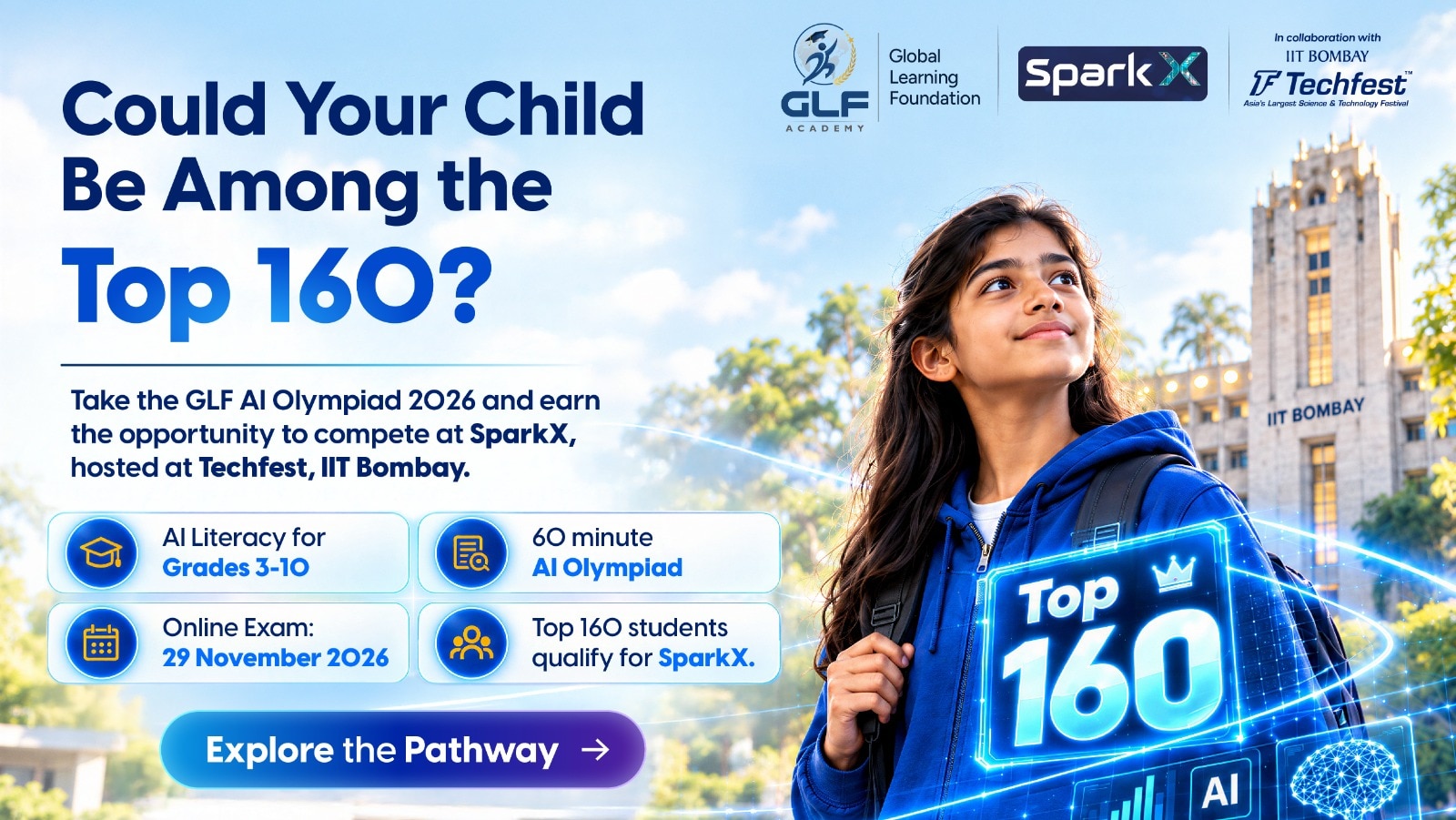
Results are declared within four weeks, and every student receives a national ranking. The top 160 students get the opportunity to take part in SparkX, the national AI challenge hosted at Techfest, IIT Bombay.
Last year’s edition, run under the STEMLearn.AI banner, reached more than 10,000 students across more than 500 schools, and its top performers were recognised through SparkX. Places are limited, so this is an opportunity, not a promise. The exam still has value for every child who takes it. IIIT Allahabad has validated the syllabus and question banks, and COEP Technological University, Pune, has reviewed the curriculum and calibrated difficulty by grade.
What the prep looks like
Curiosity comes first. No coding background is needed, and a child who has never written a line of code can begin at the Grade 3 level. The aim is to build AI literacy, and not create coders overnight. This includes the ability to understand how AI reaches an answer, and how a child can question it.
Every registered student receives grade-wise study material, access to the STEMLearn.AI learning platform with lessons, quizzes and practice modules, and an official sample paper, so the format holds no surprises on exam day. After the exam, a personalised report shows topic-wise strengths and gaps, not just a score, along with a digitally verified participation certificate.
Parents can start at home with a simple question. The next time a video app suggests a clip or a voice assistant answers a homework query, you can ask your child: “how do you think it knew that?” Most children may not have a ready answer. The effort of finding one is where AI literacy begins.
Exam dates and how to register
The Olympiad is open to any student from Grade 3-10, individually or through their school. The registration fee is ₹299 for Grades 3-6 and ₹399 for Grades 7-10. This covers the study material, platform access, sample paper and performance report.
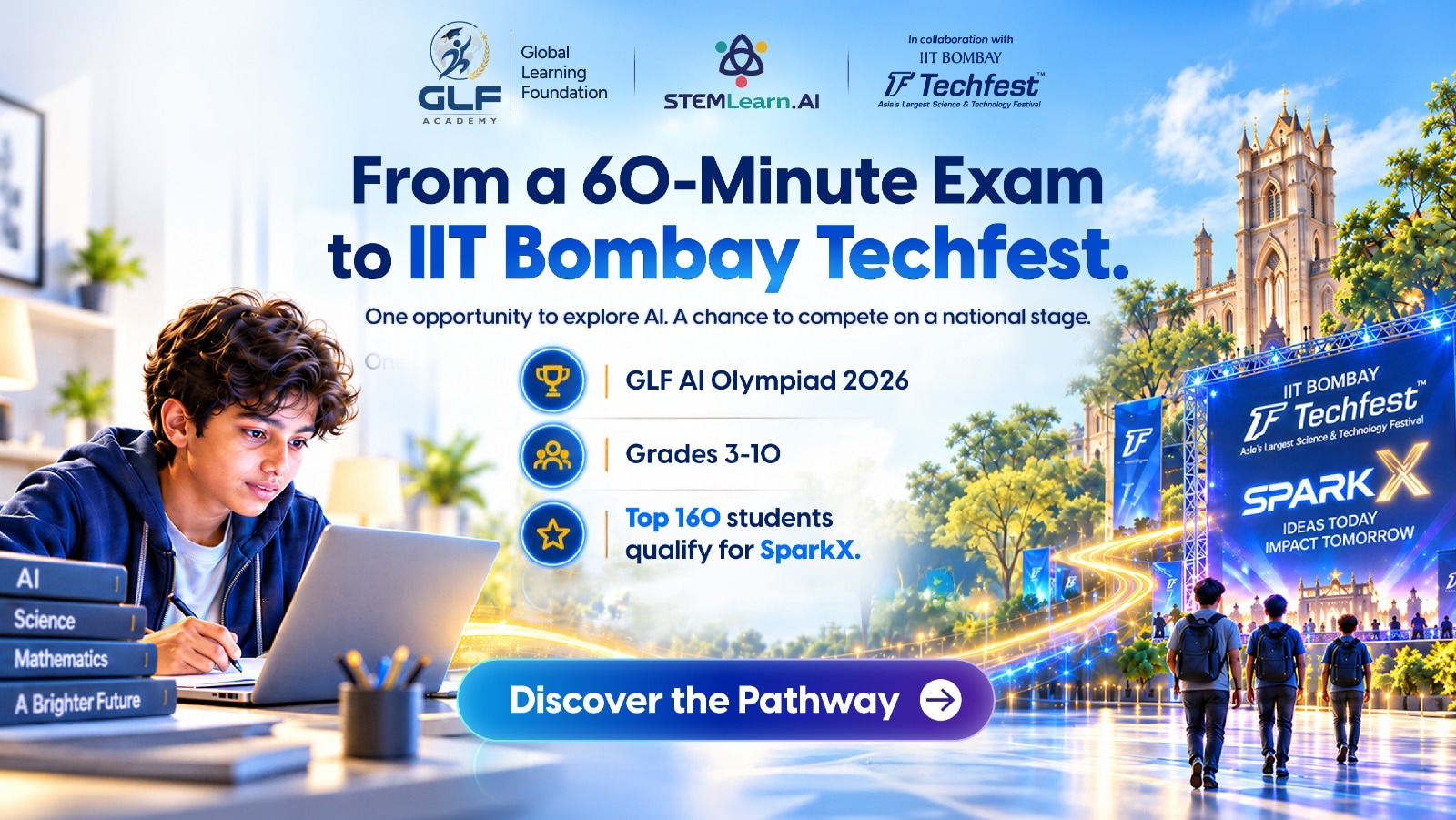
Students who register individually take the exam online, from their homes, on 29 November 2026. Registering takes a few steps: pay online by UPI, card or net banking, receive platform login within 24-48 hours, and expect the study material at home in five to seven business days. Registering early simply means more time to prepare.
Schools that sign up can hold the exam on campus on 17, 20, 24 or 27 November 2026, in an offline, OMR-based format with a flexible online option where needed. There is no institutional fee, sign-up is a two-step process, and schools receive a school-wise performance report afterwards.
Parents and students can register at https://glfacademy.org/olympiads/ai-olympiad-2026/.
Schools and educators can get started at https://glfacademy.org/schools.
Note to the Reader: This article has been produced on behalf of the brand by HT Brand Studio and does not have journalistic/editorial involvement of Hindustan Times.


