
 E-Paper



No policy interventions to clean ‘most polluted city’, Gurugram
Despite these concerns, which have persisted for years, no major policy interventions have been made by either the Haryana government or various administrative bodies in Gurugram.

 Prefer HTon Google


Multiple reports over the past year have shed light on the city’s degrading air quality. In March, a study by an international non-profit found Gurugram the most polluted city in the world (with respect to PM2.5 pollution), and triggered concerns among residents who wondered if enough was being done at policy level to tackle the issue. Other studies have suggested that life expectancy in the city has decreased by almost nine years, and that air pollution is increasing at a far higher rate than the national average.
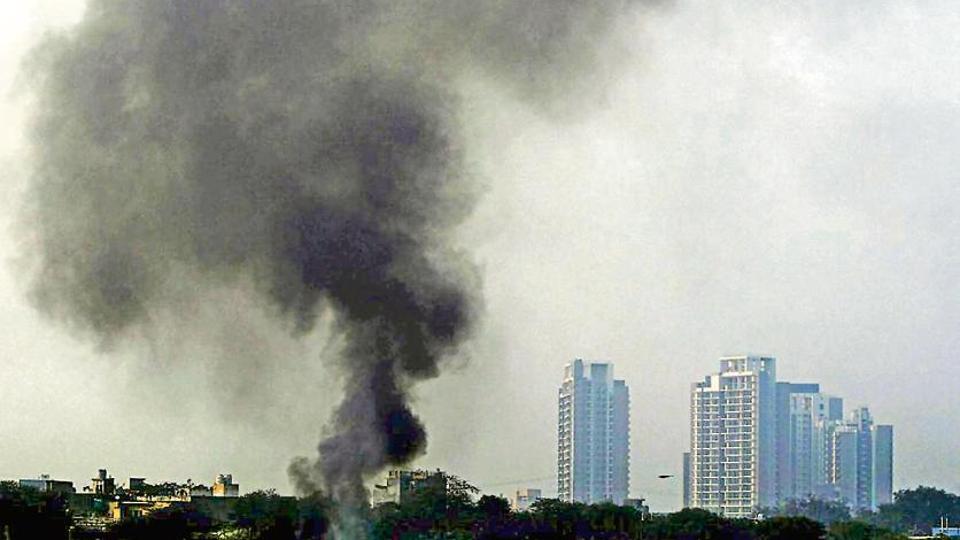
Despite these concerns, which have persisted for years, no major policy interventions have been made by either the Haryana government or various administrative bodies in Gurugram.
While basic pollution control measures, such as dust management and construction ban, among others, have been taken by the Municipal Corporation of Gurugram (MCG), the Haryana State Pollution Control Board (HSPCB) and the Department of Town and Country Planning (DTCP), experts said these steps are mandatory under the Centre’s Graded Response Action Plan (GRAP) to curb air pollution in the National Capital Region (NCR), and are not the result of local initiatives or political will.
Moreover, Gurugram continues to fall behind on many targets set in last year’s Comprehensive Action Plan (CAP) for NCR, which includes setting up robust air quality monitoring systems, improving sustainable mobility, and implementation of emission norms for industries.
“Some of these targets, such as introducing bus services, banning furnace oil and pet coke, and regulation of brick kilns have started. But these are mainly under the influence of a central policy. Going by available numbers, GRAP and CAP implementation has not had much effect on ground in Gurugram,” said Sachin Panwar, a city-based air quality scientist.
In May 2018, a study by The Energy and Resources Institute and Indian Institute of Technology, Delhi (IIT-D) said the average annual concentration of PM2.5 in the city increased by over 80ug/m3 between 1998 and 2017. The study also noted that the city’s population was highly vulnerable to health impact from this added exposure, given the state of existing healthcare infrastructure and mortality rates.
In November, a study by the Energy Policy Institute at University of Chicago said life expectancy in Gurugram has reduced by almost nine years due to exposure to PM2.5. The report, titled ‘Air Quality Life Index’ also found that the average annual level of PM2.5 in the city increased by 41ug/m3 between 1998 and 2016, which experts said is alarming compared to the national average rise of 22.1ug/m3 recorded during the same period.
The following month, another study by The Lancet Planetary Health stated that average life expectancy in Haryana decreased by at least 2.1 years as a result of air pollution in 2017. In the same year, 28,965 deaths occurred in Haryana as a direct result of air pollution. Additionally, the study found that of all deaths recorded under the age of 70 in Haryana, 54% can be attributed to air pollution.
In January 2019, a simpler, observational experiment led by Dr Arvind Kumar, chairman of the Centre for Chest Surgery at Delhi’s Sir Ganga Ram Hospital, found presence of carcinogens like nickel, and neurotoxins such as lead and manganese, in two of Gurugram’s plushest localities. It also found “substantially elevated levels of iron and calcium particulates indicating that ambient air was adversely impacted by fugitive emissions of construction materials”, in addition to high levels of crystalline silica, another symptom of construction work.
The real clincher, however, came in March when Greenpeace and Swiss software company IQ Air Visual (which tracks air quality around the world) released a report declaring Gurugram “the most polluted city in the world” with respect to average annual PM2.5 concentration in 2018. The report even elicited a response from chief minister Manohar Lal Khattar, who promised quick action at the district level.
Siddharth Singh, an air pollution and mobility expert, and author of the book ‘The Great Smog of India’ on Delhi’s air pollution crisis, advised against taking such numbers at face value. “It is best to be wary of such statements if we don’t understand the methodology of such studies. Such rank shouldn’t even matter. If Gurugram was, say, the 50th most polluted city in the word, the bottom line is that something needs to be done about it.”
The conversation around India’s pollution crisis has, for the most part, revolved around Delhi where the first action plan against air pollution was prepared in 1997. A second plan was prepared in 2015 to address the problem. Besides, various studies have also been carried out, most notably in 2010 and 2016, by the Central Pollution Control Board (CPCB) and the Delhi Pollution Control Committee, to ascertain the extent of pollution and its sources. “No such city-specific studies have ever been carried out for Gurugram,” said Guneet Singh, founder of a local non-profit working for better air quality. He added that in the absence of such data, “one cannot move forward in the manner that Delhi has”, by creating specific policies to tackle the problem.
Despite claims by the HSPCB of setting up city-wide monitors by September 2018, there is currently one operational monitoring station in Vikas Sadan and a second one in Manesar.
Haryana, Guneet explained, is instead infamous for approaching the problem with infrastructure-based solutions. “Metro expansion, bus services, peripheral highways… these are not solutions to air pollution, but are constantly presented as such,” he said.
An April report published by Climate Trends, a Delhi-based organisation working on issues related to climate change and clean energy, compiled statements made by state politicians on air pollution between 2014 and 2018, including Khattar and Union minister Rao Inderjit Singh.
Santosh Harish, a research fellow at Centre for Policy Research, pointed out that statements made by Khattar and Rao Inderjit reveal they mainly view the issue through the lens of transportation.
The Delhi-Alwar RRTS corridor, the Kundli-Manesar-Palwal and Kundli-Ghaziabad-Palwal expressways, expansion of Metro services and the Gurugaman bus service, for example, have all been touted by them as solutions to the city’s air pollution problem.
According to Panwar, it is elitist to simply say that better transport and infra will solve the issue. “This position negates very basic issues such as mismanagement of waste, road dust, construction debris, biomass burning and reliance of people on diesel gensets. These cannot be solved by large infrastructure projects. They need political will,” he said.
Singh also said that such policies are not very effective because of the influence of other economic activities. “In a city like Gurugram, which is booming and has lots of construction, the sheer force of polluting, economic activity outweighs the benefits of isolated solutions. What we need is some sort of overarching policy framework, and a supervisory body to oversee its implementation,” he said.
The World Environment Day, 2019, marks an important day for Gururgram, which will finally join the list of 102 cities included in the Centre’s National Clean Air Programme (NCAP). This will result in detailed source appropriation studies for the city, and a city-specific Urban Air Quality Management System.
“This is a positive step, and will result in richer data. The NCAP has been criticised on its own terms, because the ministry which implements it cannot influence changes in power and transport sectors, which are equally important. But for Gurugram to be included in the list is the right way ahead,” Panwar said.
To help implement various objectives set forth in the NCAP, the HSPCB will also be setting up a sub-headquarters in Gurugram in coming months. “To actively monitor the situation, we need to create a team of scientists closer to the source of the problem. The new location will be our foothold in the NCR,” said S Narayanan, member secretary, HSPCB, on Monday. The proposal for the new headquarters is currently awaiting approval from the state government.
In addition, the HSPCB has also instructed all ‘red-category’ polluting industries to install Online Continuous Emission Monitoring Systems, which will help the pollution board enforce emissions standards efficiently.
“By coming under the scope of NCAP, the HSPCB will be able to monitor air quality and produce rich data, which can then be used by other civic agencies in their respective fields, be it waste management, transport, or any other,” Narayanan said.


