
 E-Paper



India's Europe outreach: Advancing trade, technology and strategic partnerships
This article is authored by Kanishk Maheshwari, Sarang Khanna, Karthikeyan Gnanavel and Suchetta Singh.

 Prefer HTon Google


India's recent high-level engagements with Europe mark an exciting widening of the country's strategic canvas, one that moves confidently beyond ceremonial diplomacy into the promising territory of trade architecture, technology cooperation, and supply-chain resilience. Taken together, these developments offer a compelling lens into how India is sharpening its economic and geopolitical priorities at a moment when global businesses are actively looking for new places to manufacture, source, and invest.
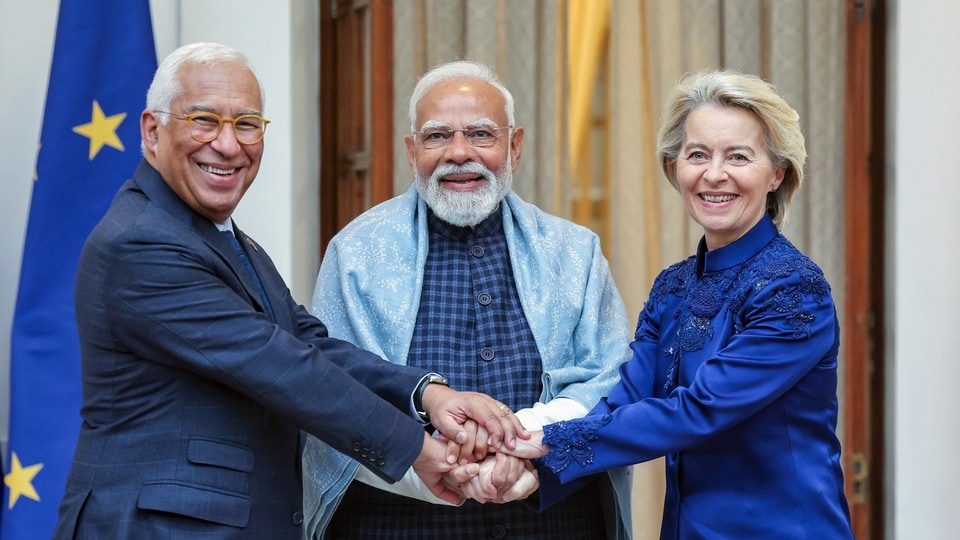
The first, and most exciting, signal is a deepening of India-Europe economic ties at a time when resilient supply chains, diversified sourcing, and reduced dependency on any single market have become boardroom priorities across the world. The scale here is already impressive, as, in 2025, the EU stood as India's third-largest trading partner, with two-way goods trade touching €118 billion, while India held the position of the EU's ninth-largest trading partner. The India-EU Free Trade Agreement, successfully concluded after roughly 20 years of negotiation, is set to expand this platform considerably, cutting or removing tariffs across more than 90% of traded goods. The underlying logic is a genuine win-win, as Europe gains a dependable partner for manufacturing and sourcing as it looks to diversify its supply chains, while India, by plugging more deeply into European industrial ecosystems, gains access to capital, technology, quality benchmarks, and export markets that can lift its own manufacturing base to new heights.
The second signal is the rising visibility of innovation and startup diplomacy within India's foreign engagement, a welcome shift in how the country presents itself on the world stage. The visit's inclusion of Bharat Innovates 2026 in Nice reflected a confident effort to showcase India less as a large consumer market and more as a genuine hub of innovation capacity. Having already built a mature and thriving startup base, India's attention is now shifting toward an even more ambitious goal, which is, helping its most promising companies scale into globally competitive players across AI, deep-tech, semiconductors, climate technology, and advanced manufacturing.
The third signal lies in how India is positioning itself in the global AI conversation, and it's a distinctive one. Where the US and China are largely racing each other on frontier AI capability, India is carving out a valuable niche built on accessibility, digital public infrastructure, multilingual reach, and responsible deployment.
The most encouraging shift here isn't just that India is showing up in Europe more often, it's that this engagement has become far more purposeful, with commercial opportunity and geopolitical strategy now pulling in the same direction. Europe's own priorities around de-risking, digital sovereignty, and building relationships with dependable partners create fertile ground for India to establish itself as a trusted, long-term collaborator across trade, technology, and industrial resilience. India's involvement in G7-related conversations added further momentum to this positioning, giving the country a meaningful seat at discussions on economic stability, technology governance, climate action, and supply-chain resilience.
The Slovakia stop on this itinerary deserves special mention. It marked the first time an Indian Prime Minister had visited the country since it gained independence in 1993. This is a strong signal that India's European outreach is deliberately and thoughtfully extending beyond the continent's largest economies. Fresh commitments around defence, digital technology, cybersecurity, and protection of critical infrastructure show that this outreach is reaching well beyond trade numbers into areas that matter for long-term technological and strategic security. More broadly, this reflects a smart and forward-looking pattern of India building relationships with mid-sized powers and specialised economies that bring focused strengths, be it in defence production, precision engineering, cybersecurity, or infrastructure protection.
For companies operating across sectors, this creates a wealth of promising openings. Manufacturers stand to gain from smoother integration into European supply chains as tariff barriers come down. Technology firms can look forward to expanded room for collaboration in AI, semiconductors, cybersecurity, and other deep-tech areas. Clean energy players have exciting new ground to explore in hydrogen, battery technology, and climate innovation. Digital economy players benefit from closer cooperation on trusted digital infrastructure and governance frameworks, while infrastructure companies can expect greater collaboration around resilient transport, logistics, and critical infrastructure. With tariffs coming down on more than 90% of traded goods under the FTA, this is a particularly bright spot for businesses that have historically absorbed high cross-border friction costs.
Several priorities now come into sharper focus, each representing a clear opportunity for India to capitalise on this momentum. Trade agreements are now well-positioned to translate into real investments, turning diplomatic commitments into commercial outcomes. Indian firms have a strong opportunity to align with European quality and sustainability standards, strengthening their global competitiveness in the process. MSMEs stand to gain significantly from targeted support that helps them navigate compliance requirements and fully leverage FTA opportunities. And, technology partnerships are ripe for evolving beyond memoranda of understanding into genuine co-development, unlocking deeper, more durable collaboration between India and Europe.
Ultimately, the true success of India's Europe strategy will be measured not just by the number of agreements signed, but by how deeply Indian businesses embed themselves in European value chains, how readily they adopt global standards, and how durable the technology partnerships they build turn out to be. Policymakers have an exciting role to play going forward, which is, helping MSMEs make practical use of the India-EU FTA, sharpening export competitiveness, strengthening standards compliance, and accelerating innovation-led manufacturing. Just as important will be converting diplomatic goodwill into commercially viable projects, joint research efforts, and real industrial investment. That final step, from paperwork to outcomes, holds real promise for India's expanding strategic footprint in Europe to translate into lasting economic gains.
(The views expressed are personal)
This article is authored by Kanishk Maheshwari, co-founder and managing director, Sarang Khanna, manager, Karthikeyan Gnanavel, consultant and Suchetta Singh, consultant, Primus Partners.


