
 E-Paper



Iranian attack on UAE’s Fujairah oil terminal a strategic mistake
This article is authored by Sanjay Turi.

 Prefer HTon Google


It’s been reported that the Iranian drones have struck the UAE’s Fujairah Oil Terminal located at the mouth of the Gulf of Oman. While the Abu Dhabi-Fujairah pipeline was supposed to bypass the Iranian blockade in the Strait of Hormuz, the recent attack on this terminal clearly underscores the pipeline’s geo-economic importance as an alternative to Hormuz. Provided that no ships are allowed to pass through the Strait of Hormuz, the UAE’s recent decision to export more than 1.5 million barrels of oil per day through this pipeline, bypassing the Hormuz, had strategically given a checkmate to the Iranian blockade. As the UAE’s exit from OPEC and its decision to activate the Abu Dhabi-Fujairah pipeline have changed the nature of the confrontation between the US and Iran, the US appears to be strategically in a more advantageous position. Given that establishing control over the Strait of Hormuz has become the central point of negotiation between the US and Iran in the ongoing peace talks, it is natural for any party to act impulsively when it loses control of this chokepoint. That is exactly what has led Iran to attack the Fujairah oil terminal of the UAE, which is trying to bypass the Strait of Hormuz, significantly reducing its geoeconomic importance for Iran, at least for the time being, as this Strait, due to its geographical location, is the most powerful weapon for Iran against the US in this war.
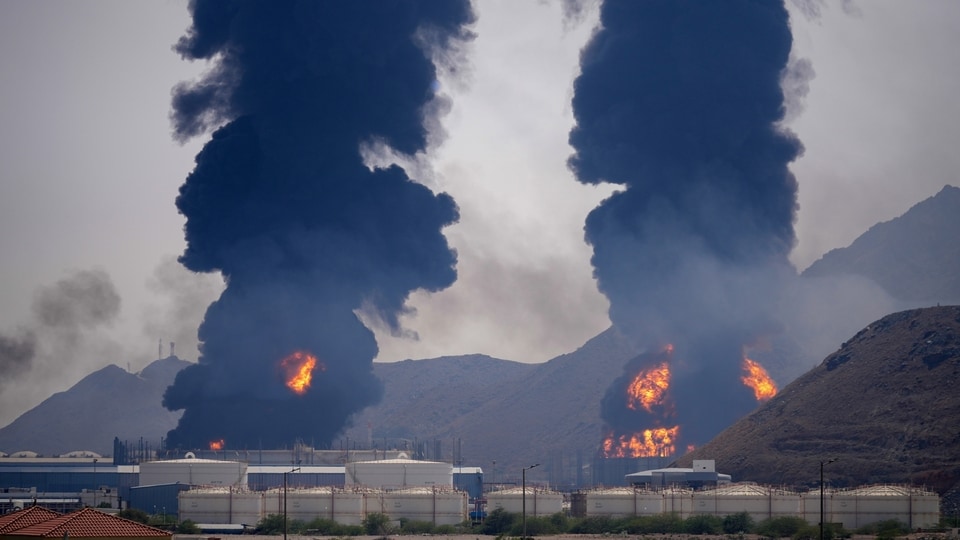
Although this attack by Iran on the Fujairah oil depot may be aimed at demonstrating that Iran not only controls ships passing through the Strait of Hormuz but also holds the power to dictate the overall terms and conditions for commercial ships trading with countries in the entire Persian Gulf region, this may backfire and provoke the Gulf monarchies, while also potentially triggering this war to the next level. As the American navy is already stationed in the Strait of Hormuz and may be waiting for Iran to make mistakes, this may also give the US reason to re-engage with the Gulf monarchies to launch a fresh attack on Iran. Since President Trump is well aware that he has failed to provide his Gulf partners with a sense of security, an Iranian offensive may bring the US and its partners together, along with the multilateral agencies working to reopen the Strait of Hormuz blockade.
President Trump has already said in a statement that the counterblockade in the Strait of Hormuz is working better than bombing, as it is costing more than $ 5 million per day to Iran. In addition, it is reported that the US has now begun exporting more than 5.5 million barrels of oil per day post-Hormuz Blockade, compared to around 3.5 million barrels per day in 2025. Given that oil prices in the global market are skyrocketing, the US, as Trump claims, is heavily benefiting from the war with Iran by diverting Persian Gulf oil supplies to the US. Although this claim does not get reflected in the US energy market, fuel prices there in the US market also continue to rise. If it is true, the Trump administration will continue to impose the blockade in the Strait of Hormuz, just to put pressure on Iran to accept the conditions put forward by the American ceasefire proposal.
Since the UAE has already exited OPEC, it has no other options left but to continue their export operation through the Abu Dhabi-Fujairah pipelines. The UAE has already increased its oil production capacity from 3.5 million barrels of oil per day to five million barrels per day. Provided that the UAE suffered the most from the Iranian attack, it will have to export the oil through this alternative pipeline as much as it can to compensate for the losses it has experienced during the war. The UAE may have realised that its excessive dependence on crude oil is not sustainable for the actual growth of the Emirates, provided that the world is rapidly shifting towards tech-based development. As transitioning to an AI-driven, advanced tech-based economy requires huge capital revenue, it can be difficult for the UAE to achieve this if it does not utilise its oil resources to the fullest capacity. Following the Iranian attack, the Emirates officials announced that they would continue their export operations through the Abu Dhabi-Fujairah pipeline. As the Emirati government has also ordered all schools and other such offices to operate online, the gradient of this announcement lies in the fact that the UAE is possibly going through a significant economic distress. In addition, the economic rivalry between the UAE and Saudi Arabia is an additional factor that has actually pushed the UAE to exit OPEC, as there was a limited cap on oil production for the Emirates.
In this context, one thing is very clear: The UAE has a reason not to stop its alternative oil pipeline, as it cannot afford to wait for the blockade to be resolved. It will have to continue its alternative pipeline, which easily bypasses the blockades in the Strait of Hormuz. However, any aggressiveness by the Iranian side with the aim of power demonstrations will certainly benefit the US, and, for that matter, Iran may have to pay a heavy price in return.
(The views expressed are personal)
This article is authored by Sanjay Turi, doctoral candidate and Amit Kumar, assistant professor, Centre for West Asian Studies (CWAS), School of International Studies (SIS), Jawaharlal Nehru University, New Delhi.


