
 E-Paper



Ralph Lauren faces fresh backlash over ‘hand-applied embellishments’ on beaded dress; Indian designers debate
A new fashion debate over beading on a Ralph Lauren dress asks where design inspiration ends and cultural acknowledgement begins

 Prefer HTon Google


Where does design inspiration end and acknowledgement begin? American fashion brand Ralph Lauren has found itself at the centre of that debate once more over a beaded dress from its Spring/Summer 2027 show at New York Fashion Week. The Indian design community and social media users have noted how zardozi and aari-looking embroidery patch on the dress was credited simply as “hand-applied embellishments”. The brand was earlier called out for describing jhumka-like earrings as “vintage accessories” and a ₹44,800 Bandhani-inspired skirt listed as a “print cotton wrap”.
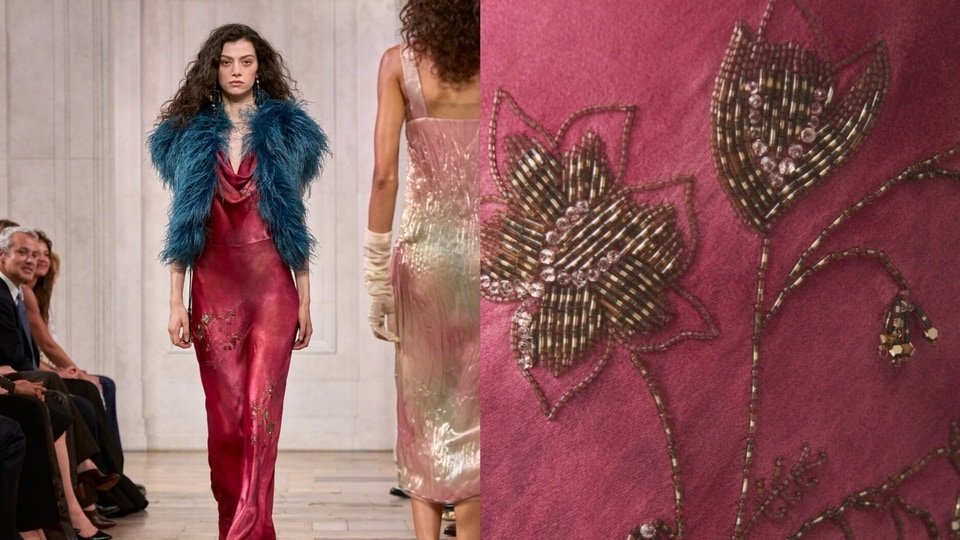
Why social media is calling for credit
Lucknow-based designer Prakhar Rao Singh Chandel (@chandel.zt) noted on Instagram, “‘Bead and metal-thread embroidery’ like this has a name where I live. Zardozi has been registered to Lucknow and six districts around it since 2013, and one lakh seventy-five thousand artisans work in that cluster. It is a place before it is a decoration. Name it when you use it. Not when you get caught.”
The sentiment has also spilt into Ralph Lauren’s comment section, with users writing, “This is Indian zari work, give credit where it is due” and “Start acknowledging Indian art.”
What designers say
Designer Nachiket Barve notes the embroidery resembles glass beading, which has a long history beyond India. “It looks like glass beading, which is pretty common across cultures, not necessarily native to India. You see it in old French and Italian garments, as well as 1920s and 1930s flapper dresses.”
He says India has its own tradition of the technique through the Aari embroidery, but it cannot automatically be claimed as exclusively Indian. “This form of embellishment using glass beads has been done across cultures.” However, he draws a line when a technique is culturally specific: “If an embroidery is specific to a culture or place, I personally feel it needs appropriate credit.”
Textile revivalist Madhu Jain says it’s not the first time a Western brand or designer has taken from India. “It’s an old colonial trend,” she says, pointing to the history of Indian chintz, Jamdani and Dhaka muslin in Western fashion. “In India, our textiles, embroideries, and techniques are deeply intertwined with our culture, tradition, and religion—they form the very fabric of our society. The West have always been ‘inspired’ by us. The difference now is that Indians are aware.”
Designer Gautam Gupta says the technique itself may not be exclusive to India, but believes acknowledgement is still the simplest way forward. “The embroidery is a very simple combination of aari and zardozi, using cut-dana and sequins. Techniques like this exist in India and across the world, and no there’s no harm in global brands using Indian skills, fabrics, and inspiration. But there must be credit.”
His solution is straightforward: “At the very least, label it ‘Made in India,’ ‘Co-created in India,’ or ‘Hand-embroidered in India.’” Individual artisan credits may be difficult at scale, he acknowledges, “but acknowledging the country is entirely doable.”


