E-Paper



30-day recharges, voice-only plans: Telecom regulator's actions after Raghav Chadha's Parliament push
New TRAI regulations will mandate telecom operators to introduce voice and SMS-only plans, benefiting consumers who need basic communication services.

 Prefer HTon Google


Prepaid mobile users in India will have more recharge options under new telecom consumer protection regulations, a move that comes months after Bhartiya Janata Party (BJP) leader Raghav Chadha raised concerns in Parliament about the limited choices available to consumers.
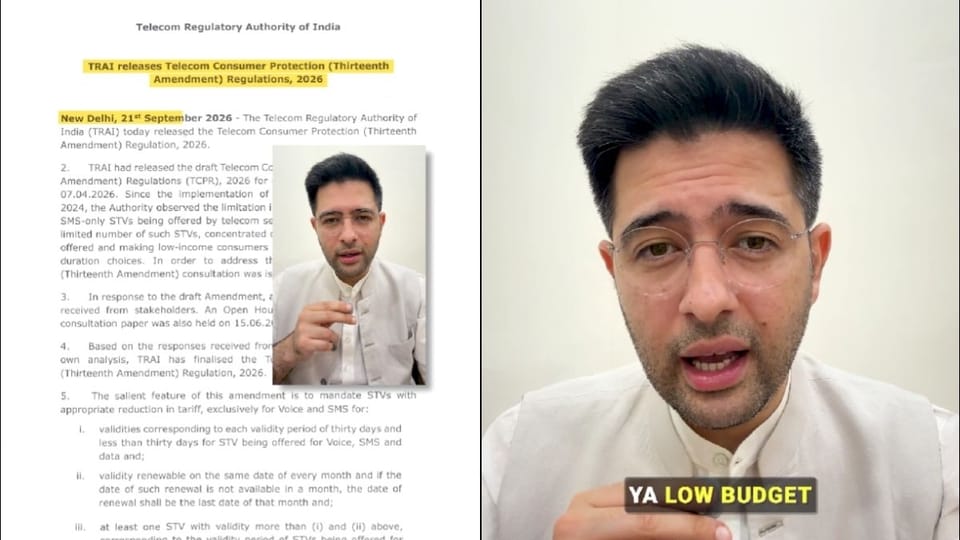
The Telecom Regulatory Authority of India (TRAI) has finalised the Telecom Consumer Protection (Thirteenth Amendment) Regulations, 2026, mandating telecom operators to offer voice- and SMS-only special tariff vouchers (STVs) with different validity options. The framework includes vouchers with validity corresponding to plans of up to 30 days, monthly renewal options and at least one longer-duration voice and SMS-only voucher corresponding to longer bundled plans.
The changes are aimed particularly at consumers who do not require mobile data and currently have fewer options for basic calling and messaging services. TRAI said the amended framework would provide low-income consumers with more choices and allow them to recharge according to their requirements and financial capacity.
The issue had been raised by Chadha in the Rajya Sabha on March 11. According to Parliament records, he raised the need to address consumer concerns regarding telecom recharge practices and connectivity that day.
In his intervention, Chadha had questioned the prevalence of 28-day recharge cycles, which require consumers to recharge 13 times over a 12-month period if they maintain uninterrupted service. He argued that consumers should have access to genuine monthly options rather than having to renew their plans every 28 days.
Chadha also raised concerns about users losing access to incoming calls and SMS after their recharge validity expires. He argued that while the suspension of outgoing services after a recharge expires may be understandable, cutting off incoming communication can create problems for consumers who depend on their mobile numbers for essential calls and messages.
He also highlighted the increasing importance of mobile numbers in India's digital ecosystem. According to Chadha's argument, a mobile number is no longer merely a means of communication but is linked to services such as banking, digital payments and other essential services.
Chadha had called for greater protection for consumers whose recharge validity has expired. Among the issues he raised was the need to ensure continued access to incoming calls and SMS for a longer period, as well as greater flexibility for users who cannot afford or do not require full data-and-voice packages.
The new TRAI regulations now provide a formal framework for greater choice in voice and SMS-only plans. Operators will have to offer such vouchers with validity corresponding to their existing voice, SMS and data STVs, with an appropriate reduction in tariff.
The regulations also provide for a voucher that can be renewed on the same date each month. If that date does not exist in a particular month, the renewal date will be the last day of that month. This is intended to provide consumers with a more predictable monthly recharge cycle.
Chadha welcomed the development in a post on X, saying consumers had previously raised concerns with him about limited and inflexible recharge options. He said he had taken up the issue in Parliament on March 11 and thanked the government and TRAI for addressing the concerns.
The development is particularly relevant for consumers who primarily use their phones for voice calls and SMS and do not want to pay for bundled data. TRAI's consultation process had also examined concerns around the availability of affordable shorter-duration voice and SMS-only vouchers.
The new framework does not mean that every existing prepaid plan will automatically become a 30-day plan. Instead, telecom companies will have to expand the range of special tariff vouchers available to consumers, including voice- and SMS-only options corresponding to different validity periods.
Telecom operators will therefore have to introduce the required plans within the regulatory framework, giving customers more flexibility to choose a recharge based on their usage and budget. According to recent reports, the new requirements are expected to come into effect after the prescribed implementation period following publication of the regulations.
For consumers, the changes could particularly benefit those who use their mobile connection mainly for calls and messages, including people who have limited use for mobile data. The move also addresses the broader question raised by Chadha in Parliament: whether prepaid customers should have more flexibility to pay only for the telecom services they actually need.