
 E-Paper



A master strategist who increased BJP’s footprint
Shah, who has never hidden his Rashtriya Swayamsevak Sangh roots, is also credited for striking a balance between the ideological demands of the Sangh and political compulsions.


To a party colleague’s question on why he prefers quick decision making over long-drawn-out deliberations, Amit Shah is learnt to have said, “If I don’t take quick decisions then I won’t get things done....My style is to work on instinct, take quick decisions then work hard to prove the decision right.”
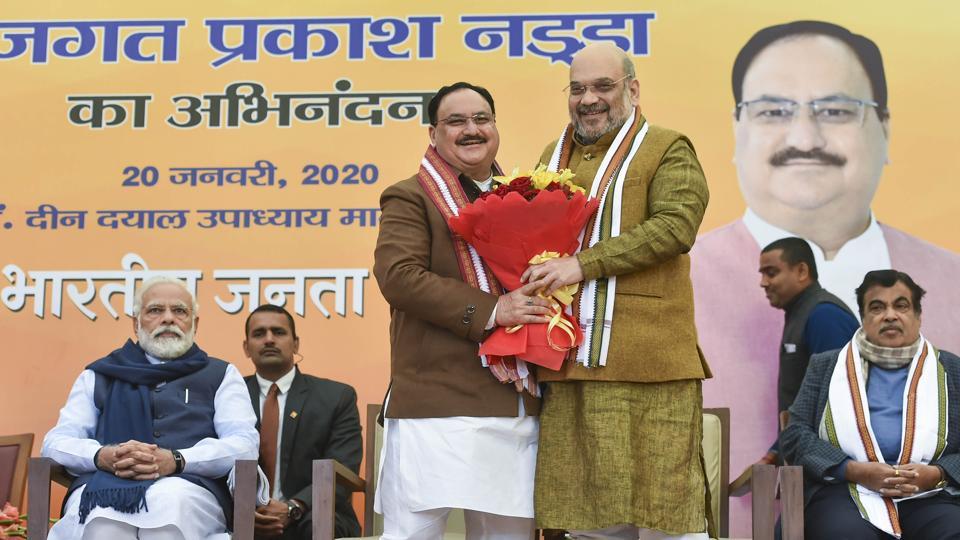
As he steps down as the president of the Bharatiya Janata Party, Shah’s tenure is marked by many such decisions. Many worked, resulting in him being hailed as a master strategist; some didn’t , resulting in the party facing criticism. Still, it can’t be denied that it was under Shah’s watch that the party expanded, in terms of the number of members, national footprint, and its strength in Parliament.
Prime Minister Narendra Modi acknowledged as much on Monday when Jagat Prakash Nadda took over as party president from Shah in a planned move. “I do not think words can do justice to the rich contribution of @AmitShah Ji as @BJP4India President. During his presidency, BJP got opportunities to serve in several parts of India. We also got our highest ever tally in a Parliamentary election. He is an outstanding Karyakarta,” the PM tweeted. shortly after the new president was appointed.
Shah was first appointed as the party president in 2014, when the then party chief, Rajnath Singh, was elevated as the union home minister following the BJP’s stunning success in the Lok Sabha elections. That performance was predicated around the party almost sweeping Uttar Pradesh, which sends the most representatives to parliament; Shah had overseen the campaign in the state.
That appointment was for the rest of Singh’s term and Shah was given charge as the president for a full term on January 24, 2016.
That stint came soon after the party lost elections in Bihar and Delhi and amid murmurs that its golden run could be on the wane.
“That is when he decided to go back to the grassroots…he emphasised that the party will have to revive the cadre, go back to its strength of presence at the booth level and borrow from the Sangh’s (RSS) door-to-door outreach,” said a party colleague who asked not to be named.
The result was an ambitious membership drive that took the number of members from a little over 20 million to nearly 100 million by 2019. And the result was an emphasis on winning everything -- from Panchayat to Parliament.The party scripted electoral successes in states such as Assam, where it won for the first time (and which gave it a foothold in the Northeast). It subsequently formed governments, on its own or with allies, in Arunachal Pradesh, Manipur, Tripura, Nagaland and Meghalaya. And it persuaded the ruling parties in Sikkim and Mizoram to join the NEDA or the North East Democratic Alliance led by the BJP.
“There was apprehension among the minorities [tribal communities as well as Christians] in the Northeast that the BJP would appropriate their culture and lifestyle and impose hardline Hindutva. But the party has been able to reach out to minorities as well,” said a BJP leader from the North East who asked not to be named.
In between, there was much talk about Shah’s unorthodox choices, which saw a person from the Other Backward Classes being appointed party president in Uttar Pradesh (between 2016 and 2017); a non-Maratha being appointed Chief Minister in Maharashtra; and even an alliance with an ideological opponent, the PDP, to form the government in Jammu and Kashmir. All this was justified as a means of strengthening the party and winning polls.
Bhupinder Yadav, a party general secretary and a Rajya Sabha MP, also a confidant of Shah, said that during the latter’s tenure “the party undertook the biggest ever membership drive, owing to which it now has over 100 million members, which is the highest for any party in the world; the party also saw a geographical expansion under his charge from the north-east of India to the south.”
The party also set up offices in every district making clear its ambitions of building a pan-India presence. This also sent out a message that the party was as serious about local elections as it was about winning the seat of power in Delhi.
“…In terms of organisational strength, he took major steps,” said Yadav.
A BJP member from the south , where the BJP has not been as successful in gaining ground, recalled how Shah insisted on daily reporting from the states. “He led the campaign in Kerala against the Left, highlighting the political violence [against right wing workers in the state]. And he has been pushing the cadre to carve their space in the political scene dominated by regional parties.”
Shah’s tenure also saw the BJP becoming the second most powerful party in West Bengal. The party won 18 Lok Sabha seats in 2019 and now has its eyes set on the 2021 state elections.
In their book on Shah, Anirban Ganguly and Shiwanand Dwivedi detail the mass contact programmes popularised by Shah and his relentless touring across the country.
“…In his quest for expanding BJP‘s footprint, Shah covered more than 7,90,000 km between August 2014 and September 2018 undertaking major outreach programmes in the duration of 49 months; the average distance covered by him during this period was about 519 km a day and this is just a figure.”
Ideologically, Shah, who has never hidden his Rashtriya Swayamsevak Sangh roots, is also credited for striking a balance between the ideological demands of the Sangh and political compulsions. A senior RSS functionary said on condition of anonymity that Shah remains committed to the Sangh’s larger ideology and was instrumental in fulfilling a long-pending dream of nullifying Article 370. “Why India needs a population policy or the need for a uniform civil code (both longtime Sangh demands) are not lost on him.”
Vijay Chauthaiwale, who was roped in to head the BJP’s Overseas Cell by Shah, said there is more to Shah than just his abilities as an electoral strategist. “He has very deep political instincts, but he also has a good understanding of history, of culture, of India’s heritage and his interests are diverse; for instance he can speak on the Shankaracharya with as much ease as he can about the treatises of Chanakya.”
Some have criticised Shah and Modi for seeking to centralise leadership and say this is probably responsible for losses in some states, including, most recently, Jharkhand. They also say the party focuses too much on national issues in local polls. Political analyst, Neelanjan Sarkar, sees the centralisation as a bid to retain complete control and prevent factionalism.
“What both Modi and Shah have done is centralise the party between them and a few others whom they trust. There has been a sidelining of many senior leaders. What they have also done at the state levels is prop up relatively unknown faces as chief ministers because they don’t want any factionalism. This is something that Indira Gandhi would have done in the 1970s. So in order to prevent factionalism at the central level they have made sacrifices at the state level,” he said.
It’s an approach that has worked, he admitted. “…So far they have been able to array powers to themselves and the results showed in 2019,” Sarkar said.
Shah’s tenure has also seen the party break up with some of its allies, including the Shiv Sena in Maharashtra; even its current partners, Shiromani Akali Dal and the Lok Jana Shakti Party have, at times, commented on the BJP’s treatment of allies.
“Today, they have an absolute majority so they don’t follow a consultative process, but what if things change at the end of the four and half years?” asked a leader of one of the party’s allies who asked not to be named.


