
 E-Paper



A year after violence, Bhima Koregaon turns into a sea of blue
Memories of the violent clashes and stone throwing that marked the bicentennial celebration of a British-era war a year ago failed to stop Dalits from across the country congregating in Maharashtra’s Bhima Koregaon on Tuesday to commemorate its 201st anniversary.

 Prefer HTon Google


Memories of the violent clashes and stone throwing that marked the bicentennial celebration of a British-era war a year ago failed to stop Dalits from across the country congregating in Maharashtra’s Bhima Koregaon on Tuesday to commemorate its 201st anniversary.
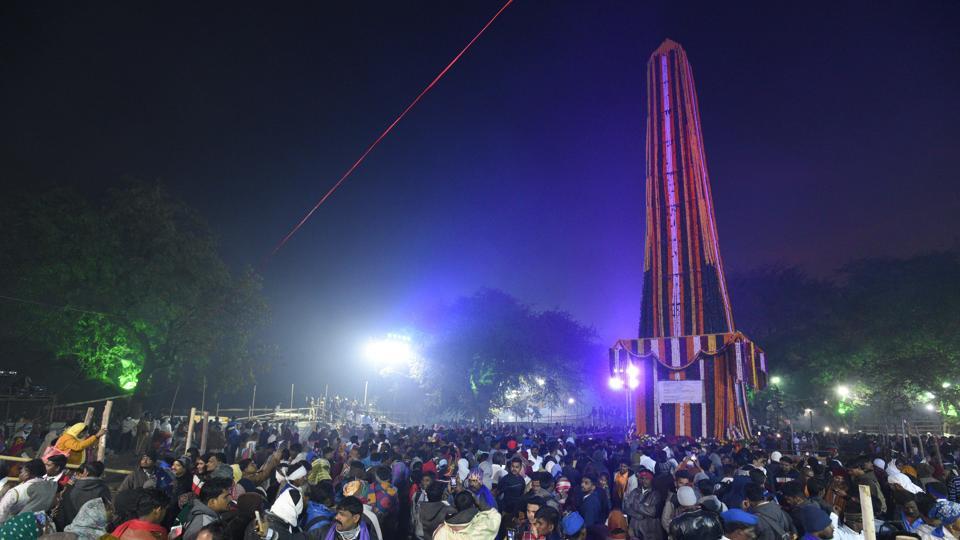
Pune Police said at least one million people made their way to the victory memorial, around 40 km from the city, as a mark of pride and assertion, waving blue flags and raising slogans of ‘Jai Bhim’, a reference to Dalit icon and India’s first law minister, BR Ambedkar.
“This year is special for us because of the riots which took place and our community was attacked by members of the right wing last year,” said Rajesh Bhole, a resident of Aurangabad, with the flower-bedecked, obelisk-shaped memorial in the background.
Union minister Ramdas Athawale visited the village late in the evening and announced that the central and state governments would collectively spend ₹100 crore on beautifying the memorial.
“The state government has prepared a ₹63 crore development plan for the Bhima Koregaon memorial and the central government will take steps to increase the amount to ₹100 crore,” Athawale said, adding that the government would take steps to declare the memorial as a pilgrim centre for Dalits.
For more than a century, Dalits have celebrated a victory in an 1818 war of the British army, manned by several Dalit soldiers, over the forces of the Peshwas, the erstwhile rulers of Pune who were known for oppressive caste practices.
Last year, peaceful protesters were attacked by an unidentified group of men who torched vehicles, ransacked shops and sparked violence that left one dead and at least 40 people injured.
Pune (rural) police initially named two right-wing leaders, Sambhaji Bhide and Milind Ekbote, but the investigation against them has stalled. Instead, Pune (urban) police have focused on an event organised by Left and Dalit groups on December 31, 2017 in Pune called Elgaar Parishad and arrested 10 prominent activists for alleged Maoist links.
In order to avert a repeat of last year, police threw a protective cordon around the village, suspended phone internet, stopped most vehicles from plying and put up numerous check posts, besides deploying 20,000 personnel and at least 350 CCTV cameras.
“While lakhs of people visited, we focused a lot on crowd management. The people were not allowed to halt near the victory pillar and our deployment was also strategic at various places,” said inspector general of police Vishwas Nangre Patil. “We did not allow aggression and impatience among visitors which helped us control the crowd,” he said.
A number of prominent politicians also made a beeline to the event. At 7am in the morning, Prakash Ambedkar, Bharipa Bahujan Mahasangh President and BR Ambedkar’s grandson, paid his respects and lauded retired Bombay high court judge BG Kolse Patil, retired Supreme Court judge justice PB Sawant and some students for creating awareness about Bhima Koregaon in rural Maharashtra.
“Now the state is labelling them as naxals as they tried to bridge differences between the Marathas and the OBCs (other backward classes) through the Elgaar Parishad as a platform,” Ambedkar said. He demanded that the government take action against Ekbote and Bhide, who, he said, were the real perpetrators of last year’s violence.
Later in the day, Bhim Army chief Chandrashekhar Azad and Athavale also visited the spot.
But the focus remained squarely on the people, many of whom walked for miles, spent hours inside packed buses and went without food or water for long durations to make the journey. Most of them said the event meant more to them than just a celebration.
“We have composed songs to commemorate the battle of Bhima Koregaon so that Dalits can undertake awareness campaigns and assert their rights guaranteed under the Constitution,” said Kabir Naiknaware, an artiste from Kolhapur.
Former soldier BS Kawade, who came from Chiplun, described the memorial as a symbol of Dalit pride and identity. “It reflects the Dalit prowess in fighting wars against the Peshwas and winning them. This anniversary is a historic occasion for us,” he said.


