
 E-Paper



Aditya-L1's halo orbit entry in Jan; vital Ganganyaan test on Oct 21: ISRO chief
Aditya-L1 will be placed in a halo orbit around Lagrangian Point 1 (or L1), which is 1.5 million km away from the Earth in the direction of the sun.

 Prefer HTon Google


Indian Space and Research Organisation (ISRO) chief S Somanath on Sunday said that India's maiden space-based solar mission, the Aditya-L1 spacecraft, is progressing smoothly and is scheduled to reach Lagrange Point 1 (L1) by mid-January.
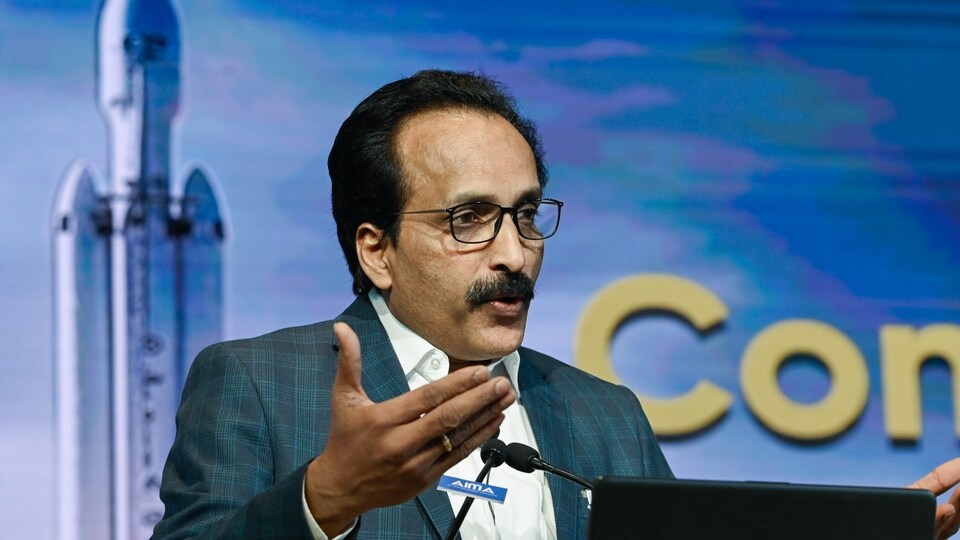
Speaking to reporters in Madurai, Tamil Nadu, Somnath explained, “It is working very well. Currently, it takes almost 110 days to travel from Earth to the L1 point. So by the middle of January, it will reach the L1 point. Then at that point, we will do the insertion into the Lagrange Point. That is called the halo orbit. It's a big orbit. So that will happen by the middle of January.”
Aditya-L1 was launched from the Satish Dhawan Space Centre in Sriharikota on September 2, days after the Chandrayaan-3 mission made a soft landing on the Moon's south pole. It carried seven different payloads to have a detailed study of the sun, four of which will observe the light from the sun and the other three will measure in-situ parameters of the plasma and magnetic fields. These instruments were intended to provide data on solar activities, such as solar flares and coronal mass ejections.
The primary objective of the Aditya-L1 mission is to study the Sun's outermost layer, the solar corona, and to investigate various aspects of the Sun-Earth relationship. The mission is planned to be launched into a halo orbit around the first Lagrangian point (L1), which is a stable point in space located between the Earth and the Sun. This orbit allows for continuous observation of the Sun without being obstructed by the Earth.
The ISRO Chief also spoke about the 'Gaganyaan' mission.
"Test Vehicle-D1 mission is scheduled for October 21. This is the Gaganyaan program. The Gaganyaan program requires testing, demonstrating the crew escape system. The crew escape system is a very critical system in Gaganyaan. If anything happens to the rocket, you have to save the crew by moving the crew away from the exploding rocket at least by two km. So this test is to demonstrate the crew escape system in one condition of the flight. So this condition we are demonstrating is called the Transonic condition...", Somnath said.
"Every month we will have at least one launch. After this test vehicle launch, we have GSLV. Then we have SSLV. Then after that, the Gaganyaan unmanned mission will be there. In between there will be a PSLV launch. So before January, you will see at least 4-5 launches", he added.
The Gaganyaan project envisages a demonstration of human spaceflight capability by launching a crew of three members to an orbit of 400 km for a three-day mission and bringing them back safely to Earth, by landing in Indian sea waters.


