
 E-Paper



AIMPLB moves top court against Hijab ban judgment by Karnataka HC
The Board claimed that the February 5 notification by the state banning hijab was “blatantly partisan and communal in colour” that was upheld without ascertaining the discrimination it meted out to Muslims in general and Muslim girls in particular.

 Prefer HTon Google


The All India Muslim Personal Law Board (AIMPLB) has approached the Supreme Court challenging the Karnataka high court order on the Hijab ban by stating that the judgment widely impacts the socio-religious ethos of the Muslim community and throws open the door for interference with the religious freedom of individuals.
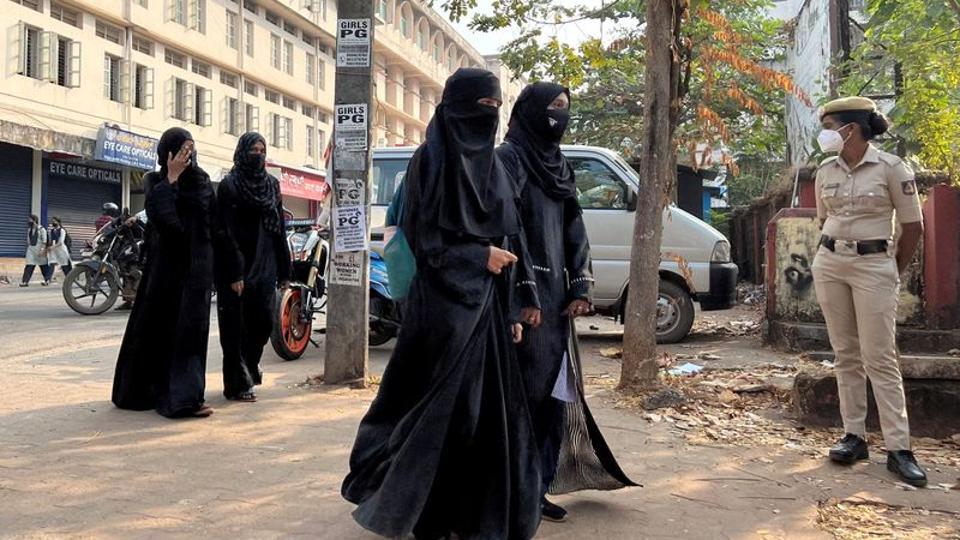
In its appeal questioning the correctness of the high court order of March upholding an order of the Karnataka government that banned hijab (head scarf) being worn by Muslim women in schools and colleges, the AIMPLB said, “The judgment legitimizes “Hijab ban” in educational institutions in the state which goes against the very basic structure of secularism.”
“It is submitted that the judgment will lead to grave encroachment on the children of the Muslim community and shall lead to a situation where a large section of Muslim girls will be deprived from the stream of general education leading them to remain in vulnerability,” claimed the petition filed by the AIMPLB and two other Muslim women who are members of the Board.
The petition also said that the judgment displayed its complete lack of understanding of the rules of interpretation of Al - Quran and the relevance of Hadith in the matter of interpretation of Al - Quran.
“The issues decided by the high court at Karnataka widely impacts socio-religious ethos of the Muslim community. It does not merely affect but it also throws wide open the doors of interference with religious freedom of individuals as well as various religious denominations by the state as well as instrumentalities of the state,” stated the petition filed by advocate MR Shamshad.
The Board claimed that the February 5 notification by the state banning hijab was “blatantly partisan and communal in colour” that was upheld without ascertaining the discrimination it meted out to Muslims in general and Muslim girls in particular. “It is a case of direct discrimination against Muslim girls,” petition said, adding, that by laying too much emphasis on bringing “uniformity” in the uniform, the high court order resulted in “travesty of justice” as it failed to accommodate religious belief of a woman’s religion that requires ‘to cover her hair with a piece of cloth’.
“There is a consensus amongst religious scholars of all schools of thought namely, Hanafi, Maliki, Shafai and Hambli that practice of Hijab is ‘wajib’ (mandatory), a set of obligations, which if not followed, he/she will commit “sin” or become a “sinner”,” the petition filed by the Board stated.
Last week, the Supreme Court had refused to allow an urgent hearing on a separate petition filed by a Muslim student challenging the Hijab ban judgment as she was deprived of giving her exams wearing the head-scarf. A bench headed by chief justice of India (CJI) NV Ramana while refusing to list the matter urgently asked the petitioner not to sensationalise the matter as hijab had nothing to do with holding of exams.


