
 E-Paper



At 36,000 feet, Air India flight to Delhi briefly lost all hydraulics within seconds, triggering ‘altitude upset’
The report also stated that the pilot-in-command, who was the pilot monitoring during the flight, tested “non-negative” for a psycho-active substance.

 Prefer HTon Google


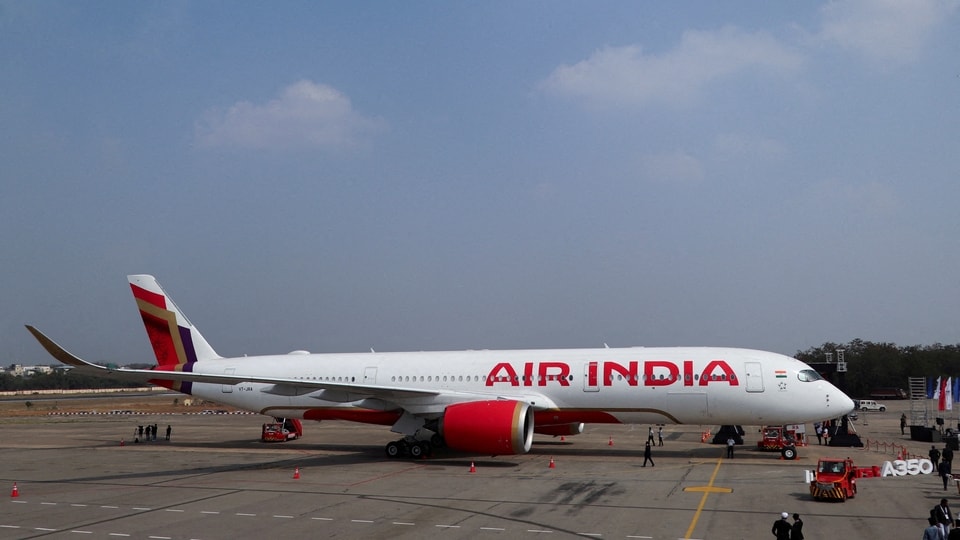
An Air India Airbus A320neo lost all three of its hydraulic systems within seconds while cruising at 36,000 feet on August 4, triggering an “altitude upset” that injured 24 people on board, according to a preliminary report by the Aircraft Accident Investigation Bureau released on Friday morning.
The report also stated that the pilot-in-command, who was the pilot monitoring during the flight, tested “non-negative” for a psycho-active substance in a confirmatory test conducted after the aircraft landed in Delhi. The co-pilot tested negative in both tests.
The preliminary report did not establish any link between the psycho-active substance finding and the incident. “Detailed investigation regarding technical and other aspects is underway,” it said. But the report now establishes a crucial timeline: that the hydraulic problems preceded a momentary but violent altitude change that left people with serious injuries.
Deep Dive

Air India flight AI 2379, an Airbus A320 registered as VT-EXO and manufactured in 2018, was flying from Phuket to Delhi with 137 passengers, including three infants, six cabin crew and two flight crew on board, the report stated. When it took off from Phuket at 1.41am UTC (7.11am IST), it reported no abnormalities.
But at 43 seconds past 9.32am IST, while cruising at 36,000 feet, the aircraft’s flight-control system detected a loss of the green hydraulic system. Four seconds later, it detected the loss of the blue and yellow systems as well.
At 9.32:48am IST the autopilot disengaged and a continuous repetitive chime sounded. Three seconds later, the stall warning was triggered for two seconds.
“The aircraft encountered altitude upset. Initially, it gained 372 ft and fell by 292 ft from its assigned FL360 during the event,” the AAIB said, detailing what was an event that threw unbelted passengers and crew against overhead bins and ceiling panels, injuring 24 of the 145 on board.
At cruise altitude, seat belt signs are typically turned off.
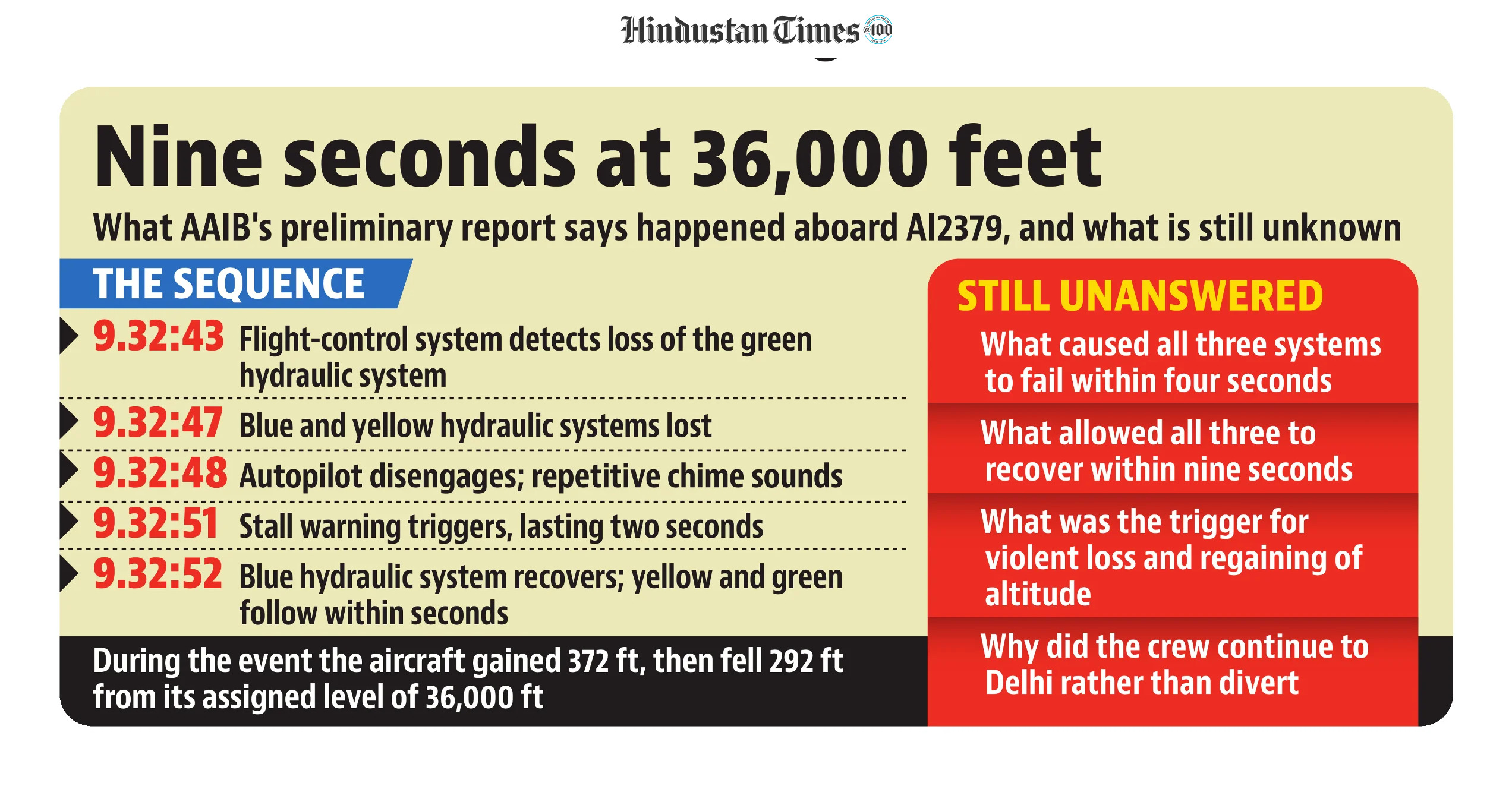
Moments later, however, the hydraulic systems came back. “At around 04:02:52 UTC (9:32:52), the Blue hydraulic system was recovered, and a few seconds later, the Yellow hydraulic and the Green hydraulic systems were also recovered. Consequently, this led to the recovery of the Flight control (F/CTL) surfaces. Subsequently, the aircraft operation returned to its normal operating condition,” the report said.
The co-pilot, who was the pilot flying, responded to the situation before the pilot-in-command took over the controls. Former pilots said the report leaves the central technical question open.
Capt Sharath Panicker, a former Dreamliner pilot, said the sequence was consistent with the elevators sitting at different positions when the autopilot disconnected. “The autopilot tripping is a natural consequence to the triple (complete) hydraulic failure,” he said. That mismatch, he said, produced the pitch-up and the gain in altitude, and the stall warning followed from it.
The recovery from a stall requires the pilot to push the sidestick forward to reduce the angle of attack. “The first push forward on the side stick had no aircraft response (system was resetting). The second push forward (probably harder/larger movement) by the first officer resulted in the negative G manoeuvre that caused all unbuckled passengers and crew to hit the ceiling and subsequent injuries,” Panicker said.
“Why the hydraulics went off within four seconds of each other needs to be determined by the investigative agency,” he added. “Once all three hydraulic systems fail, effectively the aircraft is without power to the control surfaces.”
A second pilot, who asked not to be named, said the finding on the psycho-active substance had drawn attention away from the technical question. Airbus does not train crews for a triple hydraulic failure, he said, because the scenario was not contemplated. “The questions which remain unanswered are what the real cause of the hydraulic system failure was and how the three systems failed in such fast succession.”
Also Read: Probe terms Air India pilot’s 'psychoactive substance use serious concern’, calls for action
Another key question, the second pilot who spoke on condition of anonymity, that remains is the choice of not landing sooner. “Why would you not go to Kolkata or Bhubaneswar when you have so much medical emergency and people are bleeding and the aircraft is in a damaged state?”
A third pilot, who also asked not to be named, said: “The report raises more questions than it answers. It does not establish the probable cause or contributory factors behind the aircraft’s violent loss and gain of altitude or the serious damage sustained. Most importantly, the CVR data has not been incorporated, while the report does not explain the pilot’s side-stick inputs or what caused the aircraft to move so violently despite the reported failure of all three hydraulics”.
The only finding on which the AAIB made an interim safety recommendation pertained to the drug test findings. “In view of non-negative result for psycho-active substance of one of the flight crew, it is recommended that DGCA may take appropriate actions as deemed fit to prevent abuse of psycho-active substance,” the report said, adding in its conclusion that the confirmation of use of a psycho-active substance was a serious concern.
“We acknowledge the release of the preliminary report by the AAIB and continue to extend our full cooperation to the investigation, including providing access to all relevant operational, maintenance and technical records,” an Air India spokesperson said. “Following the incident, Air India has started voluntary testing of 100% of its pilots as a further step to reinforce its safety-first approach..”
The Airbus A320 has three separate hydraulic systems — green, blue and yellow — which power a range of critical aircraft systems, including the flight controls. The three have separate reservoirs, and hydraulic fluid does not transfer between them. The architecture is designed so that the loss of one system does not compromise the others.
The report does not identify what caused all three to fail, or what allowed all three to recover within seconds.
No adverse weather was reported by the flight crew or air traffic control, the report said.
The Post Flight Report generated by maintenance personnel, which the investigation team examined for in-flight warning and failure messages, corroborates the sequence. It recorded warnings of low pressure in the green hydraulic system followed by the blue and yellow systems, along with the autopilot switching off and faults involving the left and right elevators. It also recorded low-level warnings for the yellow and blue hydraulic reservoirs.
Investigators have collected hydraulic components and hydraulic fluid samples from the aircraft for further analysis, along with fuel and oil samples, maintenance and operational records, and information from Delhi and Kolkata air traffic control.
Technical experts assigned by Airbus through France’s Bureau of Enquiry and Analysis for Civil Aviation Safety inspected the aircraft between August 13 and 15, the AAIB said, and further hydraulic components and samples were collected during that inspection.
The aircraft’s Solid-State Flight Data Recorder and Solid-State Cockpit Voice Recorder were removed after the event and taken to AAIB headquarters for analysis.
The cabin
“At the time of the event, the aircraft was cruising at FL360 and seat belt signs were off. Consequently, some passengers and cabin crew suffered injuries. Cabin Supervisor apprised the cockpit about the injuries suffered by the passengers and cabin crew,” the report stated.
The crew assessed the cabin situation and decided to continue to Delhi rather than divert to the nearest enroute airport.
“The aircraft sustained damages at several places inside the cabin mainly to the hatrack (overhead stowage bins) and ceiling panels,” the report said, offering details that corroborate the severity of the incident that left people with injuries.
Both pilots underwent post-flight medical examination on arrival in Delhi. Their breathalyser tests were satisfactory.
“In addition, both flight crew were subjected to Psycho-active substance detection test by using Psycho-active substance detection kit. The sample of PIC was found non-negative. Subsequently, blood samples of both the flight crew were sent to the pathological laboratory for confirmatory test.
“The preliminary report is published as per ICAO guidelines. The investigation is under progress. The final report will be published in due course,” the report concluded.


