
 E-Paper





Joydeep Thakur is a Special Correspondent based in Kolkata. He focuses on science, environment, wildlife, agriculture and other related issues.
Bengal CEO puts summary voter roll revision on hold
The delay leaves new and first-time voters uncertain about registration dates and comes as millions of appeals over voter deletions remain pending.
Published on: Nov 21, 2026, 06:24:36 IST


Share via
Copy link
The West Bengal Chief Electoral Officer (CEO) on Friday postponed the special summary revision (SSR) of voter list and the publication of draft roll due to “unavoidable circumstances”, sparking a controversy in a state where the special intensive revision (SIR) disenfranchised 2.71 million people earlier this year.

The surprise move comes roughly a month after the Election Commission of India (ECI) ordered SSR in 17 states and Union territories, the first such exercise in nearly two years that was expected to not only help Gen Z and first-time voters but also those deleted by SIR.
The SSR is already underway in 24 regions, including Bihar, Chhattisgarh, Goa, Gujarat, and Kerala. Bengal is the only province where the exercise was halted. The SSR was scheduled to start on November 23 in the eastern state.
“The upcoming program of special summary revision of photo-electoral roll which was scheduled from November 23 onwards is hereby postponed due to some unavoidable circumstances. Modified schedule will be intimated subsequently,” said a statement issued by Arindam Niyogi, additional chief electoral officer.
The CEO didn’t offer reasons for the delay.
A BLO in the state, requesting anonymity, said: “Delay in disposing of appeals pending before the Supreme Court mandated Appellate Tribunals could also be a possible reason behind postponement of this drive. At least four judges have quit and case disposals are moving at a slow pace.”
Also Read | Biswajit Basu becomes fourth former Calcutta HC judge to quit Bengal SIR tribunal
The Supreme Court was told in September that of the 3.8 million appeals that were filed before Appellate Tribunals, only around 126,194 applications were disposed of.
“The Appellate Tribunals are being monitored by the Calcutta high court. We have no idea,” said a state poll panel official, also declining to be named.
ECI officials said the reason for the postponement was not known. “We have no idea why the state postponed the revision. It was a decision taken by the state CEO’s office alone,” said an official, requesting anonymity.
When asked if the CEO’s office is authorised to make this decision unilaterally, the official said that the new schedule will be announced only after the poll panel’s approval. “They can announce the postponement, but the revised schedule will have to be approved by the ECI and only then will it be notified.”
If the Commission clears a revised schedule within days or a couple of weeks, the delay may prove a procedural reset. The draft roll and the claims-and-objections window would shift slightly, and the January 16 final roll would remain largely intact.
A prolonged delay would be more consequential, especially for first-time voters. Those who turn 18 by January 1, 2027 are among the prospective voters eligible to register under the exercise, so they would have no clear date for filing, and no draft list to check, until the schedule is notified.
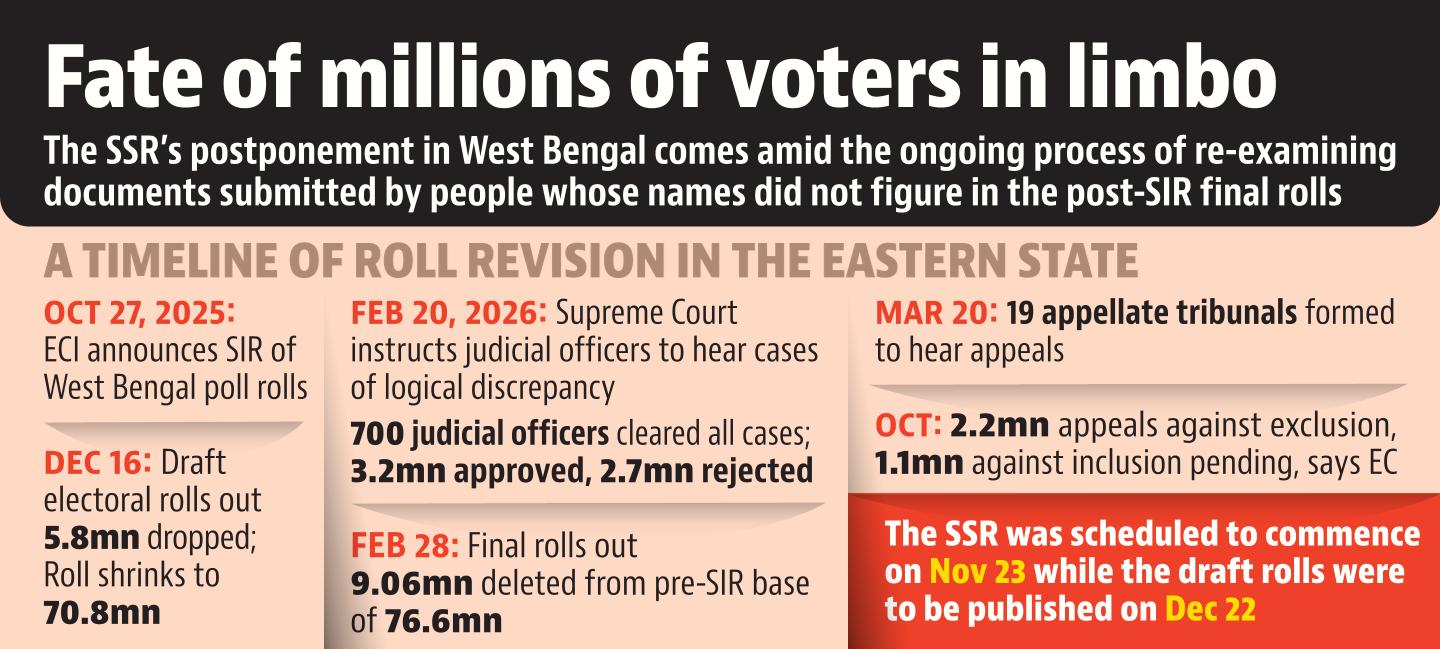
The last-minute decision further complicates the process in West Bengal, where the SIR was easily the most controversial in the country and where millions of people are still stuck before slow-moving judicial tribunals.
SSRs — where new voters can file form 6 to enter the rolls, file form 7 to object to the inclusion of another person, or file form 8 to correct details and particulars on the roll — is typically an annual affair. Unlike SIR, there is no scrutiny or verification of every existing voter in SSR and only new applications are verified before adding or dropping someone from the list. The exercise is used to bring new voters — those between ages 18 and 19 — into the electoral roll.
The SSR — which was to be conducted between November and December, with the final roll published in January 2027 — was supposed to provide political parties with machine-readable PDFs of the draft and final electoral roll, fulfilling a longstanding demand of opposition parties. This was part of a slew of changes announced by ECI to SSR, which also included greater sharing of data on additions, deletions and modifications to the roll.
Also Read | 81% pleas before Bengal post-SIR tribunals seek cuts, not inclusion, Supreme Court told
None of this will happen in Bengal, for now.
Earlier this month, chief minister Suvendu Adhikari said the process of granting citizenship to all eligible applicants under the Citizenship Amendment Act will be completed by December 31. “There are so far 2.5 lakh petitions [for citizenship certificates] pending across Bengal. We will complete the hearing process and issue them citizenship certificates by December 31 this year,” Adhikari had said on November 2, addressing the Matua community. “When the fresh revision of electoral rolls begins in January, we will help include the newly recognised citizens as voters,” he had added.
The developments bring focus back to the controversial SIR in West Bengal. The state had 76.6 million electors before SIR.
When the draft roll was released on December 16, 2025, it dropped 5.8 million voters and the roll shrank to 70.8 million. But another six million people were flagged under logical discrepancy and faced the prospect of being struck off over name mismatches, typos, age gaps between parents and applicants, and number of children.
After weeks of conflict between the state and ECI, the Supreme Court intervened on February 20, 2026, and instructed judicial officers to hear cases of logical discrepancy. Over six weeks, 700 judicial officers cleared all cases. They approved 3.2 million cases and rejected 2.7 million people, who had to appeal before judicial tribunals. But the tribunals didn’t become functional on time and eventually 2.71 million people were disenfranchised ahead of the summer’s assembly elections.
There are 19 appellate tribunals that are hearing both deleted voters appealing against their exclusion, and CEO officials appealing against the inclusion of certain voters. ECI told the apex court last month that 3.8 million appeals are pending before the tribunals – 2.2 million filed by people excluded in the logical discrepancy category and 1.6 million filed by state poll authorities against the inclusion of people.
Also Read | Did SIR exercise win West Bengal for the BJP?
The people stuck before tribunals were not eligible for SSR but the postponement will also affect new voters and those deleted under the absent, shifted, dead and duplicate categories.
Starting from November 23, the poll panel had planned around special camps during the weekends in November and December. Booth-level officers were supposed to be present in these camps in their respective polling stations to assist eligible citizens with enrolment, submission of claims and objections, and other related services.
ABOUT THE AUTHOR

Get Latest News, breaking headlines, and top India News, and today real-time updates from across the nation. Stay informed on politics, government policies, crime, Today Weather, and major developments on Hindustan Times


