
 E-Paper



Bengaluru water crisis: Use of drinking water for washing cars, gardening banned
Anyone found violating the above order will be fined ₹5,000 & for subsequent violations, ₹500 will be added to the fine


Bengaluru: Facing a water crisis, the Bengaluru Water Supply and Sewerage Board (BWSSB) on Friday issued an order banning people from using drinking water for activities such as washing vehicles, gardening, construction, and entertainment purposes like water fountains.
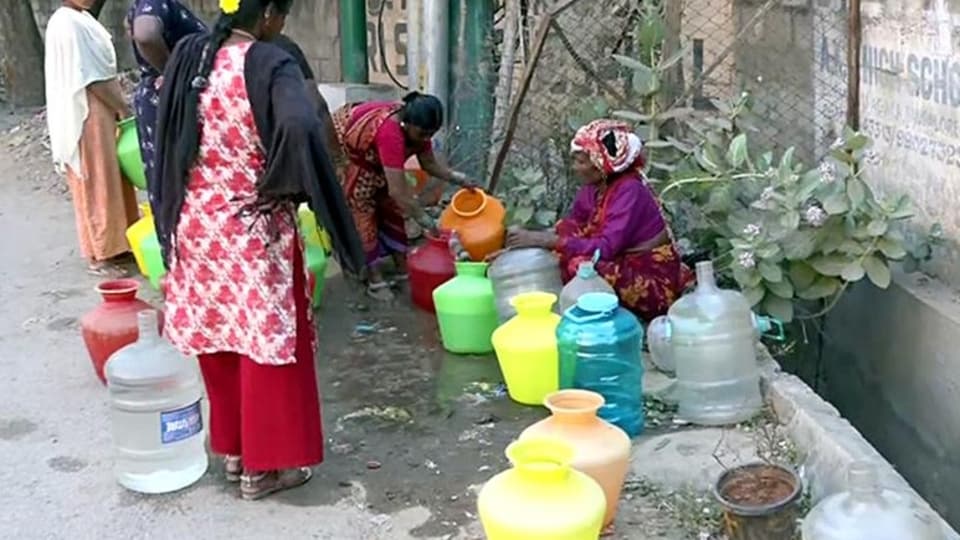
The civic body has also imposed a fine of Rs.5,000 for violation of the order. “Anyone found violating the above order will be fined Rs.5,000. For subsequent violations, Rs.500 will be added to the fine on a per-day basis to the principal fine of Rs.5,000,” reads the order.
BWSSB has also launched a dedicated call centre for queries related to water issues and urged citizens to call 1916 if they witness any violations.
Also Read | Rates of tankers fixed as Bengaluru water crisis continues
Malls and cinema halls have also been instructed to use water only for drinking, cleaning of roads, and other cleaning works. The order comes against the backdrop of acute water scarcity in Bengaluru city and rural districts. Over the past week, Bengaluru civic bodies, as well as the district administration, have been making all-out efforts to combat the water crisis in the city.
The prohibitory orders were issued under sections 33 and 34 of the Bengaluru Water Supply and Sewerage Act, 1964.
“As per the BWSSB Act 1964, Articles 33 and 34, we have decided to ban the usage of drinking water for non-essential purposes,” the BWSSB order reads.
On Thursday, the Karnataka government issued an order capping private water tanker prices due to exorbitant pricing amidst the water crisis. Previously, a 6,000-liter water tanker was charged between Rs.450 to Rs.600. However, with the onset of the water crisis, prices soared to Rs.2,000 to Rs.3,000 per 6,000-liter tanker across the city. To address this issue, the government has intervened and fixed the prices.
According to BWSSB data, Bengaluru city has a population of 14 million, including the floating population. “It is crucial to supply drinking water to the 1.40 crore population of Bengaluru city. With the summer heat intensifying and groundwater resources depleting, it is necessary to stop the wastage of drinking water to ensure its availability for citizens,” the order reads.
BWSSB Chairman Ram Prasath Manohar explained the measures taken by the board to address the water crisis. “There is no water scarcity in areas where Kaveri water is supplied. The issue lies in the rest of the city where the Kaveri water supply has not yet commenced. The actual demand in Bengaluru city is 1,450 MLD per day, and we are currently supplying 1,470 MLD to meet the demand,” Manohar said.
When asked about the feasibility of identifying violations across the city, Manohar said, “We have directed meter readers to patrol their areas daily to observe any violations. We also request that citizens help us conserve water by reporting any misuse. Citizens can inform us, and we will take swift action.”
In response to the ongoing drought crisis in Bengaluru, the district administration has taken decisive action to regulate the prices of water tankers serving the city’s residents. Following a request from the BWSSB and the Bruhat Bengaluru Mahanagara Palike (BBMP), deputy commissioner KA Dayananda announced new pricing guidelines for private water tanker operators.
Also Read: Telangana stares at drought-like crisis, power demand peaks
With all taluks in Bengaluru urban district declared as drought-hit, private water tanker services will now be subject to Goods and Services Tax (GST). This move aims to address concerns over soaring prices and allegations of exploitation by tanker operators amidst water scarcity in the city.
Under the new regulations, rates for water tankers within a five-kilometre-radius are fixed at Rs.600 for a 6000-litre tanker, Rs.700 for an 8000-litre tanker, and Rs.1000 for a 12000-litre tanker. For distances beyond five kilometres but within 10 kilometres, the rates are set at Rs.750, Rs.850, and Rs.1200, respectively for the same tanker capacities.
These fixed rates, coupled with GST, apply to over 200 private tankers already contracted to supply water to Bengaluru city. The move aims to ensure fair and affordable access to water during this challenging period of drought.
Earlier this week, amidst mounting concerns over the looming water crisis in Bengaluru urban and Bengaluru rural, deputy chief minister and city development minister D K Shivakumar issued a directive to the BWSSB to assume control of irrigation and commercial borewells to alleviate the thirsty conditions.


