Poll pundits believe the Bihar assembly election is headed for a close contest between the National Democratic Alliance (NDA) and the Mahagathbandhan. But for many in Bihar, the outcome already seems obvious.
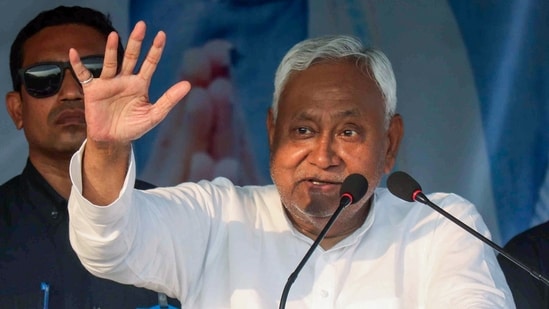
“Jeete chahe koi bhi, CM banke aayega toh Nitish hi (Whoever wins the election, Nitish will be the one who becomes the CM),” says Patna resident Jyotsana Singh, echoing a sentiment that has come to define Bihar’s politics for two decades.
The man who won't go away
Bihar is set to vote in two phases, on November 6 and 11, with the results to be announced on November 14. Once again, the poll fever revolves around one man -- the engineer-turned-politician who has been chief minister since 2005, through alliances, breakups, and reconciliations.
The NDA, under Nitish Kumar's leadership, is seeking a fresh mandate against the INDIA bloc led by RJD’s Tejashwi Yadav and the Congress.
Political observers say the NDA, with Nitish as its de facto face, holds a clear advantage -- not necessarily because of a wave, but because of the vacuum that exists without him.
{{/usCountry}}Political observers say the NDA, with Nitish as its de facto face, holds a clear advantage -- not necessarily because of a wave, but because of the vacuum that exists without him.
{{/usCountry}}In the words of a Patna-based journalist: “You can imagine Bihar without development, but not without Nitish Kumar in the conversation.”
Also read: Has the political narrative shifted in Bihar? A deep dive
For supporters, he is 'Sushasan Babu', the good-governance man who replaced 'Jungle Raj' with roads, classrooms, and safety. For critics, he is 'Paltu Kumar', the leader who has shifted between the BJP and RJD with astonishing regularity.
Nitish Kumar's flip-flops
Few politicians have rewritten their alliances as often as Nitish Kumar has.
Nitish first became chief minister in 2000 with the support of the BJP, then led by Atal Bihari Vajpayee and LK Advani. But in 2013, when the BJP named Narendra Modi its prime ministerial candidate, Nitish severed his 17-year-old alliance with the party, citing ideological differences.
He went on to ally with Lalu Prasad Yadav’s RJD and the Congress, forming the Mahagathbandhan that swept the 2015 assembly elections, propelling him back into the CM's chair.
Yet, in 2017, when corruption allegations surfaced against deputy CM Tejashwi Yadav, Nitish abruptly resigned -- only to return to power within hours with the BJP-led NDA.
The JD(U)-BJP alliance continued through the 2019 general elections, but by 2022, Nitish once again broke ranks, accusing the BJP of trying to “destroy his party from within.” He rejoined the opposition’s Mahagathbandhan with RJD and Congress, becoming CM for the eighth time.
Then, in January 2024, he swung back again -- rejoining the NDA and being sworn in for a record ninth term as Chief Minister.
Why Nitish Kumar still matters
Nitish Kumar’s legacy rests on three pillars: order, welfare, and continuity.
He is credited with pulling Bihar out of the lawlessness of the 1990s, restoring basic governance, and pushing targeted welfare programmes -- from 125 units of free power for households, to piped water in villages, to financial aid for women and a promise of one crore jobs in five years.
For millions of rural and women voters, he remains the one leader who “gets things done.”
A recent InkInsight Opinion Poll found 60.4% of women likely to vote for the Nitish-led NDA, compared to 28.4% for Tejashwi Yadav’s Mahagathbandhan.
“Nitishji doesn’t shout. He delivers quietly,” says Anjali Devi, a homemaker in Gaya. “Women feel safe and respected under him.”
The NDA equation: Stable but uneasy
The BJP, contesting 101 seats, has projected organisational discipline, while the JD(U) too has finalised its candidates for its 101 seats. Smaller allies like HAM and RLM have voiced discomfort over LJP’s 29-seat share, but the alliance overall appears far more settled than in 2020.
The BJP, which once flirted with undermining Nitish through Chirag Paswan's 2020 rebellion, now realises that weakening Nitish weakens the NDA itself.
Also read: Amit Shah's ‘four Diwali’ pitch, big praise for Nitish Kumar in poll-bound Bihar
Opposition's missed moment
Across the aisle, the RJD-led Mahagathbandhan appears to be floundering. Even as nominations close in days, the alliance has yet to finalise its seat-sharing formula.
Tejashwi Yadav’s campaign, which once carried the promise of youthful energy, now suffers from mixed messaging. Having twice allied with Nitish since 2015, the RJD has diluted its anti-incumbency pitch.
Meanwhile, Prashant Kishor’s Jan Suraaj Party has begun drawing the anti-establishment crowd that might otherwise have drifted towards the RJD.
“Tejashwi looks entitled, not inspiring,” says a political observer in Patna. “And Nitish, even when silent, benefits from that contrast.”
A quick SWOT analysis
With Bihar elections just days away, here is a SWOT (Strengths, Weaknesses, Opportunities, Threats) analysis of Nitish Kumar.
Strengths
- Longest-serving Chief Minister with deep administrative experience.
- Popular welfare schemes, including enhanced social security pensions, financial aid of ₹10,000 each to 75 lakh women, and infrastructure development projects.
- Organised BJP-JD(U) machinery with central backing.
- Seen as a symbol of stability in a volatile state.
Weaknesses
- Severe anti-incumbency after two decades in power.
- Declining autonomy within NDA.
- Perception of political opportunism after repeated alliance switches.
Opportunities
- Occupies centrist space in a polarised political environment.
- Retains credibility among moderate, non-ideological voters.
- BJP’s social limitations could make Nitish indispensable after the polls.
Threats
- Erosion of trust due to flip-flops between BJP and RJD.
- Generational challenge from Tejashwi Yadav.
- Fatigue among voters seeking fresh faces and faster jobs.
For Nitish Kumar, the 2025 Bihar assembly election is not just another contest -- it is a referendum on relevance. Will he be remembered as the man who modernised Bihar or the survivor who overstayed his welcome?