
 E-Paper



BJP, SP manifestos battle it out over farm, jobs, crime
The Bharatiya Janata Party (BJP) and the Samajwadi Party (SP) released their Uttar Pradesh poll manifestos on Tuesday, focusing on generating employment, improving farm incomes and bolstering law and order in the state where elections begin in two days

 Prefer HTon Google


The Bharatiya Janata Party (BJP) and the Samajwadi Party (SP) released their Uttar Pradesh poll manifestos on Tuesday, focusing on generating employment, improving farm incomes and bolstering law and order in the state where elections begin in two days.
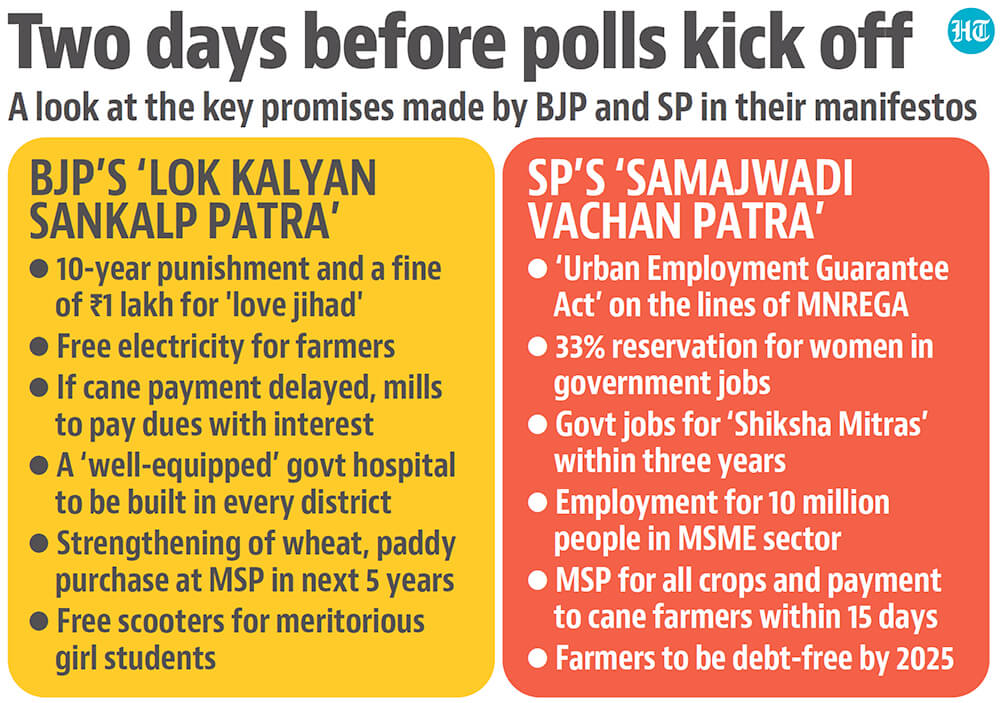
The BJP sankalp patra (commitment document) promised free power supply to farmers for irrigation, scooties for meritorious girl students, subsidised food canteens, two free cooking gas cylinders on Holi and Diwali, and a key “commitment” to ensure jobs or self-employment opportunity to one member of each family over the next five years if returned to power.
“We fulfilled 92% of the 212 commitments in our 2017 manifesto that I released here five years back and we again commit ourselves to fulfilling the ones we have made now,” said Union minister Amit Shah, who released the manifesto along with chief minister Yogi Adityanath, who he described as a successful CM.
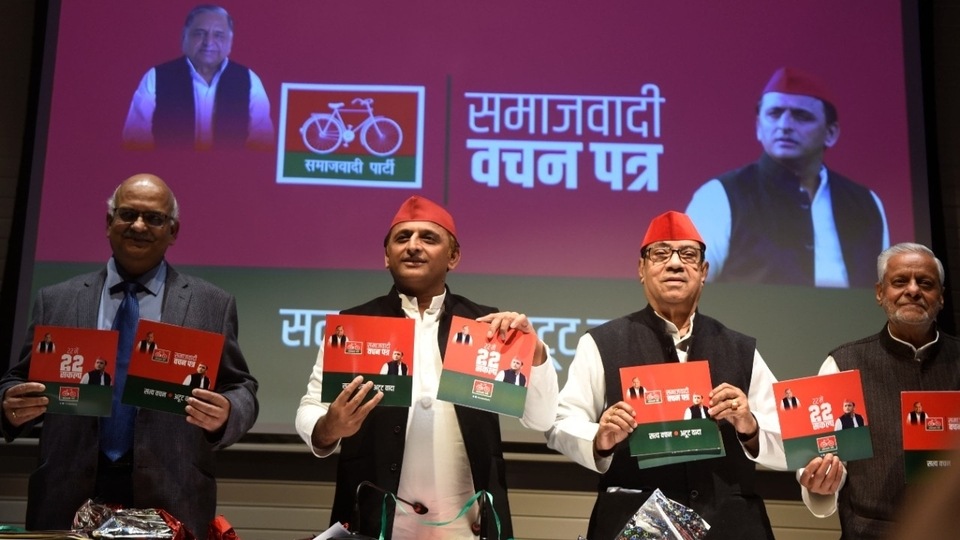
The SP’s Samajwadi Vachan Patra, which was released hours later, promised expanded procurement under the Minimum Support Price (MSP) regime, cheap loans and debt-free status (for farmers) by 2025, 33% reservation for women in government jobs, 2.2 million information technology jobs and an urban employment guarantee scheme on the lines of the Mahatma Gandhi National Rural Employment Guarantee Scheme.
“It is practical, feasible and doable. We did serious preparations on it in consultation with experts,” SP chief Akhilesh Yadav said. He also said farmers who died in the protests against three now-scrapped central laws will be given ₹25 lakh compensation and a memorial will be built to honour them.
The manifestoes come just two days before the first phase of the seven-phase polls kick off in Uttar Pradesh with 58 seats in the western part of the state, a region where farm distress and religious and caste identity are expected to shape the decision making of voters. The BJP is hoping to be the first party in almost two decades to retain power in India’s most populous and politically important state on the back of its continued ability to consolidate the Hindu vote (as it has been doing since 2014), the popularity of Prime Minister Narendra Modi, and the record of the state government headed by Yogi Adityanath on development and law and order.
The SP is hoping to ride on support from Other Backward Classes (OBCs) and Muslims, farmer angst and anti-incumbency to return to power.
The BJP’s manifesto also focused on law and order and promised to bolster its controversial law on forced conversions, promising 10 years in jail for offenders and a fine of ₹1 lakh for those engaged in love jihad, a term used by right-wing groups to describe relationships between Muslim men and Hindu women. Many of the commitments in the manifesto were named after icons and personalities from Other Backward Classes (OBC) communities, a key group that was crucial to the party’s victory in the 2014 and 2019 general elections, and the 2017 assembly polls.
On agriculture, the party promised to ensure payment to sugarcane farmers within 14 days of coming to power, focusing on organic farming in each village, ensuring maximum purchase on MSP of wheat and paddy. In 2017, a farm loan waiver was a key pre-poll promise of the BJP.
In west UP’s Deoband, Meerut and Rampur as well as in Kanpur in central UP, besides Azamgarh, and Bahraich in east UP – all with a substantial presence of the Muslim community — the BJP said it will set up anti-terrorist commando centres.
The party promised 300 units of free power, free smartphones or tablets, cooking gas cylinders for women, and CCTVs at all major points. “We have created more than three crore employment or self-employment opportunities and, over the next five years, we would either ensure jobs to at least one member of each family or provide self-employment opportunities,” Shah said.
The party also promised to create one million employment opportunities through youth start- up missions and free coaching for competitive examinations to all young people.
The SP’s 88-page-document promised MSP for all crops, a free fertilizers quota to poor farmers, one-litre petrol free per month to motorbike owners, two free LPG cylinders to below-poverty-line (BPL) families each year and zero tolerance for organised or hate crimes against women, minorities and Dalits.
Yadav said that in four years, all farmers will be made debt free. “Farmers take loans, get trapped, then often loans are waived, then they take loans and this unending cycle continues. The policy will end this unending trap”, Yadav said.
“MSP for all crops will be given and sugarcane farmers will get payments in 15 days. All farmers will get free power for irrigation, interest-free loan, insurance, and pension arrangements will be made,” he added. Yadav said the ‘Samajwadi Pension’ will be relaunched and elderly people, needy women and BPL families will get ₹18,000 every year.
Irshad Ilmi, a political observer, said, “Manifestos offer a peek into the mind of the parties and naturally, the two key players timing their release within hours of each other indicates that none wants to be left out in connecting with the voters. The terms they have used to describe their manifestos - sankalp patra by BJP, vachan patra by SP, - indicates that the power battle is as much on the ground as to capture the mind space.”


