E-Paper



‘Bimaru no more’: Amit Shah lauds Madhya Pradesh’s governance
To be sure, in the states where it is in power, the BJP traditionally considers its incumbent CM the front-runner for the post if it retains power.

 Prefer HTon Google


Union home minister Amit Shah on Sunday said that the Bharatiya Janata Party (BJP) government’s development work helped pull Madhya Pradesh out of the “Bimaru” states list, which was a “legacy” of the Congress regime.
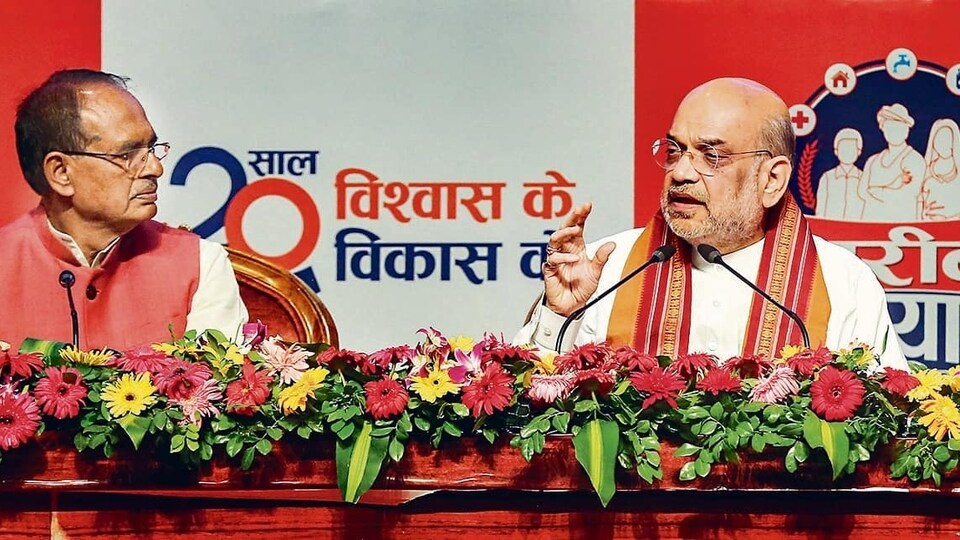
Speaking at a press conference in Bhopal to release the MP government’s 20-year report card, the senior BJP leader also hinted that the chief ministerial face for the upcoming state polls was still undecided.
Read here: Amit Shah releases 'report card' of BJP-led MP govt: ‘Removed BIMARU tag from state’
“Shivraj ji is the chief minister. Why should you do the job of the party [of deciding the CM face]? It’s our job and we will decide,” Shah told reporters when asked if Chouhan would return as CM if the party retains power.
“At present Shivraj ji is the CM and we are in elections,” he added.
The state is set to go to the polls in November.
To be sure, in the states where it is in power, the BJP traditionally considers its incumbent CM the front-runner for the post if it retains power.
At the press conference, Shah said the BJP that the state on “the path of development”.
“Madhya Pradesh came into existence in 1956 and since then, except for five or six years, the Congress ruled the state till 2003. But the state remained Bimaru during their regime. However, the BJP government has successfully brought the state out of the Bimaru tag and put it on the path of development by implementing various welfare schemes,” Shah said.
The Bimaru acronym has often been used to refer to Bihar, Madhya Pradesh, Rajasthan and Uttar Pradesh and imply that these states lagged in terms of economic growth, health care, education, and other developmental indices.
In 2003, voters in the state decided to remove “Mr Bantadhar’s” government, Shah said in an apparent reference to Congress leader and former chief minister Digvijaya Singh.
“The people of Madhya Pradesh took a historic decision of removing Mr Bantadhar’s government in 2003. The Bharatiya Janata Party government was formed under the leadership of Uma Bharti. After this, under the leadership of Uma ji, Babulal ji and Shivraj Singh ji, Madhya Pradesh was freed from the term Bimaru,” he said.
The Congress under the leadership of former chief minister Digvijaya Singh ruled the state from 1993 to 2003, when the BJP won the election ending the Congress’s rule of 10 years.
“The Congress which made the state Bimaru in its nearly 53 years of rule is now claiming to make it a developed one. If the Congress has courage, then it should come out with its report card of 50 years of ruling the state.” Shah said.
“We have started a new tradition of giving accountability in the country wherever we are in power,” the senior BJP leader said, releasing a 32-page booklet comparing the 20 years of BJP government and the previous Congress rule in the state.
In 2002, the total size of the state budget was ₹23,100 crore which increased to ₹3.14 lakh crore in 20 years, the second largest for a state in the country, Shah said.
“The budget distribution of SC/ST and OBC was just ₹1,056 crore but we took it up to ₹64,390 crore. The education budget of MP has increased from ₹2,456 crore to ₹38,000 crore. The health budget was ₹580 crore and today it is ₹16,000 crore,” he said.
He also compared the devolution of funds under the UPA (2004-14) and the NDA (2014-2023) governments at the Centre.
“In 2004 to 14, when the Sonia-Manmohan government was in power, Madhya Pradesh was given only ₹1.58 lakh crore in 10 years. After 2014, [Prime Minister Narendra] Modi’s government gave ₹8.33 lakh crore rupees to Madhya Pradesh in nine years,” he said.
The Union minister expressed confidence that his party will win all the seats in the state in the 2024 Lok Sabha elections as well.
“In 2014, people of the state gave 27 out of 29 seats to the BJP. In 2019, they gave 28 out of 29. I firmly believe that in the 2024 Lok Sabha polls, the people of the state will give this remaining one seat also to the BJP,” Shah said.
In the last general elections, the Congress’s Nakul Nath — party leader Kamal Nath’s son — won the won the Chhindwara Lok Sabha seat, the lone victory for the party in the state.
The Congress won more seats than the BJP in the 2018 assembly elections because of caste politics in Gujarat, MP and Rajasthan, Shah said.
“The 2018 elections were held under the shadow of poison mixed with casteism. Despite of it, we got 100,000 more votes than Congress. The state then saw 15 months’ rule of the Congress,” he said, adding that the party will return to power in the state with a huge majority. We are going to form the government in MP with a huge majority,” said Shah.
Kamal Nath resigned as the chief minister of the state in March 2020, after 15 months in power, following rebellion by 16 Congress MLAs.
“On social media, Kamal Nath’s government was also called ‘Corruption Nath’ government,” Shah said.
Read here: ‘Your Chacha has come, don’t trust Mama': Kejriwal jabs Shivraj Chouhan in poll-bound MP
He also hit out at other opposition parties that indulge in “dynasty politics”.
“That is not a case with BJP. Sometimes, a few family members get tickets based on merit. This not dynasty politics,” he said, targeting Samajwadi Party, Shiv Sena (UBT) and DMK.
The BJP will contest the elections in MP only the development plank, Shah said.
“We emerged as biggest party of India in just 30 years because of development and working for welfare of poor. We were nothing in 1950. From 1995, we won twice in Manipur, Assam, Uttar Pradesh. BJP has the best record of victory from Panchayat to Parliament election,” he said.