
 E-Paper



Bus services become agent of hope and progress in Maoist stronghold
A new bus service connects Pamed and Bijapur, easing travel for 50 villages in Maoist-affected Bastar, transforming lives and boosting local economy.

 Prefer HTon Google


For decades, the dense forests of Pamed held stories of isolation, fear and insurgency close.
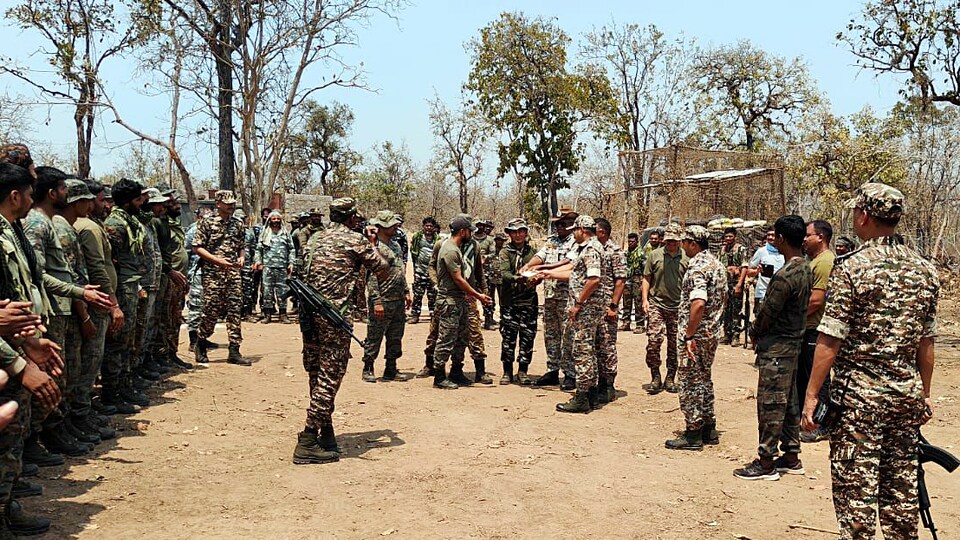
Informally known as the capital of the Maoists, this remote region of 10,000 people in Bastar’s Bijapur district was cut off from the rest of the world, the isolation styming efforts by the government to push back the rebels and win over villagers.
Residents – who largely hailed from the tribal community - were forced to undertake arduous journeys for basic necessities to Bijapur either on foot, bicycles or sometimes by tractors. From Pamed, the duration of a journey would vary between six and eight hours.
But on Republic Day this year, the first-ever bus service between Pamed and Bijapur roared to life, connecting nearly 50 villages and transforming the life of the ordinary villager. In nearly three months, the service – run by a local transporter – has served at least 15,000 people, their mobility yet another testament of the tremendous change in the region in the face of the government’s fierce onslaught against the Maoists.
“This is the best thing the government has done till now,” said Dukka Kunjam, 50, a resident of Pamed.He took the bus to reach Bijapur, where he was meeting a revenue official.
Despite the gains made by government forces, close to a thousandsecurity personnel every day line the 110km road fromBijapur to Pamed. The road itself was laid in2017. A second service from Jagdalpur to Pamed also opened on January 26.
The bus services represent yet another milestone in the government’s campaign against Maoists. Forces have killed at least 131 Maoists this year and 219 last year, far higher than 22 in 2023 and 30 in 2022. Security forces have also arrested 104 rebels in different parts of the country so far in 2025, and another 164 have surrendered, according to a home ministry statement earlier this month.
Looming behind these recent successes is the stated aim of the government – of wiping out left-wing extremism in India by March 31, 2026. With a year to go for the deadline, HT’s new series takes a critical and expansive look at the government’s push, the ripples in the state, Maoism, and the response of locals.
A symbol of progress
The bus, a rugged, locally-operated vehicle, navigates on dusty forest road deep in South Bastar’s Bijapur region. The front of the bus bears the name “BABA” in bold white letters. The route board of the bus indicates its journey from Bijapur to Awapalli, both situated in the remote, forested interiors of Bastar region.
Its body is in shades of blue and white, though the colours have faded. On top, bundles wrapped in yellow cloth are tied down —which are goods, clothes, or belongings of passengers — typical for buses serving interior tribal belts .
Shaukat Khan, who is the owner of both the buses and the conductor of the one which runs between Pamed and Bijapur, is a busy man. The service has to leave from its starting point at 2pm and the line of passengers is only growing.
“No one dared to run the bus in this area but the collector and other officers said that I have to do it and I accepted the challenge.”
Tickets are priced between ₹10 and 100.
The distance between Pamed and Bijapur is 104 km, out of which 45 km – Pamed to Tarrem – is a severely Maoist affected area that has to be covered strictly between 2pm and 4pmtime.
“People from around 50 villages from Cherela (Telangana ) to Tarrem ( Bijapur) are now taking benefits of this bus,” said Khan.
HT took a ride on the bus for 30km.
Officials say that the bus symbolises the progress that the government has made in this region. “Launching this bus service was no easy feat. Security concerns due to the Maoist presence, lack of proper road infrastructure, and the region’s challenging terrain posed significant hurdles. For over two decades, these villages remained in isolation, making road construction a daunting task,” said Bijapur collector Sambit Mishra.
The breakthrough moment was the establishment of eight new security camps over the past year along the route, he said. “Additionally, the completion of critical infrastructure, including the 264-meter bridge over the Chintavagu River near Dharmavaram, played a crucial role in making this dream a reality,” said collector.
Jitendra Yadav, the Bijapur superintendent of police, underlined the importance of the security arrangement. “We used to make the area secure and make sure that Maoists will not affect the bus service in any way. We also make sure that Maoist do not issue threats to villagers for traveling in the bus,” he said.
Bridging the gap
As of now, two private buses operate on this route—one goes from Bijapur at8am and reaches Pamed at 4pm, before returning to Bijapur at 2pm the next day. The other goes from Pamed at 2pm to Jagdalpur at 7pm, and back at 8am the next day .
The stretch from Bijapur to Tarrem is already a bituminous road, while the Tarrem-Pamed segment is being constructed by the Border Roads Organisation (BRO) in two phases -- Tarrem to Kondapalli and Kondapalli to Dharmavaram-Pamed. With critical bridges and culverts under construction, this segment is expected to be completed within two months, before the onset of monsoon.
“Regular patrols along the route and security camps at strategic locations. We focus on continuous intelligence coordination to preempt threats and minimise direct interaction of passengers and bus staff with security forces to prevent targeting by Maoists,” said a security personnel, requesting anonymity.
In the villages, the bus services are wildly popular. “Previously, people had no option but to take long and expensive detours via Telangana to reach district headquarters of Bijapur. Now, the route offers direct, affordable, and safe connectivity,” said Mishra.
Ayatu Madiyaam, a resident of Kottachur village, said that he used to travel for a day to reach Bijapur. “Now, It takes three hours to reach Bijapur and the fare is only ₹100.”
-kW0H-U20214218012MgB-250x250%40HT-Web.jpg)


