E-Paper



Centre can’t pull ₹8 lakh limit for EWS quota out of thin air: Supreme Court
A bench of justices Dhananjaya Y Chandrachud and BV Nagarathna took a grim view of the government’s inability to explain the methodology adopted in fixing the income criteria for EWS, as it examined a clutch of petitions that have challenged the 10% quota for EWS within all-India quota (AIQ) seats in medical admissions from the current academic year, 2021-22

 Prefer HTon Google


Suggesting the Union government should do a “high-level policy rethink,” the Supreme Court on Thursday observed that the Centre cannot “pull” the ₹8 lakh annual income limit to identify economically weaker section (EWS) for providing 10% quota in public jobs and educational institutions “out of thin air” and questioned if the attempt was to “make unequals as equals”.
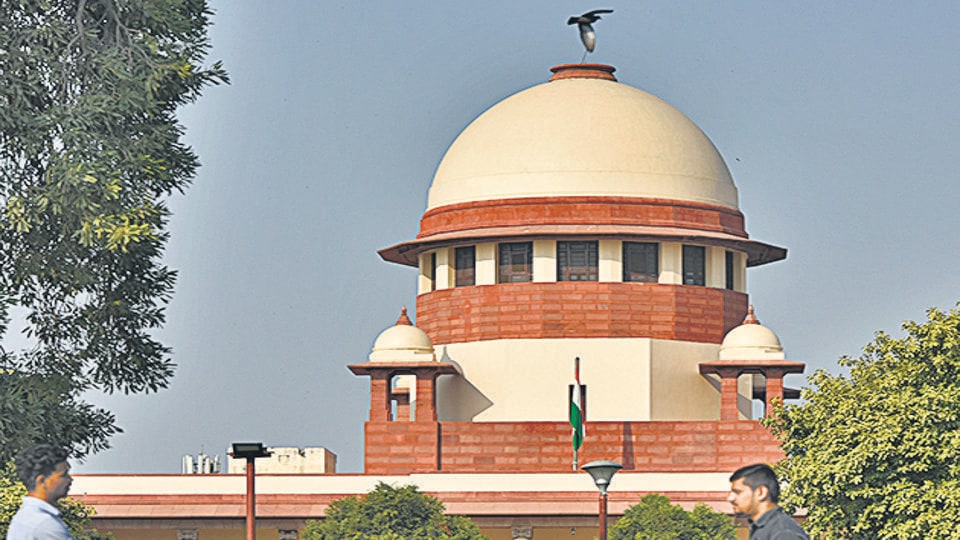
A bench of justices Dhananjaya Y Chandrachud and BV Nagarathna took a grim view of the government’s inability to explain the methodology adopted in fixing the income criteria for EWS, as it examined a clutch of petitions that have challenged the 10% quota for EWS within all-India quota (AIQ) seats in medical admissions from the current academic year, 2021-22.
“You must have some demographic or sociological or socioeconomic data. What is the exercise that you have done? Please, tell us that. You cannot just pull out ₹8 lakh out of thin air,” the bench told additional solicitor general(ASG) KM Nataraj, who was appearing for the Centre in the case.
Demanding a categorical affidavit from the Centre within a week to explain the basis of fixing the ₹8 lakh ceiling for EWS, the court also questioned how the 50% ceiling on reservation, as laid down by the Supreme Court in the Indra Sawhney judgment of 1992, could be breached by providing for 10% reservation for EWS through an executive order when quota for scheduled castes (SC), schedules tribes (ST) and other backward classes (OBC) already constitute 49%.
The 10% EWS quota was introduced under the 103rd Constitution (Amendment) Act, 2019 which is under challenge before a five-judge Constitution bench of the Supreme Court.
Since the Act has not been stayed by court, the government issued a notification on July 29 introducing 10% EWS quota along with 27% quota for OBC within AIQ seats for postgraduate medical courses from this academic year. By this decision, 2,500 PG seats in government medical colleges would go to OBCs and 1,000 to those from EWS.
This decision was challenged in a clutch of petitions that came up for hearing on Thursday. The income criterion of ₹8 lakh fixed by the Centre was one of the grounds taken by the petitioners to question the July 29 decision.
Meanwhile, the ASG sought to argue that the income criteria was based on recommendations of the 2010 Sinho Commission report, and some other inputs, which were in the nature of “policy matters” and hence exclusively in the domain of the government. The three-member commission, headed by Major Gen S R Sinho (retired), was instituted by the United Progressive Alliance (UPA) government, and submitted its report in July 2010.
But the bench was unimpressed with the law officer’s tacit appeal to it to not interfere.
“There has to be some exercise done before fixing this criterion. The only thing you argue is that it is for parity with OBC. But that will have a serious constitutional hurdle for you. You are making unequals as equals by applying ₹8 lakh limit. We gave you two weeks on the last date to file your affidavit and you should have done that in a matter as serious as this,” it told Nataraj.
Clarifying the apex court will not stay away, the bench added: “You may say that these are issues of policy but we will have to interfere for adhering to the constitutional principles. You will have to set your house in order.”
The court pointed out that unlike OBCs, EWS are not considered as socially and educationally backward under the constitutional scheme. “The creamy layer of OBC category is identified by the ones who have become advanced and have an annual income of more than ₹8 lakh. On the other hand, you fix the same income criteria of ₹8 lakh to include the beneficiaries under EWS category. So, you use the same criteria to exclude one segment of the OBC and include EWS. Is that justified? Have you taken factors like rural and urban areas into account? Or the residential flat category or exclusion of asset?” it asked the ASG.
The bench then proceeded to frame specific issues that needs to be answered by the government in the affidavit to be filed before October 28 – the next date of hearing.
The first two questions asked whether the Union government undertook any exercise before arriving at the income criteria to determine EWS and if so, whether the Sinho Commission report was the basis of this fixation.
“The income limit for determining creamy layer in OBC and EWS is same at ₹8 lakh. In the OBC, those economically progressed is excluded so that social backwardness diminishes. In EWS, it is done to include the segments. Therefore, the income criterion in OBC, which is based on exclusion, is based on inclusion for EWS. In such a scenario, will it be arbitrary to provide similar income limit for EWS and OBC,” asked the court.
It further sought a response from the Centre whether difference in rural and urban purchasing power has been accounted for while deriving the income limit of ₹8 lakh, and the reasons why assets are excluded in arriving at the annual income for EWS.
“It would be necessary for the Centre to disclose before the court the nature of exercise undertaken in accordance with Article 15 (power of the State to make special provisions for identified classes). We make it clear that we are not entering area of policy but need the disclosure for adhering to constitutional principles,” recorded the bench in its order.
It also told Nataraj that one of main contentions by the petitioners is that there is already 49% reservation combining SC/ST and OBC but by an executive order, the 50% ceiling on reservation has been breached to include 10% EWS. “If you want to do a high-level policy rethink, then do that,” the bench told the ASG.
Representing the petitioners, senior advocate Arvind Datar and Shyam Divan have argued in the case that the per capita income in states differs widely and therefore, determining EWS at the all-India level requires careful study by an expert committee, so that the ends of social justice are attained. For this year, the lawyers have pleaded, EWS reservation should not be given effect in the absence of any criteria explaining the reservation.
The petitions have also referred to a government order of January 17, 2019 which said income from all sources will be counted for EWS reservation. However, in August 2021, another government communication referred to the Sinho Commission that formed the basis for providing EWS reservation by fixing ₹8 lakh as the income limit.