
 E-Paper



Change in wind pattern covers Delhi in a thick blanket of smoke
Unfavourable weather conditions involving a sudden change in wind pattern contributed to a deterioration in Delhi’s air quality on Wednesday, India Meteorological Department (IMD) scientists said, with residents waking up to a thick blanket of smoke hanging over the Capital.

 Prefer HTon Google


Unfavourable weather conditions involving a sudden change in wind pattern contributed to a deterioration in Delhi’s air quality on Wednesday, India Meteorological Department (IMD) scientists said, with residents waking up to a thick blanket of smoke hanging over the Capital.
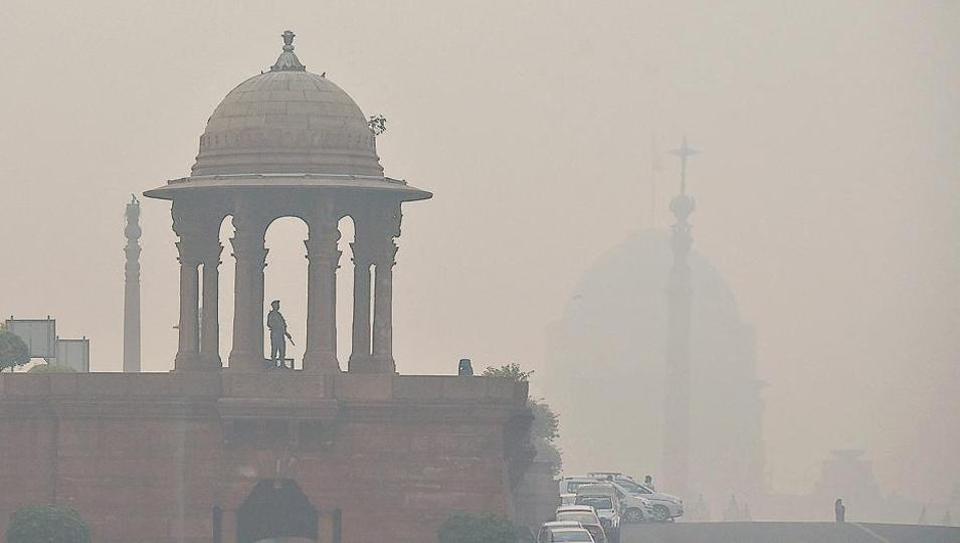
Though the air quality index (AQI) settled in the “very poor” category, like on Tuesday, the 24-hour average AQI rose to 343 on Wednesday as against the previous day’s 302, according to Central Pollution Control Board (CPCB) data.
Scientists warned that things could take a turn for the worse from Thursday.
An AQI reading of 301 to 400 is in the “very poor” category and is associated with respiratory illnesses, especially in children and those exposed to the bad air. An AQI of 400-500 is considered “severe”.
Scientists blamed Wednesday’s rise in pollution levels on a “sudden change in the wind pattern” that led to a phenomenon called “subsidence”, which is downward movement of air over a large area as it cools and becomes denser.

Due to anti-cyclonic activities (simply put, a change in wind pattern), there was “subsidence” over the national capital on Wednesday, VK Soni, head of IMD’s environment monitoring research centre, said.
This led to the smoke being carried from the neighbouring states of Punjab and Haryana to descend over Delhi (due to the downward movement of air) and settle closer to ground, he explained.
“This was an unexpected scenario. The haze that we saw in Delhi on Wednesday was primarily smoke from stubble burning activities in Punjab and Haryana. After 10 am, the air quality started deteriorating at a faster rate,” Soni said.
This was evident from the spike in particulate matter levels. The Delhi Pollution Control Committee (DPCC)’s hourly average PM2.5 (ultrafine particulate matter with a diameter less than 2.5 micrometres) recordings showed that the levels increased from 144.4ug/m3 at 7am to 183.6ug/m3 at 2pm, and continued to deteriorate during the evening.
Similarly, PM10 levels (particulate matter with a diameter less than 10 micrometers) spiked from 315.8ug/m3 at 7am to 373.2ug/m3 at 2pm.
In India, the acceptable levels of PM 2.5 are 60ug/m3 and PM 10 is 100ug/m3.
The wind speed over Delhi was also low --- between 5-8kmph --- and it was not strong enough to blow away the pollutants accumulated closer to the ground, according to IMD.
On Tuesday, 1,949 farm fires were spotted in Punjab and Haryana, according to System of Air Quality and Weather Forecasting and Research (Safar) of the Union ministry of earth sciences. And their contribution in Delhi’s PM2.5 pollution till 10am on Wednesday was 5%. However, this contribution is feared to have spiked during the day.
Safar said things could get worse from Thursday. “Wind will remain calm through Wednesday night and it is likely that the AQI will be pushed into the end of the ‘very poor’ zone. Some areas could also slip into the ‘severe’ category,” its forecast read.


