E-Paper



Chaos shrouds the hills amid influx of tourists
Visuals from tourist destinations point out violations of Covid-appropriate behaviour, with people not wearing masks or ensuring social distancing.


Thousands of tourist vehicles have been turned away from hill stations close to Delhi over the last few days for not meeting travel document requirements linked to Covid-19, with traffic snarls being reported in popular destinations because of a heavy rush of visitors amid a heatwave in the northern plains and a significant decline in infections, officials said on Sunday.
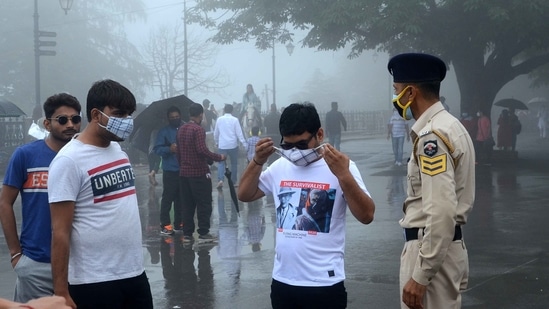
The Union health ministry said last week that a spurt in travel after lifting of Covid-19 restrictions — the government termed it “revenge travel” — led to “frightening” scenes of overcrowding in hill stations that could lead to increased outbreaks of the infectious disease. Visuals from tourist destinations point out violations of Covid-appropriate behaviour, with people not wearing masks or ensuring social distancing.
Heavy traffic jams have been reported on highways in Uttarakhand and Himachal Pradesh over the last few days. Records of the Uttarakhand Police show that close to 4,000 vehicles were denied entry to hill stations, an official said, asking not to be named. The official said those who did not have negative Covid-19 test reports and advance booking confirmation for hotels were being turned away as per “well-publicised” protocol for visitors.
“We are stopping tourists who do not have a negative test report, online hotel booking confirmation and registration on smart city portal,” Mussoorie Police station incharge Rajeev Rauthan said. About 3,900 tourist vehicles were not allowed into Mussoorie and nearby areas, and 550 were stopped in Nainital, according to official records reviewed by HT.
Visuals showed tourists being stuck in traffic as a long queue of vehicles choked a key road in Mussoorie on Saturday. Similar snarls were reported on Sunday.
Ramesh Talwar, a resident of Green Park Extension in New Delhi, said: “My family has been stuck in our apartment for the past one year... When we have reached the outskirts of the town, the police didn’t let us enter the town... We had made a booking in a hotel.” However, the police said Talwar did not possess a negative Covid-19 report, an urgent requirement to allow travel.
While Uttar Pradesh resident Pankaj Rathore said he was turned away because he had a negative rapid antigen test report (RAT) and not one conducted with the RT-PCR method, official documents detailing the guidelines said RAT reports were permitted for travel.
As the tourist influx increased in Uttarakhand, chief minister Pushkar Singh Dhami on Friday said the state government issued an order to allow only 50% occupancy at hotels in Nainital and Dehradun.
Many hoteliers and travel companies in hill stations say this is a make-or-break summer for them as their revenues have taken a hit since March last year, the first time travel restrictions came into effect to control the spiralling spread of Covid-19. Health experts warn that non-compliance of Covid-appropriate behaviour at this juncture could result in a dangerous third wave of infections. The second wave, which has peaked but is still lingering, overwhelmed the health care infrastructure across the country, prompting many states to clamp lockdowns.
Ashok Kumar, director general of police (DGP), Uttarakhand, said the restrictions have been put in place to ensure that the Covid-19 precautions are strictly implemented. “Some tourists faced some inconvenience after being turned back but it is necessary to ensure the health safety of people...”
Dinesh Chandra Sah, president the Nainital Hotel and Restaurant Association, said with police returning tourists, many are calling to find out if they will be allowed to enter Nainital. “Many have also cancelled hotel bookings but there are also many who couldn’t come as they were stopped,” he said.
In Himachal Pradesh, the growing rush of tourists, particularly during the weekends, has pushed the state government to deploy additional police personnel in hill stations. “More than 1.3 million tourists have visited Himachal Pradesh since May. Of them, about 600,000 came to the state since June-end, when Covid-19 restrictions were eased,” said state tourism director Amit Kashyap. Close to 10,000 vehicles crossed the Parwanoo border on Saturday, he said.
“Hotel occupancy in Himachal Pradesh, which was almost nil when the pandemic was raging, has now gone up to about 80%,” he added. The state government has not imposed any limit on hotel bookings in the state and, but it has not made negative Covid-19 test reports mandatory for visitors.
Ajit Kumar, a resident of Shimla, said: “It’s true that our economy is dependent on tourists but they should follow Covid protocol...”
Images on social media of tourist frenzy at Atal Tunnel in Manali, at Kempty Falls in Mussoorie and several other tourist locations in the hills have led to concerns among health experts and officials over a possible rise in cases of Covid-19 again.