E-Paper



Two Chinese survivors rescued days after cargo ship sinks near Odisha
The China-bound ship carrying iron ore had lost contact about 200 nautical miles off the coast on August 20.

 Prefer HTon Google


Two Chinese nationals rescued from the cargo ship MV Ocean Winner, which sank in the Bay of Bengal on August 21, were brought safely ashore at Paradip port in Odisha on Thursday, as the Indian Coast Guard (ICG) continued sea and air searches for 22 crew members still missing nearly a week after the vessel sank.
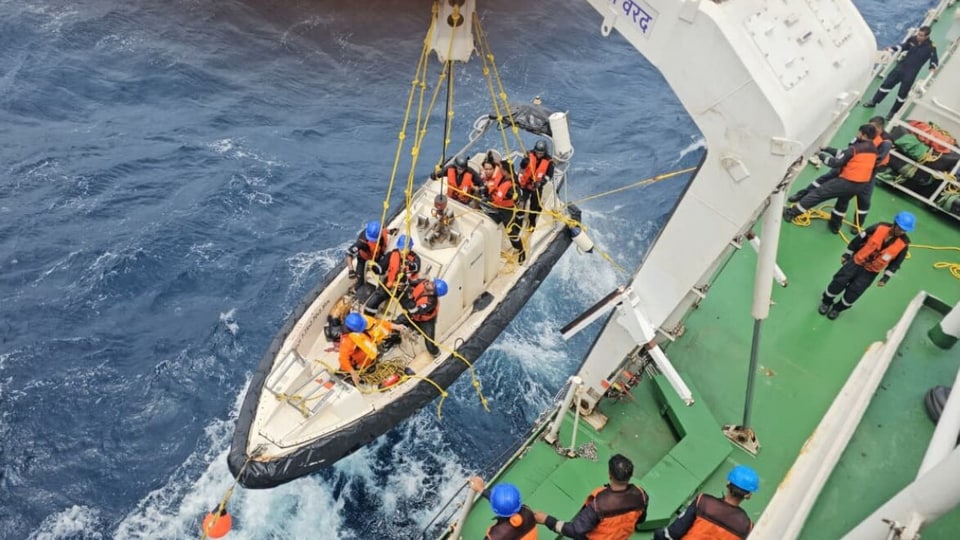
Indian Coast Guard Ship Varad brought Pan Tonglai and Chen Jianhe to Paradip after they were rescued from a liferaft on August 22, said Coast Guard chief PRO Commandant Amit Uniyal.
“Both received medical care aboard the vessel during the transit and were handed over to the ship’s loading agent in Pradip in the presence of immigration and local police officials. The agent will contact the Chinese embassy for return of the two nationals back to their country,” he said.
The 1998-built bulk carrier, carrying about 71,200 metric tonnes of iron ore fines from Paradip port in Odisha to China, sank around 290 nautical miles off Paradip in the deep waters of the Bay of Bengal on August 21. The vessel was carrying 24 crew members, including20 Chinese nationals, one Bangladeshi and three Myanmar nationals, according to preliminary information.
On Tuesday, Coast Guard ships recovered a lifeboat, but it was found to be empty.
Officials said that, owing to language issues, not much could be ascertained from the two Chinese nationals.
The search operation, coordinated by the ICG along with the Maritime Rescue Coordination Centre Beijing, has intensified.
Experts suggest that the vessel’s rapid capsize was consistent with bulk cargo liquefaction, one of shipping’s deadliest hazards.
The maritime industry publication The Maritime Executive said the speed of the sinking, the early development of a list, and the cargo type pointed to liquefaction of iron ore fines. When saturated with water, iron ore fines can shift suddenly inside cargo holds during rolling, causing a vessel to lose stability and capsize rapidly.
The publication noted that at least 29 seafarers died in iron ore cargo liquefaction incidents worldwide between 2007 and 2019.
Paradip Port Authority officials said Odisha has experienced 29% excess monsoon rainfall this season, with heavy rain lashing the coast through July and August.