
 E-Paper



Class divergence in sentiment may be one of Indian economy’s biggest problems
The headline unemployment rate in the March 2021 quarter was 9.4%. This is the lowest since the quarter ending June 2020, which coincided with the 68-day long nation-wide lockdown which was imposed on March 25, 2020.

 Prefer HTon Google


The Indian economy is showing an unprecedented divergence between consumer and business expectations about the future. While consumer confidence continues to be very low, business confidence seems to be at an all-time high. And that may well be problematic.

The results of two forward-looking surveys released by the Reserve Bank of India (RBI) on February 10 -- the Industrial Outlook Survey (IOS) and the Consumer Confidence Survey (CCS) – show this clearly. The CCS asks respondents – it covers 13 major cities in India – about their perception on the current situation and the situation a year ahead from now. The IOS asks manufacturing sector firms about their current perception and expectations for the next quarter.
Because the CCS Future Expectation Index (FEI) is only available from March 2015 onwards, the comparison can be made for a relatively short time period. The Business Expectation Index (BEI), however, is available from the quarter ending June 2000, and the latest readings (December 2021 and March 2022) are the highest ever. FEI, on the other hand, is at its third lowest value. The worst and second worst values came during the rounds which preceded the first lockdown (May 2020), and the second wave of Covid-19 (May 2021).
Whether the Indian economy will attain a sustained recovery or not in the future is a function of, among other factors, such expectations. After all, consumers can increase (decrease) their present consumption if they believe that their future incomes will grow at a faster (slower) rate. Investment decisions by firms are not just a function of availability of resources but also shaped by future expectations of demand. These expectations are also influenced by present experiences.
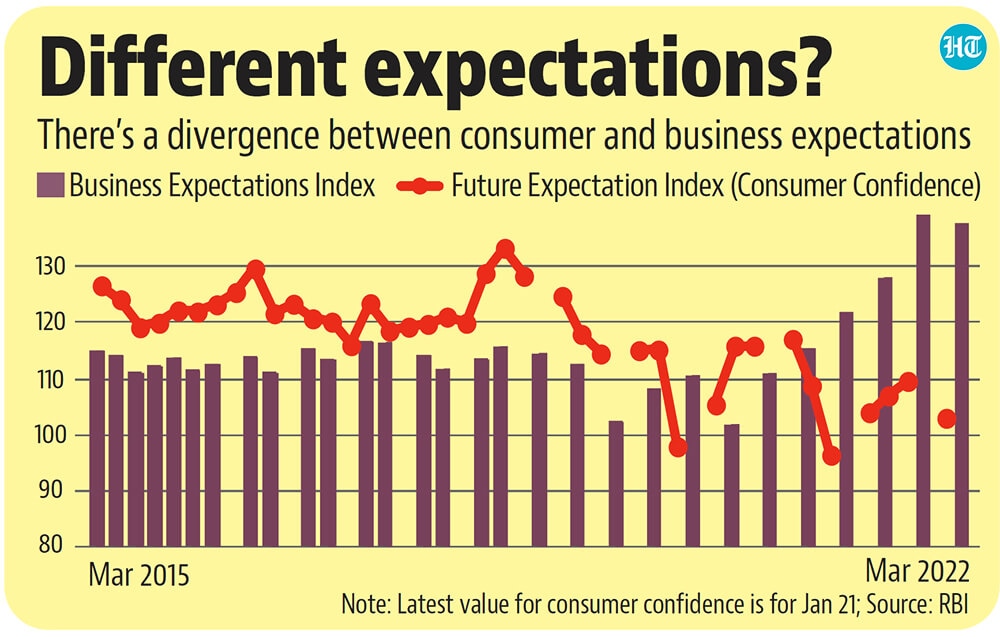
What is the significance of this stark divergence in consumer and business sentiment? It will not be incorrect to describe this as a fundamental rupture in inter-class perception about economic prospects.
Its significance can be best understood by applying the classical savings assumption in heterodox economics. The classical savings assumption, for the sake of simplicity, assumes that there are only two kinds of income in the economy: wages for workers, and profits for capitalists. It further assumes that workers consume all their wages and capitalists (business owners) invest all their profits. It follows that current profits could receive a temporary boost if the share of wages falls, but it also follows that in the long-term this will eat into purchasing power of workers and therefore squeeze profits via a fall in demand. Sure, the classical savings assumption does not hold in reality, but it is a fact that workers consume a much greater share of their incomes than capitalists.
Recent statistics about the Indian economy corroborate this line of reasoning. While overall GDP is expected to come back to pre-pandemic levels in 2021-22, Private Final Consumption Expenditure (PFCE) will continue to lag 2019-20 levels. Corporate profits have seen a sharp revival during in the post-pandemic period while labour market continues to show weakness, a fact reflected in data showing the continued high demand under MGNREGS, prevalence of high unemployment rates, and a worsening of quality of employment as HT analysed on December 1, 2021.
The share of salaried jobs saw the worst fall in the March quarter since June 2018.
The headline unemployment rate in the March 2021 quarter was 9.4%. This is the lowest since the quarter ending June 2020, which coincided with the 68-day long nation-wide lockdown which was imposed on March 25, 2020.
What is the likely outcome of such a situation?
The government hopes that its public capex push will create incentives for the private sector to invest, which in turn will create a virtuous circle of income growth. But while highways and logistical facilities help factories in moving their raw materials and finished goods easily and efficiently, they do not guarantee that they will find buyers. The problem facing the Indian economy at the moment is of demand, where consumers are unwilling to spend money in the future.
Another set of indicators from RBI’s CCS and IOS underlines this point again. The share of factory owners who think their current production capacity is more than adequate to take care of future demand has been rising but the share of consumers who think their non-essential spending will increase in the next year continues to be in negative territory. Unless this changes, businesses might not invest. If that does not happen, future incomes will continue to remain low.
Of course, there will be some multiplier impact of the government capex through earnings of construction sector workers and demand for infrastructure goods such as cement and steel – but that alone cannot be expected to rekindle animal spirits in the Indian economy.


