
 E-Paper



Congress repeated a costly mistake on national security in run-up to 2019 polls | Opinion
While the Modi government and the Bharatiya Janata Party (BJP) leadership did not utter a word against the Indian armed and security forces in the run-up to the campaign, the Congress ended up coming across as questioning the army and the chiefs of staff.

 Prefer HTon Google


One of the key political lessons from the 2019 general election is that parties should neither question military operations nor soft-peddle on national security. The Congress appears to have committed the same mistake in the run-up to 2019 polls that it committed 20 years ago.
Before the October 1999 elections, the then Congress leadership questioned the caretaker Atal Bihari Vajpayee government on alleged intelligence and political failures leading to the Kargil war with Pakistan. The narrative built by the Congress was perceived by the Indian public to be close to the version being propagated by then Prime Minister Nawaz Sharif and his then army chief Pervez Musharraf, who finally became Pakistan’s president by deposing the former in a military coup.
Even though the Kargil Review Committee headed by K Subrahmanyam pointed out lapses that led to the war at glaciated heights north of Zoji La pass, public sympathy stayed with the Indian jawans who sacrificed their lives to evict Pakistani intruders from the Batalik, Kaksar, Drass and Mushkoh sectors. The Congress leadership, by painting Kargil as a fiasco or a blunder, was seen as propagating the false narrative spread by Islamabad. The result was that the Atal Bihari Vajpayee-led National Democratic Alliance came to power despite the popular vote being in favour of the Congress-led alliance by a small margin.
Also read: In its zero hour, RJD leaders talk of cutting ties with Congress
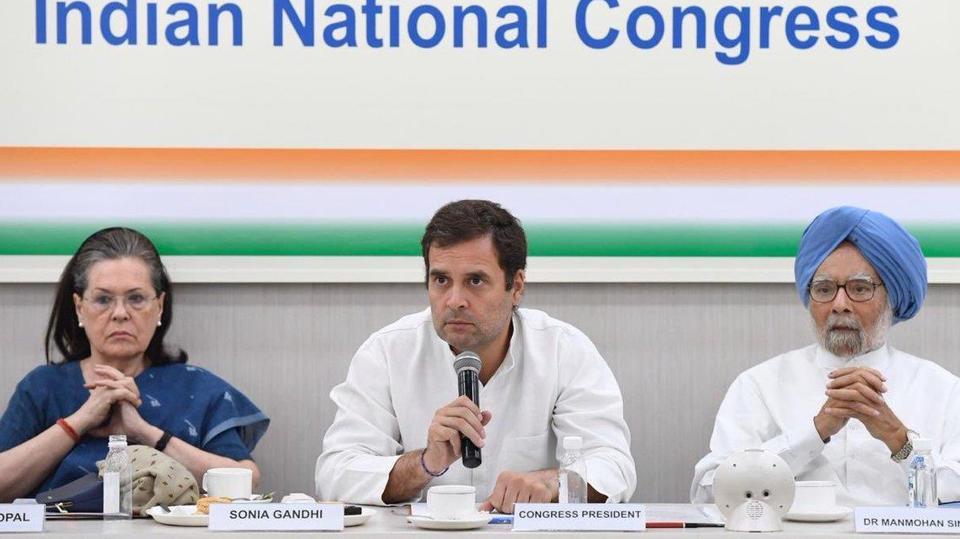
The same fate has befallen the Congress under Rahul Gandhi in 2019. By questioning the 2016 surgical strikes and 2019 Balakot air strike, the Congress fell on the wrong side of the nationalism narrative sweeping the country after the Uri terror strike by Pakistan based Lashkar-e-Taiba (LeT) and the Pulwama suicide attack by the Jaish-e-Mohammed (JeM). While PM Narendra Modi gauged the public mood and went for a perfectly planned retaliation, the Congress took a different line and asked for proof of the ripostes. The public was further confused by the Congress and its allies when the Opposition leadership took a U-turn and also claimed credit for six surgical strikes during the United Progressive Alliance regime.
The NDA, on its part, closed ranks and stuck to a plan with the UN designation of JeM chief Masood Azhar as a global terrorist, and the anti-satellite weapons test. It is clear that PM Modi outran and out-thought the UPA on national security with Congress family loyalist Sam Pitroda making matters worse with his comments. To add to this was the clean chit given by the Comptroller and Auditor General (CAG) to Modi’s government acquisition of 36 Rafale fighter jets.
The apex court also dismissed the first petition asking for a probe into the Rafale deal, and is now about to deliver a verdict on the review petition.
The Congress leadership tried to raise the release of Masood Azhar in 1999 Kandahar hijack hostage swap to counter Modi’s air strike and target National Security Adviser Ajit Doval, but ended up exposing the Manmohan Singh government’s weak response to the 26/11 Mumbai attacks with the then air chief Fali Major speaking about the UPA blocking a military response to the terror strike.
Also read: In advice to wannabe ministers, PM Modi tells them to stay out of controversy
While the Modi government and the Bharatiya Janata Party (BJP) leadership did not utter a word against the Indian armed and security forces in the run-up to the campaign, the Congress ended up coming across as questioning the army and the chiefs of staff. For the Congress to get an electoral verdict in its favour after all this was always going to be nigh impossible.


