
 E-Paper



Delhi: 19.95% turnout in 1st 4 hrs; Karol Bagh registers lowest balloting
Soumya Kumari, 18, a first-time voter from Vijay Vihar who received her voter ID card three months ago, said cleanliness and women’s safety were the main issues for her


Delhi recorded a 19.95% voter turnout in the first four hours of polling until 11am with the Mustafabad constituency recording the highest balloting in the first two hours—27%—and Karol Bagh the lowest—11%. As many as 15.6 million voters are eligible to vote. They include 7.2 million women and 1,267 third-gender voters.
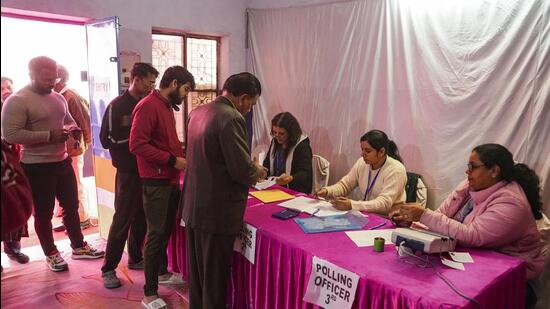
Soumya Kumari, 18, a first-time voter from Vijay Vihar, said cleanliness and women’s safety were the main issues for her. “I was a little scared about how to vote. My voter ID card came via courier three months ago, and everything about how to vote was mentioned there.” She added she wanted to vote for a candidate who could remove garbage from the streets, especially outside schools. “Women’s safety should also be addressed.”
Delhi, which has a largely urban population, has traditionally recorded low voter turnouts. A turnout of 62.55% was recorded in the last assembly elections in 2020. The polling day was declared a holiday even in the neighbouring National Capital Region cities as part of efforts to increase the turnout.
The Election Commission of India increased the number of polling centres and set up new booths in high-rise societies apart from conducting polling awareness drives.
Chief Election Commissioner Rajiv Kumar, who voted in New Moti Bagh, praised election officials and security forces for smooth poll preparations. “I would like to thank all polling officials, security forces, MCD [Municipal Corporation of Delhi], and NDMC [New Delhi Municipal Council]. Everyone had been working hard and with dedication for the last two months. All ROs [Returning Officers] and DCPs [deputy police commissioners] are working hard. As a result, over 12,000-13,000 rallies were done peacefully in Delhi in the past month,” he said.
The polling for 70 seats across 13,766 polling stations began at 7am. It is the most closely fought assembly election in Delhi and the first major electoral battle of the year with national implications. Delhi has had an outsized importance in national politics as the Capital and a diversity reflecting broader national demographics.
As many as 699 candidates are in the fray. Over 42,000 Delhi Police personnel, 220 Central Armed Police Force companies, and 19,000 home guards have been deployed for the polling. The votes will be counted on February 8 with the ruling Aam Aadmi Party (AAP), which swept the last polls by winning 62 of 70 seats, hoping to retain power.
The AAP, which has faced corruption charges, sought to focus on a welfare plank. It has offered cash hand-outs to poor women to free treatment for all senior citizens to blunt anti-incumbency. The AAP also dropped nearly a third of its lawmakers.
The Bharatiya Janata Party (BJP), which bagged eight seats in 2020, hopes to wrest power. It is banking on anti-incumbency and middle-class anger as it seeks to return to power after 27 years. The BJP failed to breach double digits in the last two assembly elections even as it won all seven parliamentary seats in Delhi.
The AAP government and the lieutenant governor have been at loggerheads over the last five years. The acrimony has derailed governance even as the Capital struggled with toxic air, crumbling infrastructure, rising crime, etc.


