E-Paper



Delhi court skewers excise policy case against Kejriwal, Sisodia and others; CBI moves HC
The court said that the excise policy case, as sought to be projected by CBI, does not survive judicial scrutiny and stood discredited in its entirety.

 Prefer HTon Google


New Delhi: A Delhi court on Friday cleared former Delhi chief minister Arvind Kejriwal, his then deputy Manish Sisodia and 21 others of any wrongdoing in planning and executing the now-repealed 2021-22 Delhi excise policy, marking a dramatic twist in the high-profile case that cast a long shadow on the Capital’s politics and influenced the assembly polls last year.
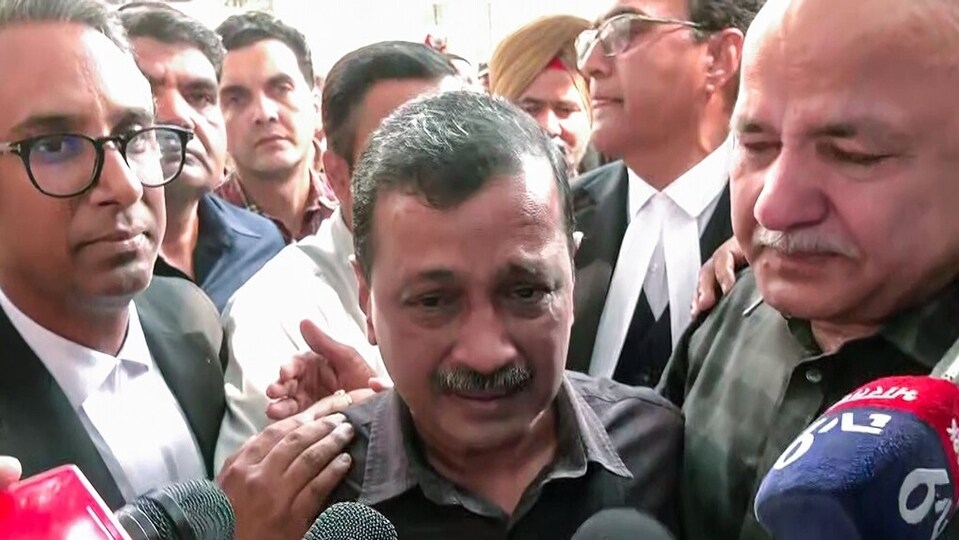
In a 549-page order, special judge Jitendra Singh of Rouse Avenue court discharged the accused, which also included former Telangana lawmaker K Kavitha, and said he had no hesitation in holding that the Central Bureau of Investigation’s (CBI) material did not even disclose a prima facie case, let alone a grave suspicion.
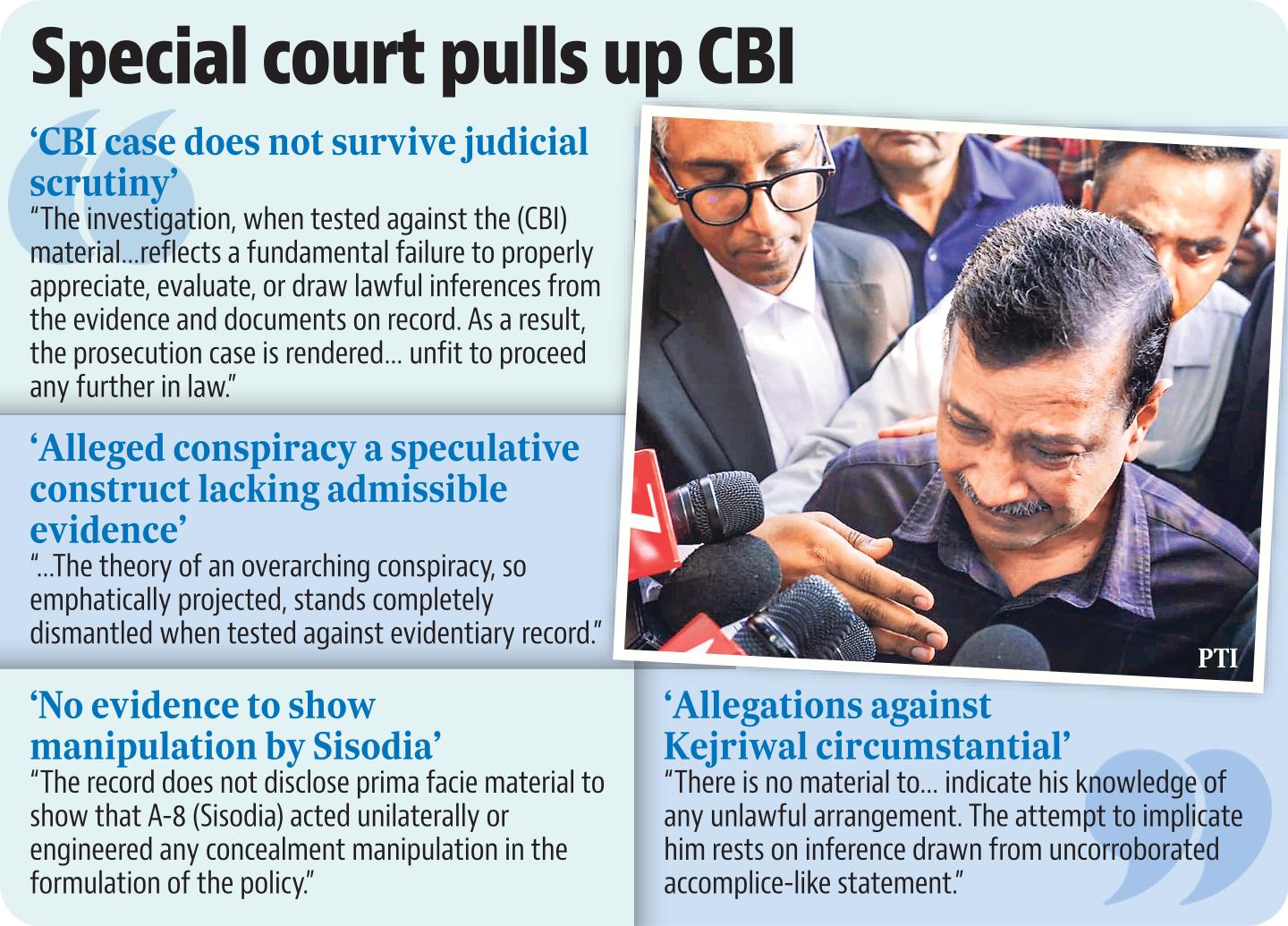
The court said that the excise policy case, as sought to be projected by CBI, does not survive judicial scrutiny and stood discredited in its entirety. It said that the alleged conspiracy was nothing more than a speculative construct resting on conjecture and surmises and lacking any admissible evidence.
“The investigation, when tested against the material collected by the agency itself, reflects a fundamental failure to properly appreciate, evaluate, or draw lawful inferences from the evidence and documents on record. As a result, the prosecution case is rendered legally infirm, unsustainable, and unfit to proceed any further in law. Stated differently, this court records that the theory of an overarching conspiracy, so emphatically projected, stands completely dismantled when tested against the evidentiary record,” the court said.
Kejriwal hailed the verdict.
“Two people, PM Modi and Amit Shah, hatched this conspiracy to finish the Aam Aadmi Party. Today, they should apologise to the country. I have only earned honesty, not money. Now this has been proved that Kejriwal and AAP are kattar imandaar (staunchly honest),” the AAP chief said, breaking down in front of television cameras.
Later in the day, CBI moved the Delhi high court. “Several aspects of investigation have either been ignored or not considered adequately,” the agency spokesperson said.
ALSO READ | Delhi court pulls up CBI over ‘South Group’ tag in Excise Policy case charge sheet
The Bharatiya Janata Party (BJP) said the judgment was technical and the AAP leaders were still guilty. “We all know how evidence was tampered with. If you (Kejriwal) were right, then why did you withdraw the liquor policy as soon as the investigation started?...The courts had also expressed their worry on this case and traces of money laundering were found. Even today you are shedding crocodile tears,” chief minister Rekha Gupta said.
Kejriwal, Sisodia, and former Rajya Sabha member Sanjay Singh were among prominent AAP leaders who were arrested in connection to the excise policy, in which the federal agency alleged kickbacks were paid.
The policy was rolled out for the 2021-22 financial year in November 2021, marking the exit of the government from retail sales of alcohol and allowing private companies to bid for licences. The objective, the Delhi government said, was to improve the buying experience for citizens by allowing market competition to raise standards.
But the policy was scrapped when Delhi’s lieutenant governor VK Saxena asked for an investigation, citing a report by the chief secretary who alleged financial irregularities. The AAP rejected the charges, alleging it to be a ploy by the BJP-controlled Union government to target its rival.
Sisodia was first arrested in February 2023 and spent nearly 17 months in jail before being given bail by the Supreme Court. Kejriwal was first arrested in March 2024 – just weeks ahead of the general elections, where he campaigned while out on interim bail – and finally granted regular bail by the apex court in September that year. Kejriwal, Sisodia and others – including several excise officials and party members – faced allegations that the liquor policy was designed to favour certain licensees in exchange for bribes, allegedly routed into the Aam Aadmi Party’s Goa campaign. The CBI’s case alleged that the accused persons altered the policy in favour of an alleged lobby of liquor businessmen referred to as the “South Group”.
The court exonerated all the accused in the CBI’s case, which was registered in August 2022 under Indian Penal Code sections pertaining to criminal conspiracy, cheating and causing disappearance of evidence, apart from sections punishable under The Prevention of Corruption (PC) Act.
Till July 2024, CBI had filed a total of five chargesheets; the first chargesheet named lower-level officials and businessmen, the fourth supplementary chargesheet named Kejriwal, alleging his direct involvement as an “overarching conspirator” of the now defunct policy.
The case by the Enforcement Directorate, registered under sections of the Prevention of Money Laundering Act (PMLA) in the same year, probed a broader conspiracy involving alleged hawala transfers and shell companies. Its fate is unclear after the main CBI case has collapsed.
Friday’s judgment noted that the allegations Kejriwal – the 18th accused – could not be corroborated and were merely circumstantial, essentially based on a hearsay statement by another witness. The court said that no document or digital evidence were produced to directly or indirectly connect Kejriwal with any alleged policy manipulation or illegal gratification. “There is no material to show his presence at any conspiratorial meeting or to indicate his knowledge of any unlawful arrangement. The attempt to implicate him rests on inference drawn from uncorroborated accomplice-like statement,” the court said.
The court noted that even the prosecution’s approver, who claimed knowledge from the stage of the policy’s formulation to the alleged utilisation of funds, was silent about the role of Kejriwal.
On Sisodia, who held the excise department at the time and who was allegedly the “principal architect” and “controlling force” behind the policy, the court said that no evidence showed any concealment or unilateral manipulation by the former minister.
The court said Sisodia, who was represented by senior advocate Rebecca John and advocate Vivek Jain, abided by the relevant constitutional channels to incorporate all suggestions recommended by then Delhi L-G Anil Baijal in the draft policy. The order said that evidence in fact indicated institutional participation rather than individualised exercise of authority by him. “The record does not disclose prima facie material to show that A-8 (Sisodia) acted unilaterally or engineered any concealment manipulation in the formulation of the policy.”
Pulling up the prosecution for its investigative lapses and lack of any cogent evidence, the court also went on to recommend a departmental inquiry against the erring investigating officer for framing one of the accused, Kuldeep Singh, in the absence of any material against him. The court noted that Singh was suspended from his job as a deputy commissioner in the excise department due to his alleged role in the case.
The court emphasised that contrary to CBI’s case, evidence clearly established that the excise policy was the outcome of a consultative and deliberative exercise, undertaken after discussions with relevant stakeholders in accordance with law. “This court is of the considered view that the prosecution has failed to place any material which, even prima facie, suggests that the DEP-21/22 was manipulated, altered, or engineered to confer any undue or unlawful benefit upon any private individual or the so called South Group,” the order said. “Though there was no statutory or constitutional requirement mandating the obtaining of suggestions from the Hon’ble Lieutenant Governor, the file notings unmistakably reflect that such suggestions were nevertheless sought, examined, and incorporated.”
Referring to the allegations of illicit funds allegedly being used in the Goa assembly elections, the court said, “To connect such allegations to the Goa Assembly elections, so as to project, layering, and utilisation of alleged proceeds of crime, rests more on inference and assumption than on legally sustainable material”.
The court also expressed its displeasure with CBI for using the phrase “South Group”.
“Such kind of terminology I feel should be avoided…is it possible that if the CBI had filed the same chargesheet in a Chennai court, it would not be perceived offensive?”. “Why didn’t you say those in the north among the accused are the north group?”