
 E-Paper



Despite agitation against privatisation move, Vizag steel plant achieves record production
Between Tuesday and Wednesday, there was a record production of 20,400 tonnes of hot metal in the steel plant.


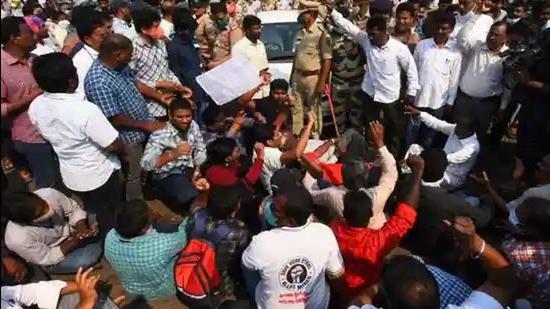
While continuing their one-and-a-half months-long agitation to prevent the privatisation of Rashtriya Ispat Nigam Limited (RINL), also known as the Visakhapatnam Steel Plant, the workers have also been striving to improve the productivity of the company and bring it back into profits.
Between Tuesday and Wednesday, there was a record production of 20,400 tonnes of hot metal in the steel plant.
“This is the highest production since the inception of the plant in the 80s. On March 6, the plant achieved a record production of 20,350 tonnes,” RP Sharma, spokesperson of Visakhapatnam Steel Plant, said.
All three blast furnaces, each having a production capacity of 7,150 tonnes, are running round the clock. “We have achieved nearly 98 per cent productivity in the company, thanks to the dedication of the workers despite their anxiety over the government’s decision,” Sharma said.
Trade union leaders said the workers wanted to prove to the Centre that if given an opportunity, they could completely turn around the company’s financial position and bring it back into profits.
According to the trade union leaders, the RINL has been making consistent profits for the last four months. In December 2020, the company made a net profit of ₹212 crore. In January this year, the net profit of the company was ₹134 crore.
“After the announcement of privatisation by the Centre in February, too, the workers strived hard to achieve a net profit of ₹165 crore and as the financial year closes by March-end, the company is likely to get the profit of around ₹300 crore,” J Ayodhya Ramu, trade union leader and convenor of Visakha Ukku Parirakshana Samithi (Visakha Steel Protection Committee) said.
Though the trade unions have given the strike notice to the management on March 11, stating they would go on an indefinite strike any day after March 25, they have not taken any decision yet. “We have been working like disciplined soldiers. A strike is our last option,” All India Trade Union Congress (AITUC) leader of the steel plant, A Adinarayana, said.
The company spokesman said the RINL had, in fact, undergone a tough phase last year due to the Covid-19 pandemic. “We had to shut down two of the three furnaces and only one furnace was in operation for six months. Subsequently, the workers were allowed in full shifts and the plant operations were back in full swing only in the last four or five months,” Sharma said.
The steel plant, which had a turnover of ₹16,000 crore in 2019-20, is expected to achieve a turnover of nearly ₹17,000 crore in 2020-21, despite the crisis prevailing in the plant due to the pandemic. “This month alone, the company is targeting a record production of 7 lakh tonnes of hot metal and the turnover is likely to touch ₹3,200 crore,” the spokesman added.
The main reason cited by the Centre for privatising the RINL was that it had been consistently making losses for four years out of the last five years. It reported a loss of ₹1,604 crore in 2015-16, ₹1,263 crore in 2016-17 and ₹1,369 crore in 2017-18. The company made a profit of ₹96.7 crore in 2018-19 but plunged into a huge loss of ₹3,319 crore in 2019-20.
Besides, the RINL is also facing a huge debt burden of ₹22,000 crore, which is being serviced at 14 per cent.
The trade union leaders, however, say the losses or the debt burden of the company were insignificant compared to the huge assets of the steel plant. “The problem is not with the steel plant or the workers. It is with the management. We have all the strength and resources to make it a profitable venture if the government gives us a helping hand,” Ramu said.
He reiterated that the RINL can bounce back into profits if it is allotted captive mines, which reduces the burden of procuring iron ore by nearly ₹3,500 crore a year, and the interest on the loan outstanding is reduced from 14 per cent to eight per cent as being extended to private industrialists.
“In the name of getting rid of the loss-making company, the Centre is virtually killing a golden goose,” Adinarayana said.


