
 E-Paper



DMK faces formidable challenge as AIADMK, BJP join hands again in Tamil Nadu
Tamil actor Vijay’s Tamizhaga Vetri Kazhagam (TVK) could be the only irritant for the alliances of two major Dravidian parties DMK and AIADMK

 Prefer HTon Google


The Bharatiya Janata Party (BJP) has allied with the All India Anna Dravida Munnetra Kazhagam (AIADMK) for next year’s Tamil Nadu assembly elections, 19 months after snapping ties, making the contest bipolar with the ruling Dravida Munnetra Kazhagam (DMK)-led grouping.
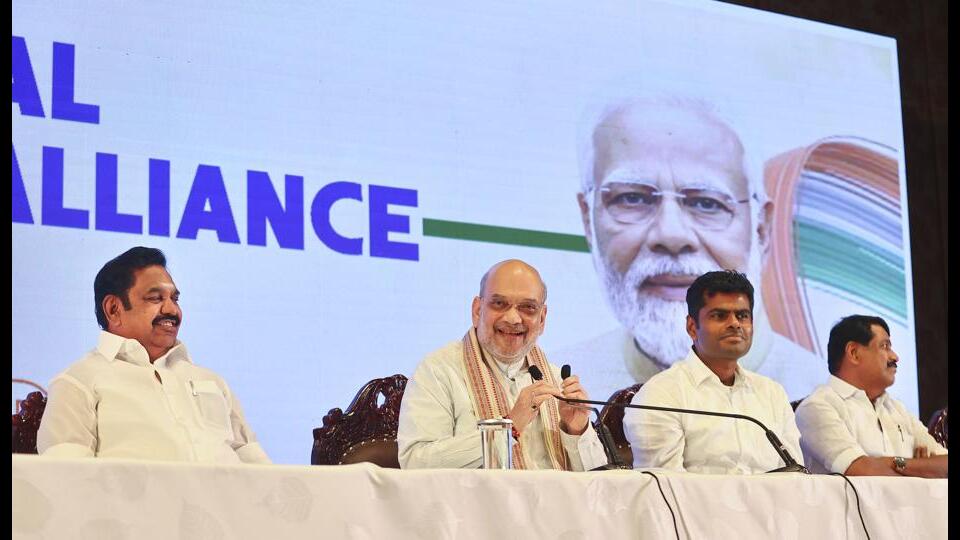
The AIADMK and the BJP contested the 2019 parliamentary and the 2021 assembly elections together, but the DMK-led alliance got the better of them. Their ties soured with K Annamalai’s appointment as the BJP state chief in July 2021. The AIADMK passed a resolution in 2023 against him for repeated provocations by insulting the late leader J Jayalalithaa and Dravidian icons, and eventually exited the National Democratic Alliance (NDA). Before the fresh alliance was announced, the BJP appointed former AIADMK leader Nainar Nagendran as its state unit chief.
The 2026 poll can swing any way, considering the two alliances have strong vote banks. The DMK-led government also faces anti-incumbency. Tamil actor Vijay’s Tamila Vettri Kazhagam (TVK) could be the only irritant for the two major Dravidian parties’ led alliances.
In 2021, the BJP-AIADMK alliance won 75 of 234 seats despite strong sentiment in the DMK’s favour. The two fought the 2024 national polls separately, losing all 39 parliamentary seats. The division of anti-incumbency votes helped the DMK-led alliance to sweep the state, winning most seats with huge margins. The AIADMK and the BJP joined hands again to prevent a repeat of the 2024 polls and put up a formidable contest against the ruling DMK, which has tried to project the BJP as a party against Tamil Nadu and its culture.
The NDA got 39.29% of the total votes in 2021, and the DMK-led alliance 45.70%. The 2025 Delhi assembly polls showed that gaining six percentage points is possible, provided there is a groundswell for a party.
In Tamil Nadu, the BJP remains a minor partner, and its alliance with AIADMK has drawbacks. Political observers believe that many AIADMK and BJP leaders could contest as rebels if they fail to get tickets. The AIADMK could also lose Muslim votes. AIADMK leaders maintain that Muslim voters in Tamil Nadu are firmly with the DMK and the party will not lose much. “Whatever Muslim votes we had were lost after the death of Amma [Jayalalithaa] and our party joining hands with the BJP,” said a Mulsim AIADMK leader.
Internal surveys of the DMK and the BJP indicate that the TVK could get up to 16% of the votes if the elections are held now. Election strategist Prashant Kishore’s survey claimed that the party can get up to 20% of the votes.
The DMK leadership believes TVK could get anti-incumbency votes, which would have otherwise gone to the AIADMK. Some AIADMK voters could go to TVK over unhappiness with the alliance with the BJP.
The AIADMK hopes TVK will cut into DMK votes and help the NDA return to power. Most pollsters estimate that TVK’s performance would be decent and could get 8-10% votes.
Impact of S Seeman’s Naam Tamilar Katchi will also be significant, even though its poll performance has been below par until now.
The AIADMK-BJP alliance is also facing issues. A week after Union home minister, Amit Shah declared AIADMK leader Edappadi Palaniswami (EPS) would lead the alliance and be the probable chief ministerial candidate, the latter said that the government, if formed, would only be of his party.
There is also a question mark over how former deputy chief minister O Panneerselvam (OPS) and TTV Dhinakaran will be accommodated in the NDA. On Saturday, EPS withdrew a case he filed against Dhinakaran, a week after his party allied with the BJP.
EPS is not willing to ally with OPS. Insiders say the Bihar formula, under which major political parties got seats and then allocated some of them to smaller ones, could be implemented in Tamil Nadu. OPS and Dhinakaran are likely to get seats from the BJP quota.
The alliance is seen as one of convenience. “We had no choice,” said an AIADMK leader. A BJP leader agreed, “AIADMK does not have a choice. They will have to work with everyone.”
The BJP is keen to oust DMK, its strongest critic in non-BJP-ruled states. The DMK has sought to counter it by labelling it as an outsider and said it will not allow Delhi to run Tamil Nadu. “[Amit] Shah cannot run Tamil Nadu,” chief minister M K Stalin said. He accused EPS of mortgaging Tamil Nadu’s dignity for his “thirst” for power. A lot could happen before the polls, both seen and unseen, and likely make the Tamil Nadu polls the most-watched in 2026.


