E-Paper



Explaining Cong’s bittersweet result in K’taka LS polls
The Congress added eight seats to its 2019 tally but the results are a let down from the party’s massive assembly election victory in May 2023

 Prefer HTon Google


The Congress has won nine out of the 28 parliamentary constituencies (PCs) in the state of Karnataka. With this, the Congress has repeated its 2014 tally in the state. Both 2014 and 2024 were Congress’s best ever performance in the state since 1999, when it had won 18 PCs in Karnataka.
While the Congress added eight seats to its 2019 tally, the results are a let down from the party’s massive assembly election victory in May 2023.
What explains the Congress’s bittersweet performance in the state?
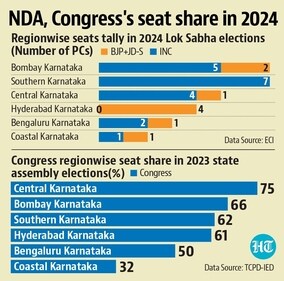
A sub-regional dynamic and an alliance between the Bhartiya Janata Party (BJP) and the Janata Dal (Secular) is the answer. Trivedi Centre for Political Data (TCPD) classifies Karnataka in six sub-regions -.Bengaluru Karnataka, Bombay Karnataka, Central Karnataka, Coastal Karnataka, Hyderabad Karnatka, and Sothern Karnataka. Bombay and Southern Karnataka are the two biggest sub-regions with seven parliamentary constituencies (PCs) each. Central and Hyderabad Karnataka have five and four PCs each. Bengaluru Karnataka has three PCs while Coastal Karnataka has two PCs.
Congress’s best performance has come in the Hyderabad Karnataka sub-region where the party has won all four PCs. The rest of the state has given the Congress just five more PCs. Hyderabad Karnataka is the region where Congress president Mallikarjun Kharge comes from. The Congress had done very well in this area even in the 2023 assembly elections.
The region wise performance of the Congress shows a huge departure from its performance in the state assembly elections held just a year ago.
In the 2023 state assembly elections, the Congress had got at least 50% of the seat share in each region of the state, except coastal Karnataka.
Even in the regions of Bombay and Central Karnataka, it had a seat share of 66% and 75% respectively. Both these regions are considered as a stronghold of ex chief minister BS Yediyurappa who comes from the Lingayat community which is a dominant caste in these regions.
The BJP removed Yediyurappa as the state’s chief minister before the 2023 assembly elections, but made his son BY Vijayendra the state president of the party after the 2023 results. The Lok Sabha election results show that this has done a lot of damage control for the BJP.
Another factor which might have kept the Congress’s tally down in the state is the BJP’s alliance with the Janata Dal (Secular), which might have led to a complete consolidation of the Vokkaliga vote behind the NDA. Region-wise vote share numbers show this clearly as the Congress’s vote share gap with the NDA is the largest in Southern Karnataka.
If the BJP and the JD(S) stay together and ensure a consolidation of Lingayat and Vokkaliga votes, then it could entail a new churn in the state’s politics.