
 E-Paper



Farmers set to call off stir as govt agrees to demands
The Samyukt Kisan Morcha, a platform of protesting farm unions, said on Wednesday that it was close to sealing a deal with the Union government after the two sides settled on a set of revised draft proposals to resolve the pending demands of the cultivators


The Samyukt Kisan Morcha, a platform of protesting farm unions, said on Wednesday that it was close to sealing a deal with the Union government after the two sides settled on a set of revised draft proposals to resolve the pending demands of the cultivators.
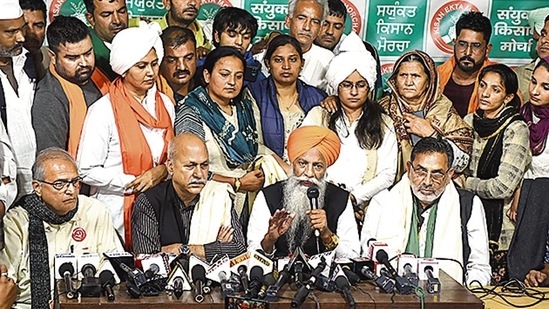
The SKM is likely to ask tens of thousands of its farmer activists across states to call off a 14-month-long movement against the Modi government on Thursday. However, an end to the agitation was still contingent upon an officially signed letter from the Union government based on the agreed draft proposals, SKM leaders said.
“The government has taken two steps forward. We are in agreement to all the revised proposals. The government must now convert these proposals into an official letter, which we are ready to sign,” Gurnam Singh Charuni, a farm leader said after the breakthrough meeting
The apparent compromise between the Centre and protesting farm unions arrived after two days of back-channel negotiations that saw proposals being sent back and forth between a five-member negotiating team of the SKM and the Union government.
A crucial meeting of the SKM’s team at the Singhu protest site on the capital’s outskirts on Wednesday began with a two-minute silence to mourn the death of the country’s top military general, chief of defence staff Bipin Rawat, and 12 others in a helicopter crash on Wednesday in Tamil Nadu.
The five members, who were authorised by the SKM to take decisions on behalf of all farm unions, unanimously accepted the Centre’s revised draft after a two-hour-long meeting.
The SKM, on December 4 named five of its senior-most members to negotiate with the Centre: Ashok Dhawale, Balbir Singh Rajewal, Gurnam Singh Chaduni, Shiv Kumar Kakkaji and Yudhvir Singh.
Earlier on Tuesday, the five-member panel raised various points of contention on draft proposals sent by the Centre, sending them back to the home ministry seeking revisions. The Centre then reworked the proposals, paving the way for an imminent agreement.
Charuni said the farmers’ team would not divulge the specifics of the proposals agreed by it until a formal letter was received from the Centre. The SKM will meet again at noon on Thursday. “The government’s letter should reach us by noon tomorrow. Only then, we will take a decision on calling off the agitation,” he added
On November 19, the Union government gave in to a major demand of the farmers when Prime Minister Narendra Modi announced his government would abandon three farm-reform laws that had sparked the year-long protests. On November 29, Parliament repealed the laws that farmers say were against their interests.
The revised draft proposals, which was agreed upon by the SKM’s team, provide for a committee “mandated to ensure Minimum Support Price can be granted to all farmers”, an SKM leader from Haryana said, requesting anonymity because he was not authorised to speak.
The Centre has also given a written assurance that it would not reduce the current level of procurement of farm produce at assured prices, a second farm leader said, also asking not to be named.
The key proposal that clinched the deal relates to withdrawal of all police cases registered against farmers during the course of the protests.
In its earlier proposal, the government said it would ensure cases against farmers would be taken back once the farmers called off their protests. The five-member team of farm leaders objected to this conditionality.
“In its revised proposal, the government has said it would ensure cases are taken back with immediate effect,” the farm leader quoted in the first instance said.
A third farm leader, who asked not to be named said there were still a few sticking points. One, the SKM doesn’t want farm organisations other than its affiliates to be part of the proposed committee to be formed to look into farm-produce prices. Second, the revised draft still did not mention a law guaranteeing minimum support prices, a key demand of the farmers. Third, although the Union government has assured in writing there would be no criminal liability on farmers for burning crop residue, a key source of air pollution, the SKM wants the Centre to free farmers from even civil liabilities, such as fines for stubble burning.
The farm protests, which first started in Punjab before spreading across states such as Uttar Pradesh, Haryana, Madhya Pradesh, Maharashtra and Uttarakhand, have posed a major challenge for the Modi government.
Farmers first held demonstrations in Punjab in October 2020, soon after Parliament passed the three contentious agricultural laws by a voice vote and without discussion, as India was battling the Covid-19 pandemic.
The laws seek to open up the country’s food markets to greater corporate participation. While Modi argued that the laws would have widened markets for cultivators, farm unions said they legislation would have allowed big corporations and supermarket chains to dictate low prices, hurting their livelihood.
The Union government’s decision to scrap the laws came as the Bharatiya Janata Party, Modi’s party, prepares to fight upcoming state elections, especially in Uttar Pradesh, Punjab and Uttarakhand, where farmers are an influential voting bloc.
“The acceptance of farmers’ demands after a year-long protests is a great victory for the farmers. It demonstrates that the farming community has reclaimed their political space through a peaceful agitation,” said Sudhir Panwar, a professor with Lucknow University.


