E-Paper



First 15 days: CJI Gavai’s 6-month tenure off to a decisive start
Justice Gavai’s first fortnight in office has been marked by strategic efforts to strengthen the judiciary’s responsiveness, transparency and internal efficiency.

 Prefer HTon Google


Taking over the reins of the Indian judiciary on May 14, Chief Justice of India (CJI) Bhushan R Gavai has begun his six-month tenure with a palpable sense of mission.
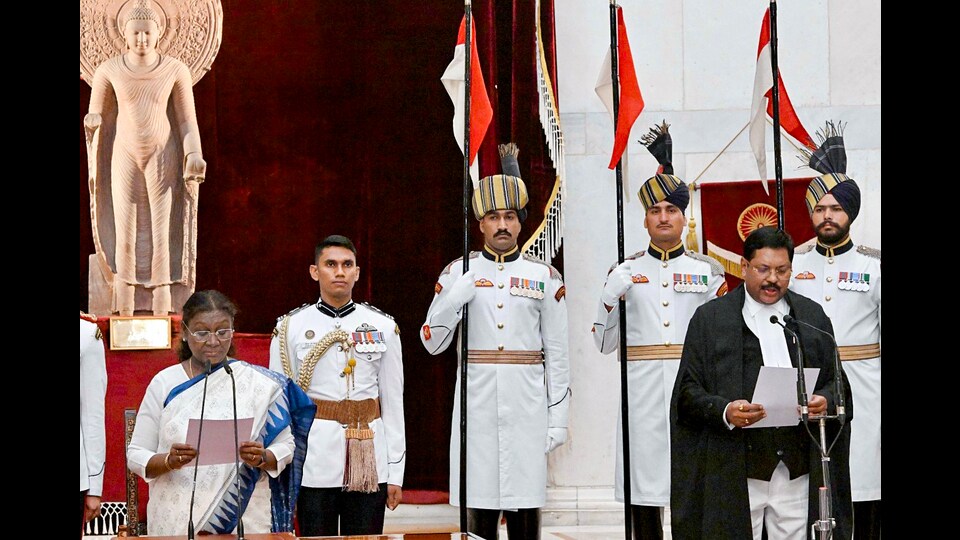
Though brief and interspersed with vacations, including the seven-week long summer recess (now defined as “partial court working days”), Dussehra and Diwali, justice Gavai has apparently chosen to act decisively by leveraging every available moment to drive change in how the Supreme Court functions administratively and institutionally.
Justice Gavai’s first fortnight in office has been marked by strategic efforts to strengthen the judiciary’s responsiveness, transparency and internal efficiency. Unlike some of his predecessors who took time to ease into the role, justice Gavai has demonstrated a preference for immediacy, prioritising long-pending matters, improving institutional communication and initiating structural corrections. These decisions reflect a firm understanding of the challenges facing the higher judiciary and an eagerness to reinforce its public credibility. By tackling operational inertia and reviving collegium activity almost immediately, CJI Gavai has signalled that his term will not be a caretaker stint, but a hands-on stewardship dedicated to real impact.
The first 15 days of justice Gavai’s tenure offer a compelling blueprint of his leadership style and priorities, best understood through the major themes that have defined his early decisions.
Judicial appointments and restructuring:
In a powerful opening act, CJI Gavai convened a collegium meeting on May 26 that swiftly resulted in an overhaul of key judicial positions across the country. Demonstrating urgency and clarity of vision, the collegium recommended the elevation of three high court judges - Justices NV Anjaria, Vijay Bishnoi and AS Chandurkar --to the Supreme Court.
The Union government acted promptly, notifying these appointments on May 30, completing the process in record time. With their swearing-in, the top court has reached its full sanctioned strength of 34 judges.
Justice Gavai’s collegium also undertook a major reshuffle in high court leaderships and judge postings. Five new chief justices were proposed -- Justice Sanjeev Sachdeva for Rajasthan, justice Vibhu Bakhru for Karnataka, justice Ashutosh Kumar for Gauhati, justice Vipul M Pancholi for Patna, and justice Tarlok Singh Chauhan for Jharkhand. Simultaneously, four chief justices were rotated between Madras, Rajasthan, Tripura, Telangana, and Jharkhand high courts.
In addition, 22 judges were transferred to various high courts based on administrative need and personal requests. The Delhi high court, notably, received a proposed infusion of six judges, reflecting a focus on enhancing transparency in judicial appointments and accountability. As previously reported, the Supreme Court now publicly discloses collegium decisions, judge profiles, and even judges’ asset declarations on its website -- part of a landmark transparency initiative launched under the leadership of the last CJI Sanjiv Khanna earlier in May. These recommendations are currently pending with the central government for their approval.
Furthermore, the collegium’s decisions regarding the Delhi high court arrived at a time of heightened scrutiny following recent controversies, including the case involving unaccounted cash found at the residence of a sitting high court judge, justice Yashwant Varma. In accordance with the Supreme Court’s in-house procedure for handling complaints of judicial misconduct, the court on May 8 confirmed that an inquiry report, along with justice Varma’s response, had been forwarded by the then CJI, justice Sanjiv Khanna, to the President and Prime Minister. Justice Khanna had also recommended initiation of removal proceedings after a three-judge inquiry committee found merit in the allegations concerning recovery of cash from the judge’s home.
The collegium’s efforts, experts note, uphold the spirit of institutional fairness while maintaining the credibility of the judiciary amidst growing public scrutiny.
Administrative reforms:
Justice Gavai has coupled his structural reforms with firm administrative resolve, particularly in addressing long-standing concerns around judicial functioning during vacation periods. In a departure from past practice, the Supreme Court under his stewardship has rebranded the summer recess as “partial court working days”. For the first time, the top five judges, including the CJI himself, will sit on benches during the summer recess -- from May 26 to July 13.
This symbolic yet impactful change has injected new energy into the functioning of the court during vacations, which were often criticised for being underutilised despite pendency. A notification issued earlier detailed weekly bench allocations and mandated registry operations from 10am to 5pm, Monday through Friday.
On May 16, when a lawyer requested adjournment of a matter post-vacation, CJI Gavai remarked: “The first five judges are sitting through the vacation and continuing to work, yet we are blamed for the backlog. In reality, it is the lawyers who are unwilling to work during the vacations.”
The first five judges, including justices Surya Kant, Vikram Nath, JK Maheshwari and BV Nagarathna, headed the Supreme Court benches between May 26 and 30. By presiding over vacation benches himself along with the four other most senior judges, justice Gavai has sent a clear signal that judicial work does not stop during recess. His stewardship of urgent matters has ensured that critical petitions continue to be heard, maintaining the credibility of the top court even during what was traditionally considered downtime.
In a move reflecting a return to tradition, CJI Gavai also restored the Supreme Court’s original logo and ordered the removal of glass partitions installed in the court’s corridors . Critics argued that such barriers eroded the court’s spirit of open access and inclusivity, making the institution seem more opaque and less participatory. By ordering their removal, CJI Gavai, people familiar with the development said, signalled a return to the values of transparency and approachability, reinforcing the judiciary’s commitment to being a people-centric institution. Restoring the original emblem of the court -- which was changed in September 2024 -- further underscores his reverence for constitutional continuity and the heritage of the Supreme Court.
Judicial decisions:
Alongside these measures, Justice Gavai has already presided over several significant rulings in the second half of May after he took over the helm:
Regularisation of court managers -- On May 16, the Supreme Court directed all states to frame service rules for court managers and take steps to regularise their appointments. The judgment, delivered by CJI Gavai, emphasised their critical role in easing the administrative burden on judges.
Uniform pension for retired judges -- In a landmark verdict on May 19, a bench led by CJI Gavai ruled that additional judges of high courts must be given pensionary benefits on par with permanent judges, ending years of discrimination and uncertainty.
Minimum experience requirement for civil judges -- On May 20, justice Gavai’s bench upheld a rule mandating three years of legal practice for applicants to the post of civil judge junior division, underscoring the importance of practical experience in judicial roles.
Protection of Zudpi forests in Maharashtra -- On May 22, a bench headed by CJI Gavai restrained large-scale deforestation in Maharashtra’s Vidarbha region by reclassifying certain forest tracts as protected, while allowing small cultivators to retain limited land, balancing environmental conservation with livelihood.
These rulings suggest that the top court remains deeply engaged with questions of judicial reform, equity and environmental justice under justice Gavai’s watch.
This administrative stance builds on earlier transparency reforms initiated by his predecessor, justice Sanjiv Khanna, including publication of collegium resolutions, judge profiles and asset disclosures. Justice Gavai’s early tenure shows an intent not only to continue these reforms but to deepen their institutional relevance.
The continuation of benches through the summer, led by the senior most justices, also marks a break from the past, where vacation benches were usually manned by junior judges.
Moreover, the decisions to swiftly notify appointments and transfers , and to initiate dialogue on long-pending matters such as gender representation on the bench (with discussions on elevating women judges likely to resume post-retirement of justice Bela Trivedi on June 9), reflect an agenda anchored in equity and institutional effectiveness.
As he navigates the challenges of a term bookended by vacations, justice Gavai’s early performance underscores that tenure length need not determine impact -- vision and execution do.