
 E-Paper



‘Focus on training, tech upgrade to implement 3 criminal laws’: Shah at DGP meet
Union home minister Amit Shah mentioned that the new laws are focused on the delivery of justice instead of punishment and implementation of these laws would transform our criminal justice system into the most modern and scientific

 Prefer HTon Google


Jaipur: India’s top police and intelligence brass on Friday began three-day deliberations on a host of internal and external security issues with a focus on cyber security, artificial intelligence, deep fakes, security at India’s border, unauthorised persons staying in the country and the roadmap for soon-to-be-implemented three criminal laws in the presence of Prime Minister Narendra Modi, Union home minister Amit Shah and National Security Advisor Ajit Doval, people familiar with the development said.
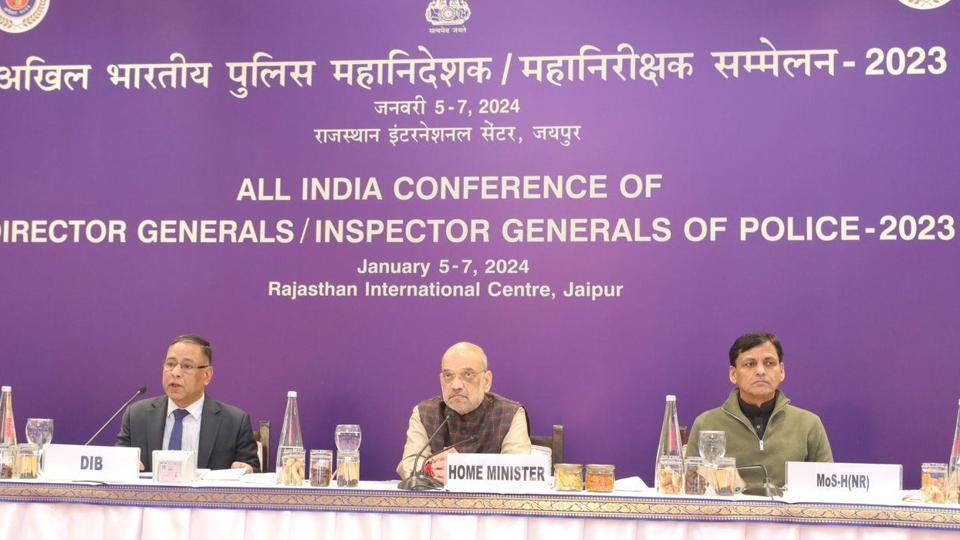
Inaugurating the 58th director generals of police (DGP)/inspector generals of police (IGP) conference at Rajasthan International Centre (RIC) in Jaipur, being attended by all police and agency chiefs besides 500 officers from across the country through video-conferencing, Shah asked the chiefs to train the police officers from SHO rank to DGP level and upgrade the technology from thana (police station) to police headquarters level for successful implementation of three criminal laws.
The government plans to notify the three laws - Bharatiya Nyaya Sanhita, Bharatiya Nagarik Suraksha Sanhita and Bharatiya Suraksha Bill – passed by the Parliament and assented by the President last month by Republic Day and completely implement them in the entire country by year-end.
“The home minister highlighted that in 2023 the nation has entered the Amrit Kal and stressed upon two important developments viz. the formulation of New Education Policy (NEP) and enactment of three new criminal laws replacing British era laws,” according to a statement by the ministry of home affairs.
Shah, the ministry said, mentioned that the new laws are focused on the delivery of justice instead of punishment and implementation of these laws would transform our criminal justice system into the most modern and scientific.
He stressed the need for training the cops from “SHO to DGP level and technology upgradation from Thana (police station) to PHQ (police headquarters0 level for successful implementation of new laws”, the ministry added.
The home minister also stressed the need for linking databases and adopting an AI-driven analytical approach for tackling the emerging security challenges, it said.
Organised by the Intelligence Bureau (IB) annually, the DGPs/IGPs conference has become a catalyst for the Modi government’s national security policy for the past nine and a half years.
Since 2014, PM Modi himself has attended all the fixtures, brainstorming with the DGPs of states, union territories and intelligence chiefs over three days to come up with ideas to tackle challenges posed by insurgency, neighbouring countries, borderless crimes, radicalisation of youth, and modernising the security establishment.
Acknowledging this, Shah said on Friday that “this conference over the years has emerged as a ‘think-tank’, facilitating decision making and formulation of new security strategies”.
He pointed out the overall improvement in the security scenario in the country since 2014, especially the reduction of violence in the three critical hotspots, i.e., Jammu and Kashmir, north-east and left-wing extremism. “He emphasized uniformity of structures, size and skill of counter-terror mechanisms across the country,” MHA said.
Sharing details of discussions, officials who did not want to be named, said three broad topics - ‘emerging challenges in border management, the role of police and inter-agency coordination’; ‘measures to check fraudulent issuance of Indian identity documents’ and ‘development of futuristic prison infrastructure’, came up on Friday among others.
They said like every year, progress on the previous year’s conference’s agenda items will also form part of discussions from January 5 to 7.
For instance, said an officer, DGPs of states were directed to sensitise all district police officers in their jurisdiction about the problem of overstaying foreigners, besides the creation of a database of illegally staying foreigners like Chins, Rohingyas, Iranians, Afghans etc.
“The states have also been told to identify individuals or groups that provide support to overstaying foreigners and the voter list should be reviewed by the Election Commission of India (ECI) accordingly in case such persons have obtained Indian identity cards,” added the officer.
The DGPs have also been asked to ensure that hotels routinely fill out the C-forms – a mandatory foreigner registration form.
On the cyber security front, the conference will discuss threats from China-backed entities to cripple India’s critical infrastructure besides the use of cryptocurrencies by narco-terrorists.
A second officer said the status of a scheme launched by the MHA to have cyber-commandoes in every district to counter cyber threats will also be discussed during the latest conference.
Earlier, the Prime Minister’s Office (PMO) had stated in a release on Thursday that the conference will discuss a “wide range of policing and internal security issues including cybercrime, technology in policing, counter-terrorism challenges, left-wing extremism, prison reforms, among others”.
“Another key agenda of the conference is deliberations on the road map for implementation of the new criminal laws. Further, the conference will also deliberate on futuristic themes in policing and security, like the challenges posed by new technologies such as AI, deepfake etc and ways to deal with them,” the PMO said.
Crackdown on pro-Khalistan elements (PKEs) and gangsters operating from foreign soil, extradition of wanted persons, and leveraging technology to locate organised crime syndicates and cyber criminals is also going to be discussed this year again, said a second officer cited above.


