
 E-Paper



Forces kill 31 Maoists in massive Bastar Op
31 Maoists were killed in a Narayanpur encounter, raising 2024's toll to 186 as India intensifies its fight against left-wing extremism.

 Prefer HTon Google


Bodies of three more Maoists were recovered on Saturday morning in Chhattisgarh's Bastar region, following a fierce encounter with security forces on Friday, police said.
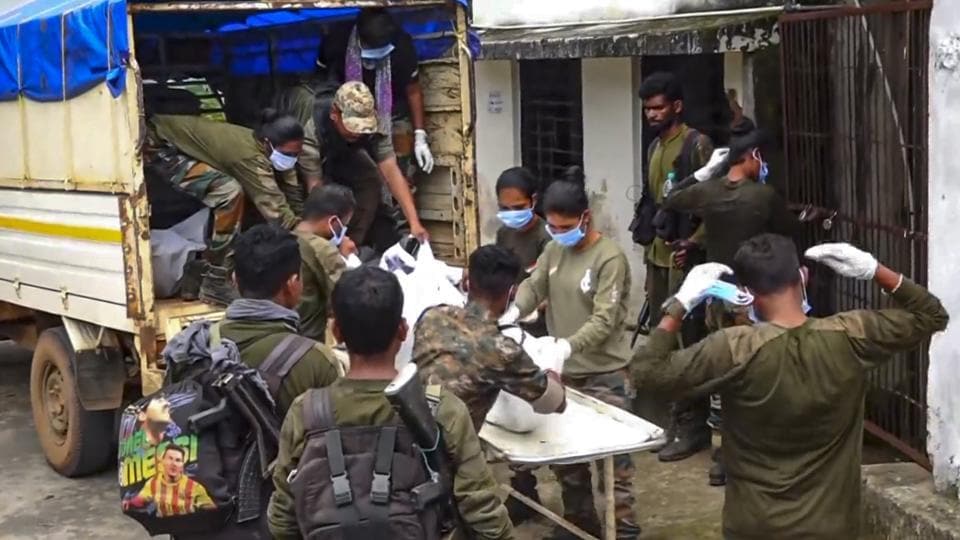
This brings the total number of Maoists killed in Friday's gun battle to 31, according to authorities, with search operations still ongoing in the area.
"Three more bodies of Naxalites were found this morning in the dense forest where the encounter took place on Friday," Inspector General of Police (Bastar Range) Sundarraj P said in a statement .
Police officers said Friday's encounter was the biggest blow to the rebels this year, taking to 189 the total number of insurgents killed in 2024 in Bastar, compared to 20 in 2023 and 30in 2022, as India intensifies its battle against left-wing extremism (LWE).
According to a statement issued by the Bastar Police, the encounter took place at around 1pm on Friday in the forest of Abhujmaad on the Narayanpur-Dantewada inter-district border when a joint team of District Reserve Guard (DRG) and Special Task Force (STF) was out on an anti-Naxal operation.
“After receiving intelligence about the presence of Maoists (Company No. 6, Eastern Bastar Division, etc.)... a joint search operation was launched. The encounter between the police party and Maoists began at 1 PM,” the police said in an official statement. It added that several top Maoist leaders were likely killed in the gunfight.and the overall toll might rise.
“So far, a total of 28 Naxal bodies have been recovered, with 3-4 more likely to be found. A large cache of weapons, including LMG, AK-47, SLR, INSAS, and .303 rifles, has been recovered,” Friday's statement said. A DRG jawan was injured in the operation. He was evacuated for treatment and was stable, people aware of the matter said.
Security forces have made significant headway against Maoists this year. A joint state police and Border Security Force (BSF) team on April 16 killed 29 Maoists, the biggest such encounter in eight years.
In a statement, Chhattisgarh chief minister Vishnu Deo Sai called Friday’s encounter “a major achievement”.
“Our fight to eliminate Naxalism will only end when we achieve complete success, and for this, our double-engine government is fully committed. The eradication of Naxalism from the state is our ultimate goal,” he said.
As part of the efforts to combat LWE, forces have also set camps inside Abhujmaad, a 4,000 sq km expanse of forests that straddles Chhattisgarh and Maharashtra. Abhujhmaad is an amalgamation of the Gondi words “Abujh” and “Maad” that translates to the “hills of the unknown” -- an area that is yet unmapped by the government of India.
It remains the epicentre of Maoist activities and about a dozen senior cadres of CPI (Maoist) are said to be still camping there.
Several attempts at conducting preliminary surveys in the region have taken place since 2017, but each has been stymied by the extremely difficult geography, complete lack of infrastructure, and heavy Maoist fortification. It is because of this administrative vacuum, that most security officers in Bastar refer to the area as the “last bastion of the Maoists”, where the most senior cadre, including the Politburo and the central committee of the CPI(Maoist) take refuge through the year.
The Bastar division, which includes seven districts — Bastar, Dantewada, Bijapur, Kanker, Narayanpur, Kondagaon and Sukma — forms the epicentre of Maoist insurgency. The government has deployed thousands of forces to battle the rebels across the insurgent-dominated region known as the “Red Corridor”.
“The encounter is still going on . We have recovered seven bodies in the afternoon and 21 in the evening. The figures can increase,” said a senior police officer adding that security forces have cordoned Maoists in the jungles of Thulthuli and Gevdi villages , in south Abhujmaad.
India has embarked on an offensive against the Naxals, constructing roads and setting up camps in districts and areas that were once plagued by LWE. Union home minister Amit Shah has consistently maintained that the government will soon wipe out left-wing extremism.
“The central government is committed to completely eliminate Naxalism by March 2026. On that day, Naxals will be given their aakhri Salam (last salute). I promise you that Naxal menace will end before that,” Shah told visiting members of the Bastar Peace Committee (BPC) at his residence on September 20.
Police officials said that they had information that the senior cadres of East Bastar Division of CPI ( Maoist) had convened a meeting in the jungles of Thulthuli village.
“Acting on the information, a team of district reserve guard (DRG) Dantewada and DRG Narayanpur were sent to the jungle for an anti-Maoist operation on Thursday night,” said an officer.
-kW0H-U20214218012MgB-250x250%40HT-Web.jpg)


