E-Paper



No G20 consensus on key climate crisis goals
The G20 countries, responsible for 80% of global greenhouse gas emissions, failed to reach an agreement on critical climate action at recent ministerial talks.

 Prefer HTon Google


The G20 countries, which contribute 80% of global greenhouse gas (GHG) emissions, failed to reach an agreement on the most critical steps to tackle the climate crisis at ministerial talks that concluded on Friday.
Among the issues on which the countries were unable to put up a united front were scaling up renewable energy, phasing down unabated use of fossil fuel, doubling the global rate of improvement of energy efficiency, and ensuring greenhouse gas (GHG) emissions peak no later than 2025.
In short, the G20 leaders could not agree on all critical actions needed to stick to the Paris Agreement goals of keeping global warming well below 2°C, let alone target the more ambitious 1.5°C threshold beyond which the world is expected to see devastating floods, droughts and natural calamities.
Also read: G20 meeting in Chennai: Canada expecting strong language on fossil fuel phase-out
India, which has the G20 Presidency, issued a G20 environment and climate ministers’ meeting outcome document and chair’s summary that said that “the outcome document comprises the entire text, which was unanimously agreed to by all G20 delegations, except for paragraphs 63-66, which pertains to the Chair’s summary”.
“With the efforts of all G20 countries, a good outcome document came of around 68 paragraphs, out of which 64 paragraphs are by consensus. There is agreement on 95% of the text. The G20 ministers stand united to create a sustainable and resilient future,” said Union environment minister Bhupender Yadav during the concluding press conference.
Agreements struck on the other paragraphs largely included commitments that have been previously agreed upon, at COP27 for instance. The bloc also managed to agree on principles for sustainable and resilient blue/ocean-based economy. A set of nine principles, these are aimed at conserving ocean biodiversity and address impact of climate crisis on ocean-based economies in the G20.
To be sure, climate negotiations have been some of the hardest to crack on global forums over an inherent difference in the priorities of developed countries and developing nations. The outcome of Friday’s meeting loosely mirrors events from several climate summits over the past decade, and bears worrying indicators for the UN Climate Conference (COP28) in Dubai later this year, where the countries could stick to positions they took this week at the G20.
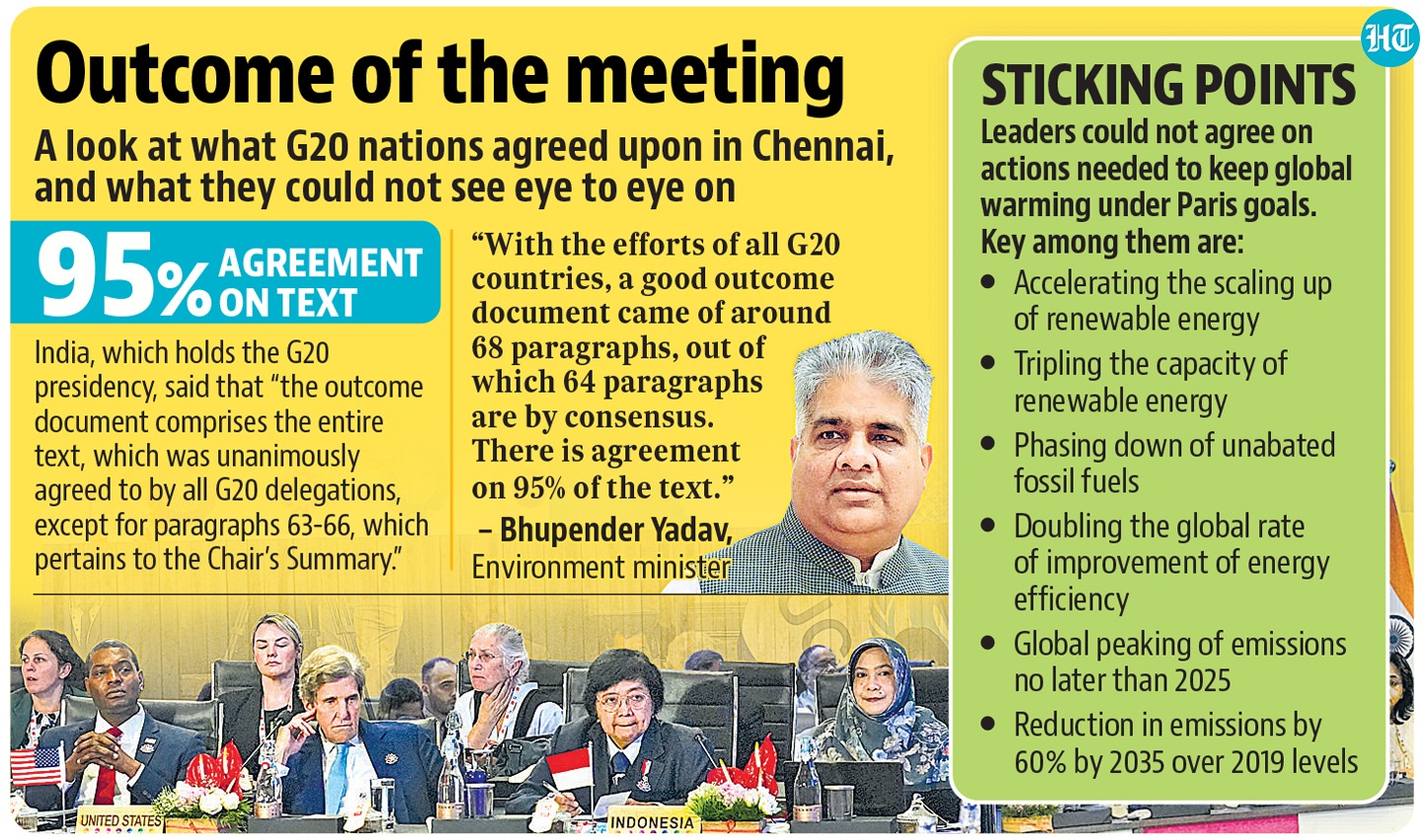
Among the participants were climate and energy ministers of all G20 nations, US special climate envoy John Kerry and COP28 president-designate Sultan Al Jaber.
Experts and climate ministers of several countries expressed dismay at the lack of progress on Friday.
Simon Stiell, the UN Climate Change executive secretary, said in a statement on Friday that the G20 ministerial may have been a “waste of emissions” with 35 ministers and several delegates flying in from different parts of the world for meetings but there being no progress.
“The point I’m making is that this forum has both precedent and obligation to demonstrate leadership on crises and as I laid out in my opening — this is a crisis. Our ministerial convenings must deliver progress. It is a colossal waste of time and emissions for us to gather, if our intention is merely to reiterate what we already know,” Stiell said.
“Let me highlight a few specifics areas of consensus or suggested solutions from recent meetings that we could be taking forward: Phasing down fossil fuels is essential and inevitable,” the UN official added.
The final meeting of the climate-related talks between the G20 countries before the presidency passes on from India came a day after UN chief Antonio Guterres warned: “Climate change is here. It is terrifying. And it is just the beginning. The era of global warming has ended; the era of global boiling has arrived.”
Guterres was referring to projections that showed it was inevitable that July will become the hottest month ever recorded, with large swathes of the world registering blistering temperatures and raging wildfires.
And a day later, the G20 ministers concluded the meeting with no discussion on gaps in climate scenarios and models, depleting carbon budgets, historical, current and projected emissions, investment requirements in clean energy technologies to reach net zero.
But it became clear that countries were relying on carbon capture — a still-nascent approach of taking carbon out of the atmosphere — and storage is being considered as a major means of mitigation by some G20 countries.
“Some G20 members also stated that both emissions reduction and removals are important for achieving the temperature goal of the Paris Agreement. Some G20 members stated the need for reaching net zero by 2040 by developed countries,” the chair’s summary said.
“This means that there will be no progress at COP28 which is disastrous in view of recent heat waves, floods, wildfires, loss of glaciers we are seeing,” said a European country’s minister, asking not to be named.
“Countries are not ready yet. We have to understand that countries are holding on to their positions based on their economic priorities and it is only natural. The readiness will possibly come after the global stocktake this year at COP28 when they are told very clearly that this is catastrophic,” said an Indian official, who did not wish to be named.
The global stocktake will review whether the commitments made under the 2016 Paris Agreement are leading to any of the agreed upon objectives of keeping global warming to well below 2°C (and striving to restrict it to 1.5°C) above pre-industrial era temperatures.
At present, the world is believed to have warmed to around 1.2°C since pre-industrial times.
The divides on climate cut across several lines, including wide differences between developing countries — which point out that rich nations must do more since they have historically spewed most the carbon causing warming today — and rich countries that insist all nations must stop using cheaper but more polluting fossil fuels.
“On loss and damage there is clear expectation that we will deliver on the task parties set themselves at COP27 — to operationalise arrangements, including the fund. We must keep 1.5°C alive, for instance through global 2030 targets on renewables, energy efficiency and economy-wide emission reduction targets, covering all greenhouse gases,” Stiell said.
Steill added that there was a need for “tangible movement on climate finance, which is essential to all other workstreams”.
According to those attending the meeting, Saudi Arabia and a few others are strongly against having agreement on peaking emissions in a joint statement that was abandoned ultimately. On Friday, ministers at the Chennai gathering also said China and the US had reservations with specific targets as well.
Apart from the disagreements on climate mitigation; the G20 also had no consensus on Carbon Border Adjustment Mechanism (CBAM) and the ongoing war in Ukraine.
Also read: Bharat Mandapam in Delhi to be open for bookings after G20 in Sept
The G20, however, unanimously recognised the importance of Paris Agreement goals. “We acknowledge that the impacts of climate change will be much lower at a temperature increase of 1.5°C compared with 2°C and reiterate our resolve to pursue further efforts to limit the increase to 1.5°C. Further, we will strive to implement, as appropriate, nature-based solutions, ecosystem-based approaches and other management and conservation approaches for mitigation and adaptation action while ensuring relevant social and environmental safeguards,” the outcome document said.
“Despite the Indian G20 Presidency’s work to achieve ambitious outcomes across both the G20 Energy Ministerial and Environment and Climate Ministerial, the text indicated that negotiations were mired in differences, with countries failing to rise beyond politics. Ministers highlight that it is imperative to use the best available science for effective climate actions, but the outcomes, especially on energy, leave a lot to be desired.,” said Madhura Joshi, senior associate, Fossil Fuel Transition Team, E3G.
HT reported on July 23 that the G20 energy track in Goa was unable to reach consensus issues such as trebling of renewable energy deployment and phasing down of fossil fuels. This meeting too concluded merely with a chair’s summary, instead of a communique. It was clear from the summary that some G20 members did not support the language on phasing down of fossil fuels and trebling of renewable energy deployment.