
 E-Paper



Grain lustre, procurement, income: The 3 big troubles of wheat farmers now
In March, torrential rains and hail lashed Rajasthan, Punjab, Haryana, UP, and MP—often referred to as food-bowl states—flattening fields with standing crops.


New Delhi/Bathinda: Kamaljeet Singh from Bathinda’s Dialpura Mirza village is a distressed man: the hailstorm that struck in the early hours of March 25 has left him facing a near-total loss of crop and income. “A cluster of 10-12 villages in Phul block was hit by a hailstorm nine days ago. The crop that was in the final stages of maturing was unable to bear the weight of hail stones.”
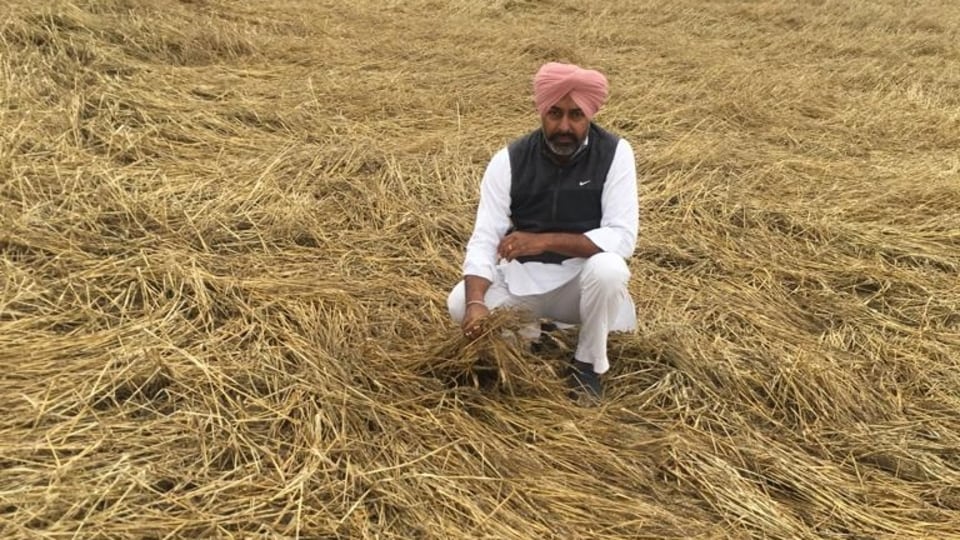
Singh, 41, said he spent nearly ₹7 lakh on planting wheat on the 45 acres that his family owns. “The crop in our entire field was destroyed. My family elders said that this is the first time they have witnessed a hailstorm of this scale.”
A series of untimely rain, hail and storms battering India’s fertile wheat belt in northwestern states since mid-March has left at least a quarter of a million farmers like Singh staring at losses due to widespread damage to winter-sown crops.
The wet, squally weather pattern caught the government and farmers off-guard: authorities were on a nationwide alert for possible crop-shrivelling heat waves after the India Meteorological Department (IMD) warned of an unusually hot early summer in the second week of February.
Instead, in March, torrential rains and hail lashed Rajasthan, Punjab, Haryana, Uttar Pradesh, and Madhya Pradesh—often referred to as food-bowl states — flattening fields with standing crops. These states produce nearly all of the wheat in India, the world's biggest producer after China.
Starting March 6, hailstorms lashed Madhya Pradesh — till March 24, an estimated 150,000 hectares of wheat, gram and mustard crops in 300 villages across 20 districts of Madhya Pradesh have been destroyed. The principal secretary of the agriculture and farmers’ welfare department said the loss of wheat was close to a per cent of the total production. Elsewhere, the damage to the wheat crop, a staple in the northern belt, was worse.
In Punjab, for instance, over 1.4 million hectares crop area (nearly 40% of total wheat sown area) was affected in the first spell of rainfall, high-velocity winds and hailstorm starting March 24. The subsequent spell which began on March 30 (and continued well into Monday in different parts of the state) multiplied the damage.
In Rajasthan, 24 districts were affected by untimely rains and hailstorm starting March 16, and at least 945,000 hectares of sown crop land sown with wheat, gram, barley, mustard, and cumin has been damaged. In Uttar Pradesh, at least 175,000 farmers have faced crop damage – a total of 35,480 hectares in 11 districts were hit by rains that started on March 15.
Haryana reopened its online portal, Kshatipurti, where affected farmers can upload information on the extent of damage, after the state saw a fresh spell of rain on April 1. Initial reports from the districts indicated that at least 7 lakh acres of standing crops, including 500,000 acres of wheat, have been affected. The state has 5.87 million acres under wheat cultivation.
Haryana deputy chief minister Dushyant Chautala said that 125,000 farmers have registered damages to their crop, but the number is going to increase.
“The damage is certainly more than what happened in the first spell [of rainy weather]. A girdawari [a term used to assess the loss to crop] has been ordered by the chief minister Bhagwant Mann,” said the director of Punjab’s department of agriculture, Gurvinder Singh.
Singh, however, made an informed guess: the overall agricultural yield will suffer by at least 15%, and the total wheat production, earlier expected to be around 17-17.5 million tonnes, is now expected to be lesser by at least 3 million tonnes. The quality of grain has also suffered, and more shrivelled and discoloured grain is expected to hit the markets, he said.
Impact: From procurement to grain lustre
India is likely to see a lower wheat output than projected for the second straight year. In March 2022, a prolonged heatwave, just when wheat was being harvested, crimped output of the staple by 2.5% to 106 million tonnes even as exports rose due to high global prices because of the Ukraine conflict.
This stocked domestic shortages. The government’s own purchases, or procurement, for state-held granaries fell to a 15-year-low at 18 million tonnes. Consumer cereal inflation rose to a record high. It stood at nearly 14% in February. This year, therefore, it was crucial to have bountiful harvests.
India officially forecast a record wheat output of 112 million tonnes. Wheat is sown in November and harvested at March-end. “Output could fall by a million tonnes but we don’t have estimates yet,” a central government official had told HT last week.
The wet spell has set back procurement, which might take at least two weeks to start in UP, Haryana and Punjab, said an official, requesting anonymity. “The delay in harvesting and procurement is good because sunny weather expected from now on will evaporate excess moisture from grains, restoring some of their quality .”
The big hit: Farm incomes
Farm incomes have already taken a hit. Nearly 80% of wheat being brought to the market is soiled and of sub-optimal quality, said CP Gupta, the proprietor of Cheshta Enterprises, a large wheat-trading firm in Kota, Rajasthan. “Fields are inundated. Discolouration of grain is widespread. Wheat price has fallen.”
High moisture content, loss of lustre, or the natural gloss of grains and puffiness mean farmers have lost their bargaining power in private markets. The staple, mostly soiled, is selling between ₹1,800- ₹2,040 a quintal (100 kg), whereas the federally fixed minimum support price (MSP) is ₹2,125 per quintal, according to Gupta.
In a relief to farmers, the Centre on March 31 relaxed quality specifications of wheat eligible for procurement from Madhya Pradesh and more states are likely to be given the benefit based on assessments. Procurement refers to the Centre’s purchase of cereals at MSP.
Wheat in MP with lustre loss of up to 10% would be procured without any cut in the value of MSP. Grains with lustre loss of more than 10% and up to 80% will be procured with a cut in value of 0.25 of MSP.
Other states have requested this too. UP’s additional chief secretary, agriculture, Devesh Chaturvedi said the government would soon send a proposal to the Centre, seeking permission for procurement of low-quality wheat from affected farmers at the MSP.
“We are collecting reports from districts where the quality of wheat has suffered. Once we receive reports, we will send a proposal to the Centre, seeking relaxation in conditions related to wheat purchase so that even low-quality wheat also could be procured from farmers at the MSP in the districts concerned,” Chaturvedi said.
Punjab’s food and civil supplies department that procures food grain on behalf of the Centre has also sought a similar relaxation from the Union ministry for food and public distribution.
While policy mostly focuses on big cereals, the bedrock of the country’s food security, relief often bypasses small farmers and growers of horticulture produce, which can stoke food inflation as much as cereals.
Rajasthan, which is assumed to be a desert state, is a major producer of items such as oilseeds, gram, wheat and spices. “Fenugreek, oilseeds and an array of vegetable crops have been damaged in Uttar Pradesh, Haryana, Punjab and Rajasthan, apart from wheat,” said Ramandeep Singh Mann, an independent farm expert.
The rough patch in agriculture and risks to the sector, which still employs half of all Indians, isn’t over yet. As a caution, the government has said it will not lift a ban on wheat export and continue with curbs on overseas shipments of rice.
This summer, India could be staring at an El Nino, a weather pattern known to weaken the monsoon and trigger drought. There is an almost 50% probability of El Nino conditions prevailing during summer months, according to the latest probabilistic estimates of both the US National Oceanic and Atmospheric Administration (NOAA) and India’s IMD.
“The wet spell has replenished soil moisture and will help in robust sowing of summer crops since forecasts point to a dry, very hot summer. That’s the silver lining,” said Mahesh Palawat, a meteorologist with Skymet, a private weather firm.
Climate scientists have warned that scorching heat waves, among other extreme weather events, in India are “most certainly” being driven by global warming, posing a risk to the country’s food security.
Scientists at the Indian Institute of Tropical Meteorology, Pune, have concluded that heatwaves in India are being driven by global warming-induced changes in weather patterns. “The only reason behind these heat waves is global warming,” said Roxy Mathew Koll, a climate scientist at the Indian Institute of Tropical Meteorology.
The immediate concern for farmers however is quick compensation. Assessing crop damage is the sole responsibility of states and is a time-consuming process.
According to UP relief commissioner Prabhu Narayan Singh, only farmers whose loss of affected crop area is 33% or above qualify for compensation under the Central government’s guidelines. “Taking the 33% and above loss criteria into account, we have identified 35,480.52 hectares of crop area (all crops) damaged due to rains and hailstorms so far since March 15,” he said.
₹5,859.29 lakh has already been given as compensation to 107,523 affected farmers, he said.
The work to identify losses of less than 33% is in progress and the final figures are expected only after harvesting.
“When we burn stubble and pollution reaches Delhi, satellite tracks it immediately and we are fined. Why can’t satellite capture wheat damage as quickly,” wheat trader Gupta quoted a farmer as telling him.
Vishal Joshi, Brajendra K Parashar, Gurpreet Singh Nibber, Shruti Tomar, Neeraj Mohan and Sunil Rahar have contributed to this story.
 ABOUT THE AUTHORZia Haq
Zia Haq reports on public policy, economy and agriculture. Particularly interested in development economics and growth theories.


