E-Paper



Haryana challenges stay on job quota law in apex court
The Haryana law provides reservation for a “local candidate”, who has been defined under the Act as someone “domiciled in State of Haryana”.

 Prefer HTon Google


The Supreme Court on Friday agreed to urgently hear an appeal filed by the Haryana government, complaining that the Punjab & Haryana high court did not duly follow the principles of natural justice when it put on hold the state government’s law reserving 75% private sector jobs, paying up to ₹30,000 a month, for local candidates.
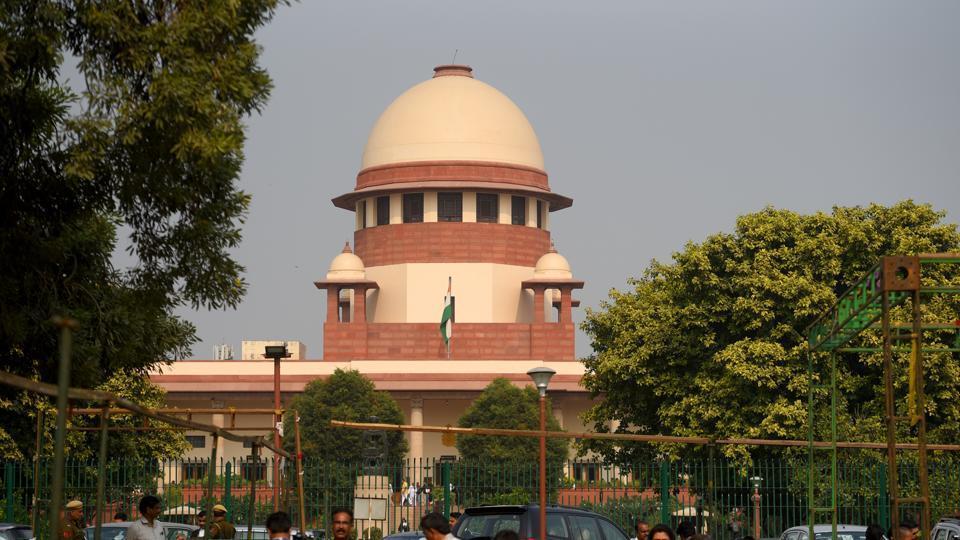
A bench, headed by Chief Justice of India NV Ramana, directed that the state’s appeal shall be listed on Monday after solicitor general Tushar Mehta requested for an urgent hearing on behalf of the Haryana government.
“After giving me opportunity of arguing just for 90 seconds on Thursday, the high court stayed the legislation. The high court order is yet to be released. We are requesting an urgent listing. Kindly, list our petition on Monday, subject to our placing the high order on record,” the S-G urged the bench, which also comprised justices AS Bopanna and Hima Kohli.
Accepting his request, the CJI directed: “List this matter on Monday subject to placing the high court order on record.”
In a decision that came as a setback to the Manohar Lal Khattar government, and a relief to industry bodies that have opposed it, the high court on Thursday stayed the law as it failed to find merit in the state’s emphatic arguments on treating the legislation prima facie valid in the interests of the unemployed local youth in the state.
Following a hearing that lasted less than two minutes, the HC bench of justices Ajay Tewari and Pankaj Jain suspended the operation of The Haryana State Employment of Local Candidates Act, 2020, and admitted a clutch of petitions filed by various industry bodies, including Faridabad Industries Association, Rewari Chamber of Commerce and Industries and Gurgaon Industrial Association.
The Haryana law provides reservation for a “local candidate”, who has been defined under the Act as someone “domiciled in State of Haryana”. Under the law, every employer is required to employ 75% “local candidates” for posts where the gross monthly salary is not more than ₹30,000. The Act, which covers private companies, societies, trusts and partnership firms, came into force from January 15. The law was made applicable for 10 years.
The petitioners argued before the HC that the Act is unconstitutional on account of being excessively vague, arbitrary, and also against the basic principle of meritocracy that was the foundation for businesses to grow and remain competitive.
It will affect productivity and industrial competitiveness and the post-Covid 19 recovery of the economy, the pleas said, adding that the government, by introducing this policy of “sons of the soil” wants to create reservation in the private sector, which is an infringement of constitutional rights of the employees and citizens of India because private sector jobs are based on skills and an analytical bent of mind.
In its appeal filed in the Supreme Court on Friday, the Haryana government, regretted that the HC passed the interim order a day ago “without affording an effective hearing to the State and without hearing the law officer (S-G) appearing for the State in the hearing which lasted only one minute and thirty seconds.”
“It (order) has been passed in violation of the principles of natural justice. It is submitted that the hearing granted by the Hon’ble high court was a mere empty formality, whereby, the high court, with a pre-determined conclusion, opened the hearing by saying that the Act is liable to be stayed,” added the petition, drafted by advocates Rajat Nair and Madhav Singhal.
Dubbing the stay order “ex-facie unsustainable,” it further said that the HC order is in contravention of the law laid down by the Supreme Court that a legislation pertaining to reform or change should not be stayed unless a party challenging it can show the legal provisions to be manifestly unjust or glaringly unconstitutional.
The state government added that there is a presumption of constitutionality attached to the impugned Act, besides the fact that the law that has been enacted is within the legislative competence of the state.
The petition, filed through Haryana government’s additional advocate general BK Satija, stated that the Act makes a “geographical classification” on the basis of domicile and in furtherance of the fundamental right to life, livelihoods and health conditions of persons domiciled in the state. It claimed that there is no restraint against a state legislature from creating “geographical classification” to incentivise and grant concessions to citizens or industrial units.
The state government further submitted that the Act makes a valid classification by grouping together local candidates who are unemployed and domiciled in Haryana, irrespective of their caste, creed, sex, place of origin or place of birth and their social status, so as to achieve the object of providing suitable employment in the private sector.
“Hence, domicile of an individual unemployed youth is the basis on which classification has been done and the object of providing suitable employment locally is achieved based on this classification, which nowhere violates any provisions of the Constitution of India...The aim and objective of the state legislature is nowhere to bar employment of the person out of the state of Haryana,” maintained the bench.
The appeal pointed out that acquisition of agricultural land in Haryana has resulted in high rates of unemployment and therefore, the 2020 Act was brought in to boost local employment. “The intention of the state legislature remains to cater primarily to provide livelihood to the local unemployed youth locally as well as to provide low paid workforce to the industry/factory in the state.”
The state government has also sought to highlight that influx of a large number of migrants, competing for low-paid jobs, places a significant impact on local infrastructure and housing and leads to proliferation of slums.
It added that the 2020 Act not only protects the fundamental rights of the domiciled citizens of the state but also prevents infringement of the fundamental rights of migrant workers, who it claimed, are at the mercy of employers
The petition further said that the HC failed to appreciate that the Act would provide tremendous benefits to private employers by making a qualified and trained local work force available.