
 E-Paper



Blood spilled as love bloomed in a Bihar village’s Maoist trenches
A relationship in the trenches, so to speak, grew into love and they decided to run away together

 Prefer HTon Google


Kumartadi is eerily quiet, the kind of quiet that can only exist in a forest. An 8km dirt road, traversable only by two-wheeler or on foot, is the only meandering path in, framed by a thick, dark cover of green. For all of those eight kilometres, there is no electricity pole or drinking water pump, not one school, nor one primary health centre.
Kumartadi is haunted by death.
At its entrance are the burnt remains of two thatched homes, blown up six years ago, and a half-burnt tractor. Once a thriving village of 250, there are only 25 left, mostly women, children or the elderly; their fearful eyes following every visitor in, or peeking out from behind the huts they hide in at the slightest hint of unfamiliar movement.
Around one home in particular, there is an even sharper silence.
Inside there is a dust-caked lantern, and a rusted shovel. It was out of this home that on July 13 2017, 50-year-old Meena Devi emerged to stand trial in a Maoist kangaroo court and was beaten to death with her two sons, aged 17 and 13. Since then, Kumartadi has been haunted, and over the next six years, three more from the same extended family have turned up dead, the latest on July 20 this year, showing in part, that while left-wing extremism has faded in Bihar, there is still a kick left.
It all began with a love story, under the shadow of the gun.
The relationship that started it all
Ranjit Koda was Kumartadi’s heart-throb.
He was a musician; the main act in a dhol-tasa troupe that went from village to village. He was a sportsperson; the captain of the village football team. By June 2009, when he was 16, Koda married Anita Devi, and fathered two children with her. But marriage did nothing to dim his star and Koda remained popular, a group of affected young men always buzzing around him.
He caught the eye. But not always from the most welcome quarters.
With a densely forested topography and a porous border with Jharkhand, Bihar’s Jamui is one of the few districts in the state that still has an active Maoist presence. By 2011, the Purvi-Bihar Purvottar Jharkhand Special Area Committee (PBPJ-SAC) of CPI (Maoist), the division that operates in the area, wanted Koda to join their cadre.
“At one point in 2011, they arranged a meeting in the village and threatened me with dire consequences if I did not join,” Koda, now 30 years old, said. There was little choice, and Koda acquiesced. His first roles were menial; he continued to live in the village, and was asked to prepare meals for senior cadre when they visited. Then, he began to travel, and would go from village to village to organise entertainment programmes for the Maoist leadership. By May 2012, they thought Koda was ready. He was told to camp in a forest in Paisra, and with eight to 10 other men was sent to the Abhaypur railway station to snatch weapons from the police, a plan that eventually failed when the personnel opened fire and they had to retreat.
By April of next year, Koda was fed up with life with the guerillas and ran back home. But the Maoists followed him, and in October 2014, asked him to return. He refused at first, so they torched his tractor. Again, there was really only one choice.
Koda said that in January 2015, the Maoists issued a diktat to villages in the area, asking them to send their women to the organisation. Afraid of the consequences, 15 women joined. One of them was 16-year-old Sunita Devi, Kumartadi’s prodigal daughter.
Remote as it is, girls travelling to school from Kumartadi, where most young men drop out and migrate for work, are rare. But Sunita persevered, all the way through class 10, and passed her matriculation in 2014 with a first division. The village remembers a beaming Meena Devi, her mother, bursting with pride. “Sunita was the first tribal girl in the village, and maybe the entire area, to have done it,” a villager said.
She applied for intermediate — a colloquial term for class 11 — in a junior college in Khaira block. But news of her academic excellence had spread, even to the Maoists; the “war” always requires written propaganda, pamphlets, posters, press notes. Devi joined, and began writing work, translating letters and documents.
“I still remember how happy I was when I got ₹10,000 from the government for clearing matriculation with a first division. I gave it to my mother. But destiny intervened, and the Maoists asked me to join. They wanted more young girls in the party, so they forced me to bring my friends. All of us would stay together in different homes in villages. I would write, but most would sing. We were told we would be given arms training when we were older,” Devi said.
In 2015, she came into extended contact with the young and energetic Ranjit Koda. He was a familiar face from her village, six years older to her.
A relationship in the trenches, so to speak, grew into love and they decided to run away together. Ranjit left the Maoist camp first, but stayed in touch with Sunita. Dismayed at an initial delay, she threatened suicide. Ranjit hatched an escape plan, met her at Malaypur in Jamui, and both of them left for Mumbai by train in early 2016.
They got married and lived under the shed of an under construction building in Kalyan, where Ranjit worked as a labourer. They were poor but happy. At one point, several months in, he even told his first wife Anita and his two children to join them.
But Maoists do not take betrayal lightly. They did not condone two of their cadres falling in love, and fleeing the war. They began threatening Sunita’s family. “Despite her reluctance, she had to return in 2016 to protect them,” said 90-year-old Jhari Koda. Ranjit, afraid of the consequences, did not return immediately.
But things were to get worse. “Barely a few months after Sunita returned, there was an encounter outside the village with the CRPF’s COBRA battalion in which two Maoists were killed. The Maoists increasingly suspected that Sunita had passed on information, because she had just come back,” Jhari Koda said.
On July 13, a kangaroo court was called by Pravesh Da, the in-charge of the (PBPJ-SAC) special area committee of the CPI(Maoist). Sunita was at home, but not on trial; they still wanted her with them. But her mother and two brothers, Shivkumar Koda(17) and Bajrangi Koda(13) were suspects because the Maoists believed that they had passed on information, and also angry that they had allowed Sunita to marry. “On that day, some female cadres were asked to bring Meena Devi, who was asked to be well-dressed. She arrived at the clearing with her year-old daughter, Khushi, in her arms. The infant was separated forcefully from her lap, and fell to the ground. Devi and her two sons were beaten to death by the order of the court. As the Maoists left, a wailing Khushi was attended to by the villagers. The three bodies were found the next day near the Kukur Jhap dam. This scared all of us, and when the police arrived the next day, most were shifted to the Pacheshwari upgraded high school,” Jhari Koda said.
Jamui superintendent of police Shaurya Suman said an FIR was lodged in the case. “Some suspects have either surrendered or been neutralised while many are still at large. The police is committed to making the area free of Maoists and action continues,” he said.
The chase
Stunned by the triple murder, Koda returned from Mumbai; Sunita did not join the Maoists; and both resided among the residents of Kumartadi that lived cloistered together at the Pacheshwari upgraded high school.
But the Maoists now had one agenda; kill Ranjit Koda.
On Holi day in March 2018, as dusk settled over Pacheshwari, the school suddenly went dark. Maoists had surrounded the premises, and as they entered, they made it clear; they were looking for Ranjit Koda and his two brothers. Madan Koda, the eldest brother, was asleep, and was shot dead. The second brother, Pramod Koda, also elder to Ranjit, was shot in the back attempting to flee.
Koda only survived through sheer dumb luck. He had gone out to the toilet. “I stopped near a hand pump to fill water in a bucket when I dimly saw several people standing outside the school. I knew some of them, and realised something was wrong. It was dark, and I was able to move away without being noticed. It was only later I found out that both my brothers were killed,” Koda said.
“In this case too, an FIR has been registered and investigations are still underway,” Suman said.
Shaken by two more deaths, the Jamui district administration shifted the villagers again, this time to an upgraded middle school in Korasi under the Lachhuwar police station. Lacchuwar is bustling, known for its Jain temple and a Sashastra Seema Bal camp. It would be safer, the police said.
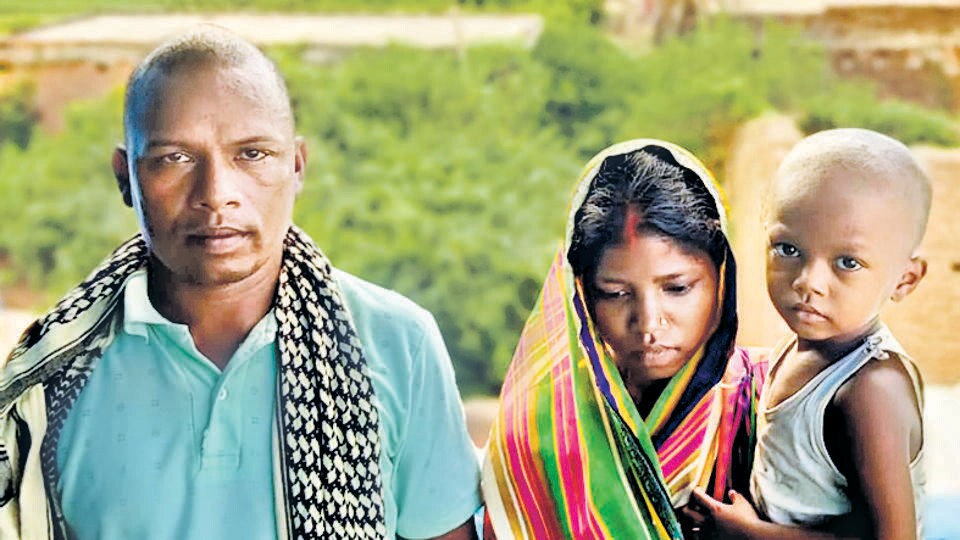
It is here that Koda has lived since, on the first floor of the school, from where he has a clear view of the surroundings. In the room, he lives with Sunita and their young children Dhanraj and Lakshmi Kumari, while Anita Devi and his two children with her live at the makeshift camp just outside.
During the day, when the school is in operation, Koda works as a farm hand in nearby farms, or as a labourer. “I was assured that I would be appointed a special police officer, but that has not happened thus far,” Koda said.
He was lulled into the sense that the worst had passed. But two weeks ago, he got a reminder that his was a life in exile.
On July 20, his sister’s husband Mahendra Koda disappeared from the village of Tamkolia Korasi. A day later, his body was found in the Kukur Jhap dam, the same place the bodies of Meena Devi and her two sons were discovered six years ago. There were injuries caused by sharp edged weapons, and there was a blood caked rope tied around his torso. His family believes he was tortured.
The motive is still unclear, but Ranjit Koda fears the worst. “My brother-in-law had received a threat from Maoists who wanted that he ask me to withdraw the case involving the murder of my two brothers. When I didn’t, they killed him,” Koda said.
SP Shaurya Suman said they had not been able to tie anyone, including Maoists to the murder. “The probe is being conducted from all angles,” she said.
The Bihar Maoist story
Bihar’s history of Maoism is long and storied, going back to the 1960s to a group called “Dakshin Desh” that operated first in Bengal and Eastern Bihar and then eventually became the Maoist Communist Centre. Through the last quarter of the twentieth century, Bihar became fertile ground for violence, the Maoists often pitted against upper caste groups such as the Ranvir Sena as well as the state. The Ranvir Sena faded around the turn of the century, but in 2004, MCC merged with the People’s War Group to become the banned CPI(Maoist). By 2012, 22 of Bihar’s 38 districts were the recipients of the Centre’s security-related expenditure(SRE), funds given to states to combat extremism.
More than a decade later, a combination of deepening politics, increasing urbanization, a fading ideology, and state intervention has meant that the number of SRE districts has dropped to 10. Of these, three, Gaya, Lakhisarai and Jamui, are considered seriously “LWE affected”, in an admission that in limited pockets, a battle continues to rage.
Jamui is close to the Bhimbandh forests that seep into Munger and Jharkhand’s Giridih. The Giddeshwar hills on the border of Jamui and Giridih are thickly forested and difficult to access, and these areas are still challenging for the police. “Maoists cannot face the police in the plains but it is difficult to counter them in hilly areas, considered their bastions, because they know the demography, strategically plant IEDs and influence locals,” a senior police officer said.
Still, senior police officers said, the district has made strides over the past three years, arresting 146 Maoists including zonal committee members, recovering 1,045 kilograms of explosives, 36 firearms and 664 live cartridges. Twenty-two Maoists, one of them in Jamui, have been killed in Bihar over the past five years.
Sushil Khopde, additional director general of police (operations) said the Maoists were being increasingly squeezed into isolated safe havens. “They are either surrendering or getting caught by the security forces that are entering the areas they were earlier comfortable in. The Maoists are not even getting fresh youth for recruitment,” Khopde said.
A third officer, however, admitted that the attacks on Koda’s family show that despite these advances, Maoists can still spread terror. “These incidents are on the wane though,” the officer said.
Back inside the room that is a tenuous sanctuary, in Koda’s mind, there is only one thing he can do to help.
“I cannot avenge my family because the Maoists are mighty, but the forces can. The police take me to raids to understand the way Maoists operate. I did not want to harm the Maoists. I just wanted to move and live my own life, but they didn’t allow it. Now, I have no option left.”


