
 E-Paper



Himanta Sarma for rules in CAA to protect indigenous Assamese
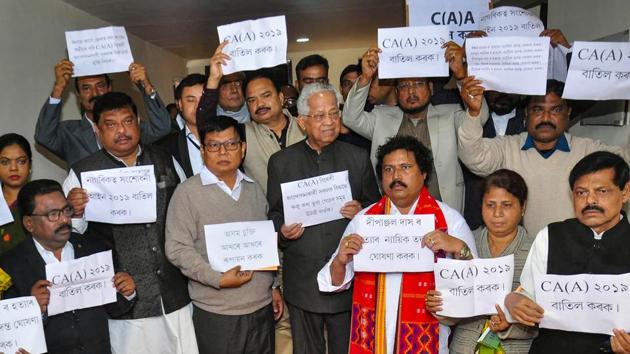
Sarma’s address came amid protests by Congress lawmakers, who shouted slogans inside the Assembly and staged a demonstration outside the House, seeking a discussion on the CAA.


Amid protests against the Citizenship Amendment Act (CAA), Assam finance minister Himanta Biswa Sarma told the state assembly on Monday that some proposals could be sent to the Centre to frame rules regarding implementation of the law to address the concerns of the indigenous population.
“The leader of the opposition has said that those who entered India would not be required to provide proof [for citizenship under the CAA] of when they crossed the border and anyone [even those who entered after the deadline] could say that they entered on or before [December] 2014,” said Sarma.
Sarma’s address came amid protests by Congress lawmakers, who shouted slogans inside the Assembly and staged a demonstration outside the House, seeking a discussion on the CAA.
“People have lost lives and those who are opposing the CAA are being arrested. By bringing the legislation into force, the Centre has violated the Assam Accord. All sections of Assamese society have come out on the streets to oppose the CAA,” said Congress leader Tarun Gogoi.
“If we think that we need to protect ourselves, this assembly has the right to ask Centre to include rules [for implementing CAA] that there should be clear proof of beneficiaries entering India on or before 2014,” said Sarma.
“Applications submitted for National Register of Citizens (NRC) could be one such proof. Secondly, there should be a time limit of 3 or 4 months during which people can apply for citizenship under the CAA. Lastly, there should be a guarantee that the deadline [of December 31, 2014] will never be extended in Assam,” he added.
The CAA was passed last month to fast-track the citizenship process for non-Muslims, who have entered India from Afghanistan, Pakistan and Bangladesh before 2015. Opponents of the CAA insist it violates the 1985 Assam Accord, which was signed following an agitation for the detection and deportation of undocumented immigrants irrespective of their faith. The accord set March 24, 1971, as the cut-off date for the detection.
Protests against the CAA first erupted in the North-east, especially in Assam, where residents fear the law could result in a fresh influx of outsiders.
All India United Democratic Front lawmakers, too, staged a sit-in demonstration in the Assembly against the CAA.
Protests against the CAA separately continued in Assam. “We are not going to rest till the CAA is repealed. In recent days, the state government has announced various schemes. We welcome them as they are due but that does not mean our protests would end,” said Samujjal Bhattacharya, the chief adviser to the All Assam Students Union, one of the organisations leading the anti-CAA protests.
Reacting to Sarma’s statements, Congress leader and Leader of Opposition in Assam assembly Debabrata Saikia said: “We oppose unconstitutional CAA. We would urge the state government to adopt a resolution in assembly rejecting the legislation. Congress would support the move.”



