
 E-Paper



How the Opposition lost Uttarakhand
In Uttarakhand, the Bharatiya Janata Party (BJP) changed its CM twice — in March and then in September last year — thus giving the state three CMs in a span of five years


To understand Uttarakhand, think of Punjab.
In Punjab, the Congress’s decision to change its chief minister (CM) led to the perception of a party in disarray and opened up internal squabbles in unprecedented ways, contributing to its defeat in the state. The primary opposition, the Aam Aadmi Party, capitalised on the churn and won a historic mandate in a state where the political playing field is deeply fragmented and winning an outright majority is hard.
In Uttarakhand, the Bharatiya Janata Party (BJP) changed its CM twice — in March and then in September last year — thus giving the state three CMs in a span of five years. It ran into trouble with its own religious conservative base over the relationship between the State and temples. It faced enormous criticism for holding the Kumbh Mela in the state, even as the second wave of Covid-19 was building up. It witnessed natural disasters, throwing open the debate about the implications of the development paradigm and climate crisis. And its third pick as CM, the current incumbent, Pushkar Singh Dhami, lost his own seat.
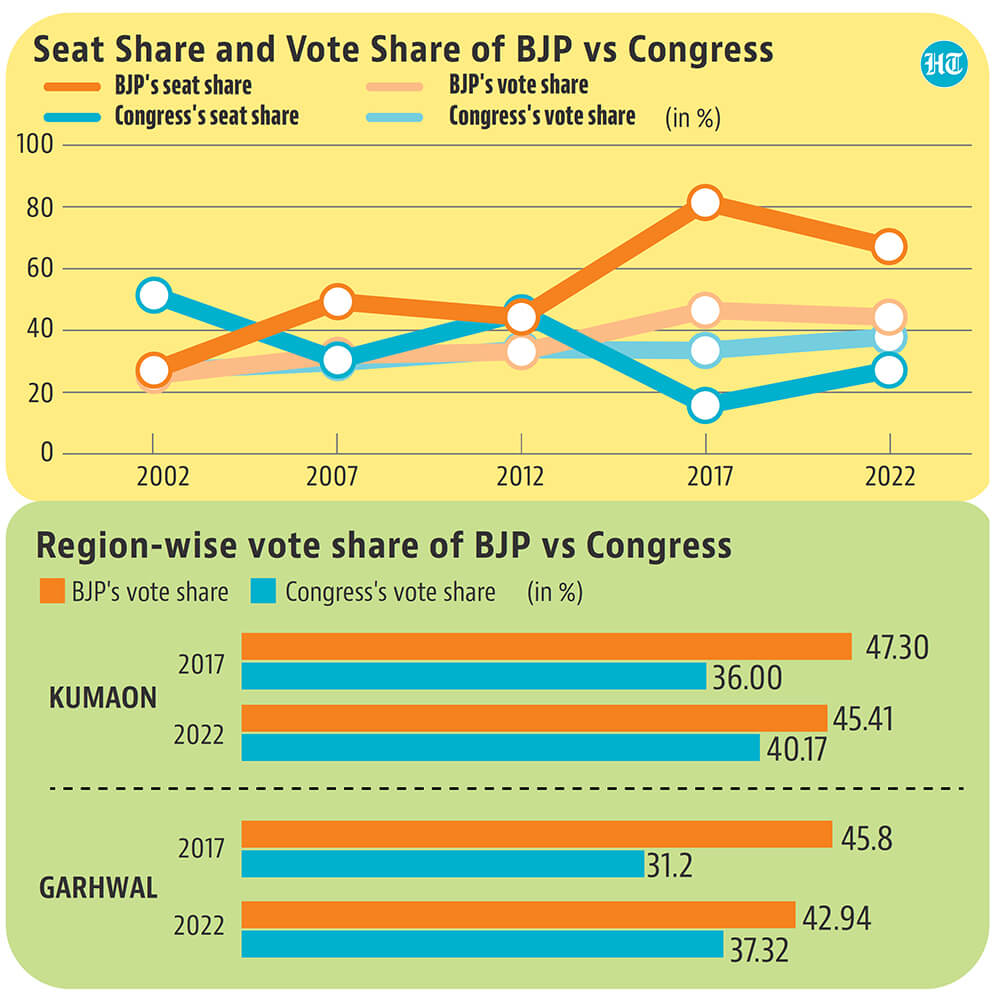
Yet, the Opposition, represented by the Congress, in what is fundamentally a bipolar state, was unable to capitalise on the political weaknesses and governance deficits of the regime in power. The BJP made history by becoming the first party in the state to return to power in its 22-year history.
That, in a way, sums up the story of the Uttarakhand elections.
The BJP displayed an ability to act on ground-level feedback and take difficult decisions — it knew that having Trivendra Singh Rawat in power ran the risk of alienating its base, and his replacement, Tirath Singh Rawat, hadn’t been able to put the house back in order, thus picking a third candidate in less than a year. It displayed an ability to keep its house in order despite this churn — which was a sign of organisational discipline. For a party that prides itself on offering stability, it recognised that it was associated with political instability, and invested considerable campaign resources and high-level attention to offset this perceived weakness in the state. And it sought to cement its base in both Kumaon and Gharwal, amplify its national security credentials in a state that contributes substantially to the armed forces, and reiterate its commitment to religious institutions, both as a cultural symbol but also an economic multiplier. And it focused on its welfare delivery. All of this was supplemented by the overarching popularity of Prime Minister Narendra Modi in the state.
On the other hand, the Congress first sent its most prominent state-level face, Harish Rawat, to douse — or some would allege ignite — the fires in Punjab and lost precious time. It then was unable to resolve a leadership tussle between Rawat and Pritam Singh. It failed to introduce a new vocabulary that would wean away voters, who were actually looking for viable alternatives, from the BJP. It failed to build a political constituency on issues of development, environment, and political stability. And it did not have a language to counter the BJP’s assertion of religiosity.
The BJP won Uttarakhand for sure, but in this victory, its biggest asset was a truly dysfunctional Congress, both in Delhi and Dehradun.


