
 E-Paper



HT This Day: March 26, 1953 -- Andhra state from Oct 1
An Andhra State comprising the 11 Telugu-speaking districts of the present Madras State and a part of Bellary will come into being on October 1.

 Prefer HTon Google


An Andhra State comprising the 11 Telugu-speaking districts of the present Madras State and a part of Bellary will come into being on October 1.
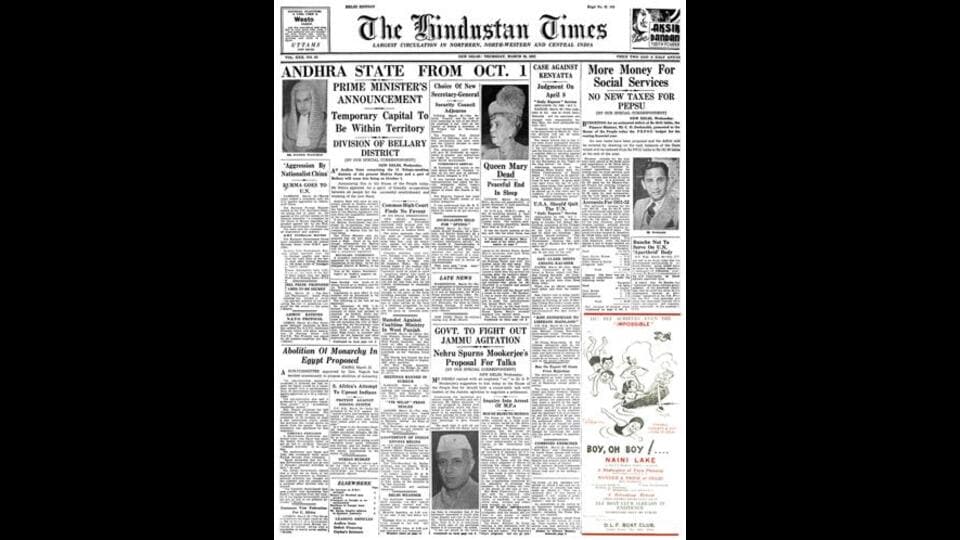
Announcing this in the House of the People today, Mr. Nehru appealed for a spirit of friendly co-operation between all people for the successful establishment and working of the new State.
Andhra State will have its temporary capital in Andhra territory itself. The decision about its site has been left to the Andhra members of the Madras legislature who will form the Legislative Assembly of the new State.
It has, however, been agreed, and the Madras Government has promised its co-operation, that some of the offices of Andhra State might continue in Madras City for the time being.
The Prime Minister also announced that the new State will have a High Court of its own, though temporarily the Madras High Court will continue to function for that State. It will have only a unicameral legislature.
BOUNDARY COMMISSION
A boundary commission is to be appointed to determine the exact boundaries of the State. As for the bilingual district of Bellary, it has been decided that three of its taluqs should go to Andhra and the six Kannada-speaking taluqs To Mysore.
Legislation to give effect to this decision will be introduced in the next session of Parliament.
The following is the text of the statement:
On December 19. 1952, I informed this House that the Government of India had decided to establish an Andhra State, consisting of the Telugu-speaking areas of the present Madras State, but not including the City of Madras, and that the Government were appointing Mr Justice K. N. Wanchoo. Chief Justice of the Rajasthan High Court, to consider and report on the financial and other implications of this decision and the questions to be considered in implementing it.
Mr Justice Wanchoo conducted this inquiry and presented his report on February 7. A copy of this report is placed on the table of the House. Other copies will be available to members.
The Government have given the most careful consideration to Mr Wanchoo s report and to the other matters connected with the establishment of Andhra State. Some of these matters, more especially those relating to financial implications and the effect on the services, require further detailed consideration which they are receiving. There are, however, certain questions of a political nature which have given rise to some controversy, and which have to be decided immediately so that further progress may be made. In regard to these, the Government have arrived at certain decisions.
BASIC CONSIDERATIONS
The basic considerations which have to be kept in view are that an Andhra State has to be established and that it should consist of the Telugu-speaking areas of the pre-sent Madras State. Further that the City of Madras is not to be included in the proposed Andhra State. The new State, therefore, is consist of what might be called the undisputed Telugu-speaking areas of the present Madras State. At a subsequent stage, as I shall indicate later, a boundary commission or commissions may have to be appointed to determine the exact boundaries of this new state. As this investigation might involve some delay, it is desirable that the State should be constituted as early as possible on the basis of existing boundaries of the districts except, in one case, where the boundary might be according to taluqs.
Andhra State will consist of the following 11 districts: Srikakulam, Visakhapatnam, East Godavari, West Godavari, Krishna, Guntur, Nellore, Kurnool, Anantapur, Cuddapah and Chittoor. It will also consist of a part of Bellary district as I shall indicate later.
STATE CAPITAL
It is clear that the capital of Andhra State has to be in the territory of the new State. The Government are of opinion that the site of this capital should be determined by the Andhra people themselves through their Legislative Assembly.
A question has arisen about the temporary capital of Andhra State till adequate arrangements are made for the functioning of the permanent capital. It has been suggested that there is some convenience in this temporary capital being located in the city of Madras. While it is true that certain conveniences in regard to accommodation, etc., will result from this temporary location in the city of Madras, there are Important and, in the opinion of the Government, overriding considerations against this proposal.
It is desirable that, right from the inauguration of the new State It should have its political head- quarters in the State itself and should be enabled to function as a complete unit, freely and un- hampered by any other considerations.
The full integration and progress of the new State will thus be facilitated and any possible friction and complications, which might arise from the temporary location of the capital in the territory of another State, would be avoided. The location of the political capital of Andhra State in Andhra territory, right from the commencement, will also result in the development of normal and co-operative relations between the new State and the residuary State.
The Government, therefore, are of opinion that the temporary capital of Andhra State should be located in Andhra territory. This means that the seat of the Governor, the Ministers and the Legislature should be located in the territory of the new State. The decision as to the site of this temporary capital should be left to the Andhra people themselves and may be taken by the Andhra members of the Madras Legislature, who are likely, at a later stage, to form the Legislative Assembly of the new State. This decision should be indicated to the Government of India by the beginning of July, 1953.
While the capital of the State should be located within the territory of the new State from the date of the inauguration of that State, it is not necessary that all the offices pertaining to Andhra State should also be transferred to the Territory of the new State from that date Some offices of Andhra State might continue to be located in the city of Madras till arrangements are made for their transfer of Andhra territory. The Government are assured that the residuary State of Madras will make every effort to accommodate such offices.
The new Andhra State will be Inaugurated on October 1, which is considered a suitable and convenient date for this purpose.
FINANCIAL AID
It should be clearly understood that any proposals involving financial assistance from the Central Government would require the approval of the Central Government and would depend upon the capacity of the Central Government to render help. Therefore, any decision about the capital or any other matter involving financial assistance would require the approval of the Central Government in so far that financial assistance is concerned.
The Andhra Legislature after the inauguration of the new State, should decide upon the location of the High Court within the territory of the new State. Till such decision ‘s taken, the present Madras High Court will continue to function also as the High Court of Andhra State. During this period certain necessary conventions may be observed in regard to the administrative side of the High Court relating to Andhra as well as such other matters as may be considered necessary.
The legislature of Andhra State will consist of one Chamber only that is, Legislative Assembly, and there will be no second Chamber. As regards the residuary State of Madras, it should be left to that State to decide the future of its second Chamber.
The members elected to the pre-sent Madras Assembly from the areas which would form part of the new Andhra State should constitute, to begin with, the new Andhra State Legislative Assembly.
The case of Bellary District has to be considered specially and it cannot be treated as a single unit for attachment to any State. It is bilingual and considerable part of it has a clear majority of Kannada-speaking people. There are at present ten taluqs in this district. Six of these taluqs, namely Harpanahalli, Hadagalli, Hospet North, Hospet South, Sandur, and Siruguppa, have, each of them, a very large Kannada-speaking population.
Three taluqs. namely Adoni, Alur, and Rayadrug have each large majority of Telugu-speaking people. The remaining taluq of Bellary has a very mixed population and there are certain other factors also to be considered. The Government have, therefore, come to the conclusion that the three taluqs of Adoni, Alur and Rayadrug should form part of the new Andhra State and the six Kannada speaking taluqs, mentioned previously should form part of Mysore State. In regard to Bellary taluq the Government propose to consider the matter further and come to a decision later.
TUNGABHADRA PROJECT
One part of the Tungabhadra Project is situated in Hospet North taluq. The other part of it is in Hyderabad State. That part of the project in Hospet North taluq will thus be in Mysore State after the establishment of the Andhra State. This great project will feed not only those areas which go to the Mysore State but also some areas in Andhra State. Both these States will be especially interested in this scheme. Special arrangements should, therefore, be made for the joint control and supervision of the project by the States concerned in co-operation with the Central Government.
The Ministry of Irrigation and Power will, in consultation with the Ministry of Finance, the Planning Commission and the States concerned, work out the necessary financial and other arrangements and prepare a scheme for the purpose. Till the date of inauguration of the new State, the Madras Government will continue the work on the Tungabhadra Project, as before. From October 1, the States concerned will manage it with the assistance of the Central Government, in accordance with the scheme drawn up therefor. It is desirable that the work on the project should be continued under the present set-up till it is completed. A boundary commission or commissions will be appointed sometime after the establishment of Andhra State to determine the exact boundaries of that State and to recommend such adjustments as may be considered necessary in regard to the boundaries of that State with the residuary State of Madras and Mysore State.
The question of services and the financial implications of the formation of the Andhra State will be considered separately later. As far as possible the officers now serving in the Andhra area should continue. A committee of senior officers of the present Madras Government should, in consultation with an officer appointed by the Central Government, consider the adjustments that might be necessary between Andhra State and the residuary State of Madras in respect of the services.
Legislation to give effect to the decision to form an Andhra State will be undertaken during the next session of Parliament. Before the Introduction of such legislation, the “laws of the State legislatures concerned will be obtained, as required under Article 3 of the Constitution.
The Government earnestly trust that the creation of this new State, so long desired by the people of Andhra, will take place in a spirit of friendly co-operation between all the people concerned, so that the State might start under the most favourable auspices and lead to the progress and happiness of its people. The formation of the new State should not and will not come in the way of the cultural life of the city of Madras in which the people of Andhra have had such a great share. Full assurances have already been given by those in a position to give them that educational, hospital and other facilities will continue to be open to the Andhras in Madras city
I earnestly hope that the controversy, which has accompanied this issue of the formation of Andhra State, will now end and our united efforts will be directed to the successful establishment and working of this State.


