
 E-Paper



Jaishankar on US ties: Lack of understanding on India's cross-border terror concerns can impact relations
External affairs minister S Jaishankar said India’s concerns over terrorism must be better understood by its partners, including the US.

 Prefer HTon Google


External affairs minister S Jaishankar on Tuesday said India-US ties had faced “bumps” over the pace and complexity of trade negotiations, tariff uncertainty and differences over India’s concerns about terrorism originating from Pakistan.
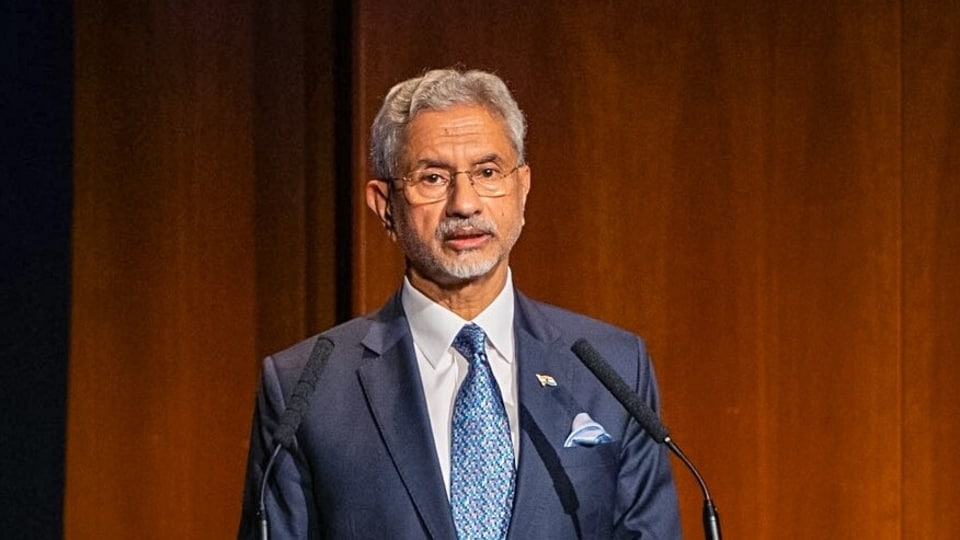
He said a lack of sufficient understanding or appreciation of India's concerns on terrorism could affect its relationship with its partners, as he also discussed the changing dynamics of ties between New Delhi and Washington.
Speaking at an Asia Society event in New York alongside former US diplomat Daniel Russel, Jaishankar said India's economic structure had made trade negotiations more complicated than initially expected, while changes in the US tariff framework had added another layer of uncertainty.
Deep Dive

“The relationship has had its bumps, I would say, primarily over the pace and the complexity of the trade negotiations,” Jaishankar said.
He said India's large base of small producers, agricultural producers and factories meant that negotiating a trade agreement involved addressing a complex set of interests.
Jaishankar said there was now “more or less an understanding” on the trade agreement, but a key question was what had changed on the US side.
“Today, I would say that more or less there is an understanding on the trade agreement. But the question really is what has changed on the US side,” he said.
Jaishankar pointed to changes in the US tariff framework after reciprocal tariffs were struck down, saying a new process under Section 301 was still unfolding.
ALSO READ | ‘Everybody’s dealing with everybody’: Jaishankar says world is headed for multipolarity amid churn
Terrorism remains a key concern for India
Jaishankar said terrorism remained one of India's primary concerns, particularly because of what he described as “decades” of attacks originating from Pakistan.
“For us in India, what is particularly important is the issue of terrorism,” Jaishankar said. “We feel that as a country, perhaps there are very few countries which have been subjected to the kind of terrorism that we have from a neighbour as part of a deliberate, conscious policy over many, many decades.”
He said a lack of sufficient understanding or appreciation of India's concerns over terrorism could also affect its relationships with partner countries.
“If something which matters so deeply to us, there isn't enough understanding or appreciation or empathy of that, I think that creates a problem too,” he said.
“If one of my primary concerns is not fully appreciated by my partner, then clearly there is an impact of that on the relationship,” he added.
Jaishankar's comments come amid a period of uncertainty in India-US ties, with the two countries negotiating a trade agreement while also dealing with disagreements over tariffs and differences in their respective approaches to relations with other major powers.
ALSO READ | Trade agreement can contribute to ‘better’ India-US ties: EAM Jaishankar
Jaishankar on India's ‘strategic autonomy’
Jaishankar also spoke about the changing nature of India's relationship with the US and Washington's engagement with multiple countries.
He said there had once been a narrative in the US that India should not have “too many options” and should focus primarily on its relationship with Washington.
“Today that pretence has dropped,” Jaishankar said, adding that “everybody is openly dealing with everybody else”.
He said the world was moving towards a multipolar system, with countries maintaining relationships with multiple partners simultaneously.
“Pretty much what people used to say about us, Washington is today practising with a great deal of gusto,” Jaishankar said, referring to the US managing its relationships with China, Russia, Ukraine, Asia and Europe.
“So actually, Washington was doing what India had practised,” he added.
Jaishankar's attack on Pakistan at UNGA
Jaishankar's remarks came days after he sharply criticised Pakistan Prime Minister Shehbaz Sharif at the United Nations General Assembly in New York.
Without naming Sharif, Jaishankar said Pakistan had “misrepresented facts” before the UNGA and called Islamabad a “serial practitioner of terrorism”.
“Yesterday, a serial practitioner of terrorism misrepresented facts before this assembly. Arguments were invoked to normalise terrorism and claim immunity from its consequences. That will not stand. Our right to defend ourselves will be exercised,” Jaishankar said.
“Friendship and goodwill cannot coexist with terrorism. It is for the perpetrator of terrorism to mend his ways,” he added.
Sharif, in his UNGA address, referred to the four-day military confrontation between India and Pakistan in May 2025 following Operation Sindoor. He said Pakistan exercised its “inherent right of self-defence” under Article 51 of the UN Charter. He also praised Pakistan's armed forces and credited US President Donald Trump with “timely intervention” during the confrontation.
India has maintained that the May 2025 ceasefire was reached through direct communication between New Delhi and Islamabad, with no third-party mediation.
Diplomacy in the social media era
Jaishankar also said diplomacy was no longer driven only by governments, leaders, ministers or diplomats, with public opinion playing an increasingly important role in the social media era.
“Foreign policy or diplomacy today is not just something which is conducted by states or leaders or ministers or even by diplomats,” he said.


