
 E-Paper



Imran ‘bloodbath’ speech at UN appears to echo JeM, LeT words
PM Khan’s speech predicting a “bloodbath” in the Valley, did not appear much different from the words used by Jaish-e-Mohammed (JeM) leader Mufti Rauf Asghar or Lashkar-e-Taiba (LeT) leader Talha Saeed routinely from Shaheed Chowk in Muzaffarabad in Pakistan-occupied Kashmir.

 Prefer HTon Google


When Pakistan’s National Security Adviser, Naseer Khan Janjua, met his Indian counterpart, Ajit Doval, in Bangkok on December 26, 2017, he told him that Rawalpindi GHQ had given a green signal to wage jihad after the Americans had convinced Islamabad that the Soviet Red Army’s main aim behind the 1979 occupation of Afghanistan was to capture the warm water port of Karachi. Janjua, a former Quetta Corps commander, said that Pakistan, without much ado, took up arms at America’s call. Pakistan’s Prime Minister, Imran Khan, repeated the same Army line in his September 27 address the UN General Assembly, exculpating home-grown jihadists of crimes.
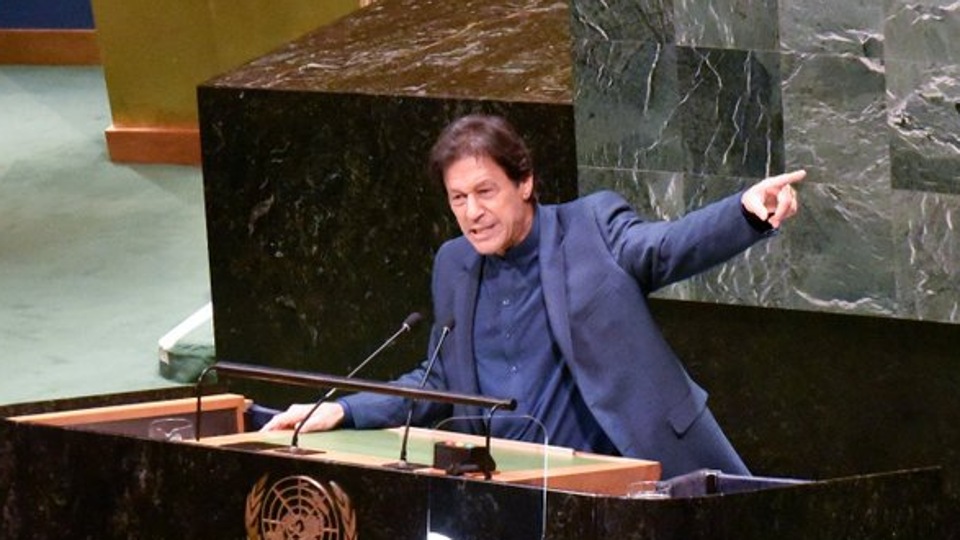
PM Khan’s speech predicting a “bloodbath” in the Valley, did not appear much different from the words used by Jaish-e-Mohammed (JeM) leader Mufti Rauf Asghar or Lashkar-e-Taiba (LeT) leader Talha Saeed routinely from Shaheed Chowk in Muzaffarabad in Pakistan-occupied Kashmir.
On September 13, at a rally in Gujaranwala, Hafiz Saeed’s son Talha said “jihad fi sabilillah (jihad in the name of Allah)” would bind Muslims, while the younger brother of Masood Azhar, Talha Saif, said the situation both in Afghanistan and Kashmir had reached a “turning point”. The common thread from PM Khan’s speech to Saif’s to Saeed’s was an attempt to incite Kashmiris to react with violence once the restrictions are lifted in the Valley.
Also read: ‘We spent millions on JuD,’ Pak minister admits funding banned terror organisation
The strategy to call on hinterland Indian Muslims to join the jihad in support of their brethren in the Valley is an old one, and has been rejected time and again. In a resolution, the Jamiat Ulema-i-Hind (JUH), the leading organisation of Islamic scholars based in Deoband, condemned Pakistan by saying that the enemy had made Kashmir a battlefield using Kashmiris “as a shield”, and supported Indian Parliament’s decision to nullify Article 370 by a two-thirds majority. The Deoband seminary is the ideological mother ship for the Sunni clergy in the Indian subcontinent.
PM Khan’s call for an uprising in Kashmir was not only aimed at his domestic audience and the Pakistani Army, but also designed to appease Pakistan-based terror groups who are now questioning the relevance of Rawalpindi GHQ. The rant against Prime Minister Narendra Modi and the Rashtriya Swayamsevak Sangh seemed part of the ISI’s prescription to build jihadist fever for Kashmir in Pakistan.
Interestingly, PM Khan and Army Chief Qamar Bajwa interpretation of jihad does not include Muslim Uighurs in Xinjiang province of China but only confined to the Valley. This selective jihad was pointed to Pakistan after Khan’s speech by the US State Department.
While India’s permanent representative to UN Syed Akbaruddin asked first secretary Vidisha Maitra to cut down PM Khan’s arguments, it is quite evident that Pakistan will do its utmost to make the Indian government’s development plank fail in a new Kashmir. The long road towards the region’s development has just begun.


