
 E-Paper



In US, PM Modi to present his vision of India’s role on global platform
India would not discuss the scrapping of Jammu and Kashmir’s special status through the revocation of Article 370 of the Constitution at the UN, and the prime minister will present his vision of India’s role on the global platform.


Prime Minister Narendra Modi will focus on India’s role in shaping the global agenda and a reformed multilateral order at the UN General Assembly, the external affairs ministry said on Thursday against the backdrop of Pakistan’s plans to rake up the Kashmir issue.
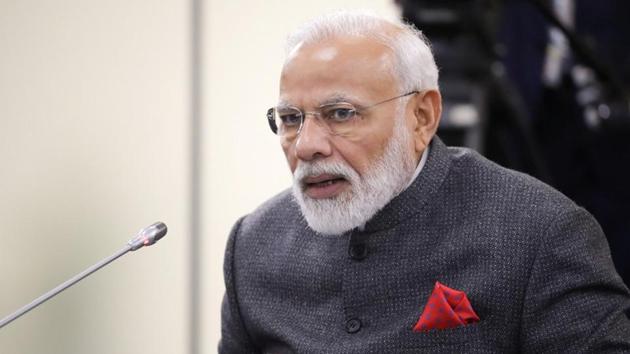
India would not discuss the scrapping of Jammu and Kashmir’s special status through the revocation of Article 370 of the Constitution at the UN, and the prime minister will present his vision of India’s role on the global platform, foreign secretary Vijay Gokhale told a news briefing.
Modi, who will be in the US from September 21 to 27, will first travel to Houston to participate in a roundtable with CEOs of US energy companies and “Howdy, Modi!”, a diaspora outreach event at which he will be joined by President Donald Trump.
He will then go to New York, where he will hold bilateral meetings with about 20 leaders, including one with Trump on September 24, and participate in high-level meetings such as the UN Climate Action Summit, an event on global health and a leaders’ dialogue on strategic responses to terrorism and violent extremism.
Modi will address the high-level debate at the General Assembly on September 27, shortly before his Pakistani counterpart, Imran Khan. This will be his first address at the forum since 2014 when he made his maiden speech at the General Assembly.
Gokhale said the prime minister believes it is important for India to play the role expected of it in shaping the global agenda on political and socio-economic issues. Modi will focus on India’s role on the international platform and present his vision for this, he added.
The prime minister will also reiterate India’s position that a “reformed multilateralism” must be at the centre of global politics. Arrangements “determined half a century ago cannot be sustainable in the 21st century” and the multilateral order should reflect the “new reality” of India playing a larger role, Gokhale said.
“The issue of Article 370 is an internal issue. India will not discuss it at the UN,” Gokhale said, adding the focus would not necessarily be on terrorism, which would be discussed alongside matters such as development and climate change.
India’s stance is in marked contrast to indications that the Kashmir issue will be the sole focus of Imran Khan’s address at the UN General Assembly and interactions with other leaders on the margins of the session in New York.
Modi’s participation in two more events on September 25 – delivering the keynote address at the opening plenary of the Bloomberg Global Business Forum and an investment roundtable with 40 top US firms such as Bank of America, Coca-Cola, IBM, Lockheed Martin and Mastercard – will underline the importance being attached by India to trade and economic issues.
Gokhale said the roundtable will help get feedback from the firms about their plans in India and demonstrate the government’s business-friendly approach in attracting investments.
The prime minister will also participate in an event at the UN on September 24 commemorating the 150th birth anniversary of Mahatma Gandhi. He will launch the Gandhi Solar Park or installation of solar panels on the roof of the UN headquarters with an Indian grant of $1 million. Modi will also receive the Global Goalkeeper Award from the Bill and Melinda Gates Foundation for his leadership of the Swachch Bharat Mission launched in 2014.
Modi will co-chair two meetings as part of the government’s outreach to smaller nations – the India-Pacific Island States meeting and India-Caribbean Community meeting – that will allow him to interact with leaders of 26 countries.
Gokhale said India will also make its case for permanent members of a reformed UN Security Council that reflects current realities. However, he said this will require consensus in the UN and India will have to “assess to what extent there is traction on this matter”.


