E-Paper



India and Australia voice concern over Ukraine war
India and Australia on Monday expressed serious concern over the conflict and the humanitarian situation in Ukraine, with Australian Prime Minister Scott Morrison saying Russia must be held to account for the loss of life during an “unlawful invasion”.

 Prefer HTon Google


India and Australia on Monday expressed serious concern over the conflict and the humanitarian situation in Ukraine, with Australian Prime Minister Scott Morrison saying Russia must be held to account for the loss of life during an “unlawful invasion”.
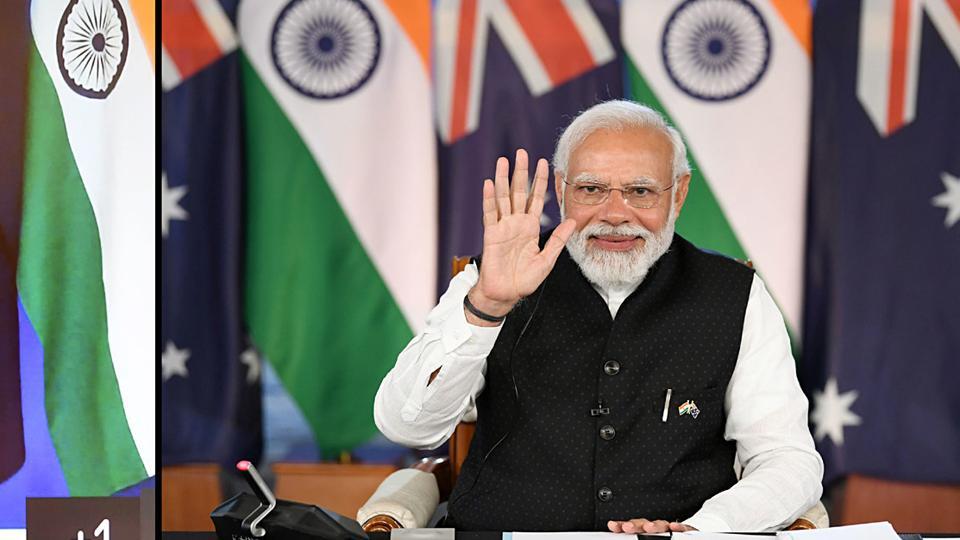
The Ukraine crisis and the issue of China were among the topics related to the region and beyond that were discussed when Morrison and his Indian counterpart Narendra Modi held their second virtual summit. In his opening remarks, Morrison said India and Australia should ensure the “terrible situation in Europe” can never occur in the Indo-Pacific.
Modi didn’t refer to the situation in Ukraine or Russia in his televised opening remarks, and foreign secretary Harsh Shringla told a media briefing after the summit that Morrison expressed understanding for India’s position on the issue of Ukraine. Shringla said both India and Australia did not perceive the conflict in Europe as a “reason for us to divert our attention from the Indo-Pacific”.
Morrison was the second Quadrilateral Security Dialogue or Quad leader, after Japanese Prime Minister Fumio Kishida, to raise the Ukraine crisis with the Indian side since last week. Kishida discussed Russia’s invasion of Ukraine with Modi at their annual summit on Saturday, saying the attack had shaken the roots of the international order.
India has so refrained from criticising President Vladimir Putin’s invasion of Ukraine in view of its close strategic partnership with Russia, and has also abstained on resolutions at UN agencies that were critical of Moscow. The Indian side has called for respecting the sovereignty and territorial integrity of all states while Modi has made several calls for an immediate cessation of violence and a return to diplomacy and dialogue.
Morrison noted in his televised opening remarks that the virtual summit was being held against the “very distressing backdrop of the war in Europe, which must never happen in our own region”. He said: “While we are obviously distressed at the terrible situation in Europe, our focus...is always very much on what is occurring in the Indo-Pacific and ensuring that those events could never occur here in the Indo-Pacific.”
The Quad leaders’ virtual meeting on March 3 was an opportunity to discuss both “Russia’s unlawful invasion of Ukraine”, and the “implications and consequences of that terrible event” for the Indo-Pacific and the “coercion and the issues that we face here”, Morrison said. “The tragic loss of life underlies the importance...of holding Russia to account,” he added.
Modi confined himself to priorities in bilateral relations in his opening remarks and highlighted how collaboration between India and Australia reflects the commitment to a free, open and inclusive Indo-Pacific.
At the media briefing, Shringla said the two prime ministers exchanged views on important topics related to the region and beyond, including the Ukraine issue and the issue of China. He noted both sides had referred to the Quad summit, at which the leaders “had a fairly clear perspective that the situation in Ukraine should not impact on the Indo-Pacific”, and that the focus of the Quad members should remain on the region.
Morrison “expressed understanding for India’s position on the issue of Ukraine, which he felt definitely reflected our own situation, our own sort of considerations”, Shringla said. Both leaders expressed serious concern about the conflict and the humanitarian situation in Ukraine, and the need for cessation of hostilities and violence, he added.
Both leaders also emphasised that the world order “stands on the UN Charter, the rule of law and respect for the territorial integrity and sovereignty of states”, and the humanitarian aspects of the situation, Shringla said. There was a “great deal of comfort” in both sides perceiving that the conflict in Europe should not “divert our attention from the Indo-Pacific, he added.
On the issue of China, Modi referred to the situation on the Line of Actual Control (LAC) and in Ladakh and the incidents of the previous year, and “emphasised that peace and tranquillity in the border areas was an essential prerequisite for normalisation of relations with China”, Shringla said. Morrison provided a detailed perspective of “how he saw China and its actions in the region” and spoke particularly about the situation in the South China Sea.
The two prime ministers also expressed concern about the situation in Myanmar following last year’s military coup, and called for cessation of violence, measures to protect the civilian population, the release of people who were arbitrarily detained and humanitarian access. The Indian side stressed the long border shared with Myanmar, and its belief that engagement and the humanitarian aspect of the relationship have to be kept in mind. Both countries also backed Asean’s initiatives to address the situation in Myanmar.